
Convergence of Newton's Method for Approximating Square Roots



Requires a Wolfram Notebook System
Interact on desktop, mobile and cloud with the free Wolfram Player or other Wolfram Language products.
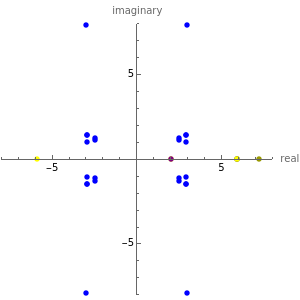
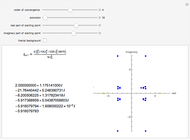
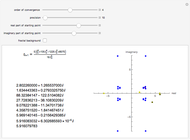
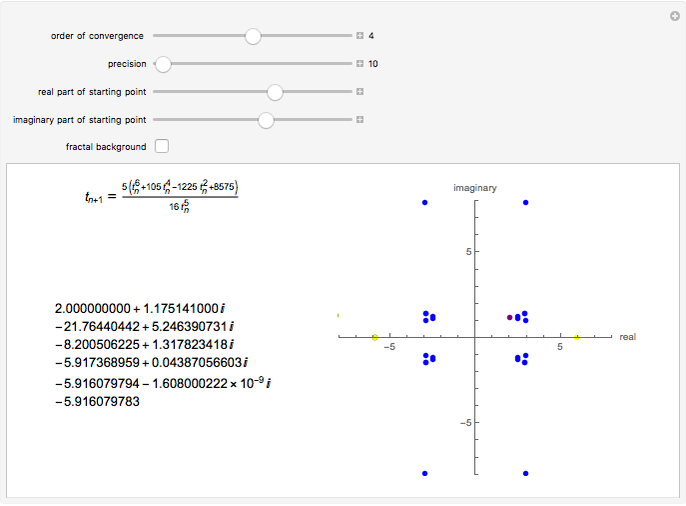
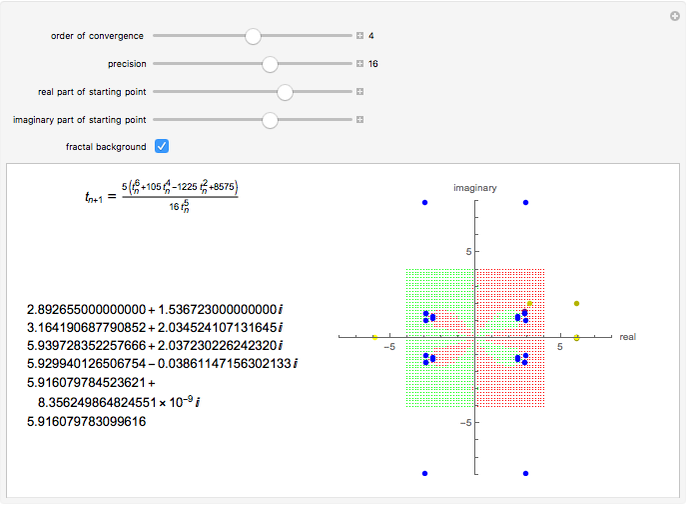
This Demonstration shows the convergence properties of a family of Newton-like methods for computing square roots of positive reals as constructed by Hernández and Romero. In this Demonstration the roots of 35 are used. For each integer  , the iterative formula (displayed in the top left‐hand corner) is defined. It generates a sequence (displayed below the formula) converging to one of the roots of 35 for almost all chosen starting values in the complex plane, outside the imaginary axis. The initial point is shown in purple, the two roots (limit points) are colored yellow, and some of the intermediate points are colored in shades of yellow, with darker colors corresponding to later positions in the sequence.
Contributed by: Andrzej Kozlowski (March 2011)
After work by: M. A. Hernández and N. Romero
Open content licensed under CC BY-NC-SA
Snapshots

Details
The well-known classical iterative method for computing the square root of a positive real number is globally convergent in the entire complex plane with the imaginary axis removed: initial points in the half‐plane  produce sequences convergent to the positive square root, while those in the half-plane
  converge to the negative square root. Hernández and Romero constructed for each
  2 an iterative method that exhibits a much more complicated behavior. For each
  2 these sequences have convergence order
  (so for "generic initial" points larger should produce a shorter sequence). For even these methods have the property of "global convergence" on the real line, that is, they converge to one of the roots starting with any nonzero value on the real line. For odd the methods have the property of "general convergence" (a concept introduced by Smale)—that is, they converge for almost every starting point. In the complex plane the behavior of convergence with respect to different starting points is highly complex and displays an intricate fractal structure. Some points of the Julia set of this structure are displayed in blue. In particular, for odd there are always points in the Julia set lying on the real line (these are the fixed points of the iteration).
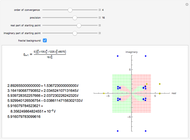
Checking the checkbox "fractal background" will show initial points that give rise to sequences converging to the positive square root (red) and those that give rise to sequences converging to the negative square root (green). (Unfortunately, to see the fractal nature of the convergence phenomenon we need a much larger number of points, which would excessively slow down the Demonstration).
Reference: M. A. Hernández and N. Romero, "Methods with Prefixed Order for Approximating Square Roots with Global and General Convergence," Applied Mathematics and Computation, 194(2), 2007 pp. 346–353.
Permanent Citation
 Comparing Iterative Root-Finding Methods
Andrzej Kozlowski Power Series Interval of Convergence
Olivia M. Carducci (East Stroudsburg University) Global and Local Errors in Runge-Kutta Methods
Luis Rández Square Roots with Newton's Method
Jon Mormino Learning Newton's Method
Angela Sharp, Chad Pierson, and Joshua Fritz Two Geometric Views of Newton's Method
Bruce Atwood Newton's Method on a Mesh of Initial Guesses
Ken Levasseur Newton-Cotes Quadrature Formulas
Eugenio Bravo Sevilla Bisection Method
Edda Eich-Soellner (University of Applied Sciences, München, Germany) Approximating Polar Area with Sectors
Abby Brown
-
 The Black-Scholes European Call Option Formula Corrected Using the Gram-Charlier Expansion
Andrzej Kozlowski -
 Option Prices in the Kou Jump Diffusion Model
Andrzej Kozlowski -
 The Polar and Bipolar of a Convex Polytope
Andrzej Kozlowski -
 Two Jump Diffusion Processes
Andrzej Kozlowski -
 The Vieta Mapping for the Coxeter Group A_2
Andrzej Kozlowski -
 The Bifurcation Set of the Space of Smooth Real Functions
Andrzej Kozlowski -
 The Swallowtail Singularity
Andrzej Kozlowski -
 Singularities of an Ellipsoidal Wave Front
Andrzej Kozlowski -
 Nonuniqueness of Option Pricing Under the Meixner Model
Andrzej Kozlowski -
 Coin Machine
Andrzej Kozlowski -
 A Mean-Reverting Jump Diffusion Process
Andrzej Kozlowski -
 Standard American and European Options
Andrzej Kozlowski -
 Density of the Kou Jump Diffusion Process
Andrzej Kozlowski -
 The Meixner Process
Andrzej Kozlowski -
 Fitting the Meixner Distribution to S&P 500 Returns
Andrzej Kozlowski -
 Simple Graphs and Their Binomial Edge Ideals
Andrzej Kozlowski -
 The Eneström-Kakeya Bounds for Roots of a Polynomial with Positive Coefficients
Andrzej Kozlowski -
 Newton Polygon and Branching of Algebraic Curves
Andrzej Kozlowski -
 Counting the Number of Roots of Transcendental Functions in Bounded Regions Using Winding Numbers
Andrzej Kozlowski -
 The Space of Inner Products
Andrzej Kozlowski