
Electronic Structure of a Single-Walled Carbon Nanotube in Tight-Binding Wannier Representation



Requires a Wolfram Notebook System
Interact on desktop, mobile and cloud with the free Wolfram Player or other Wolfram Language products.
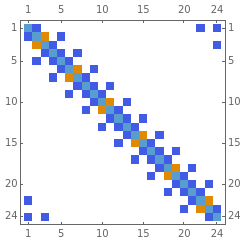
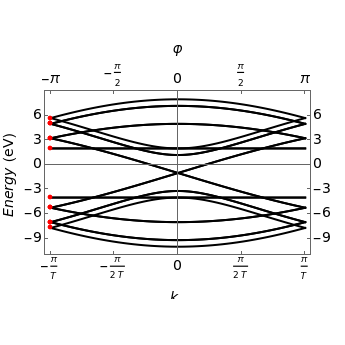
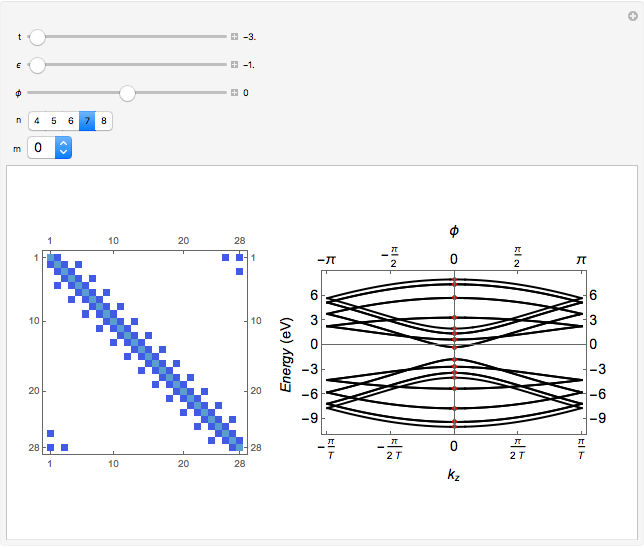
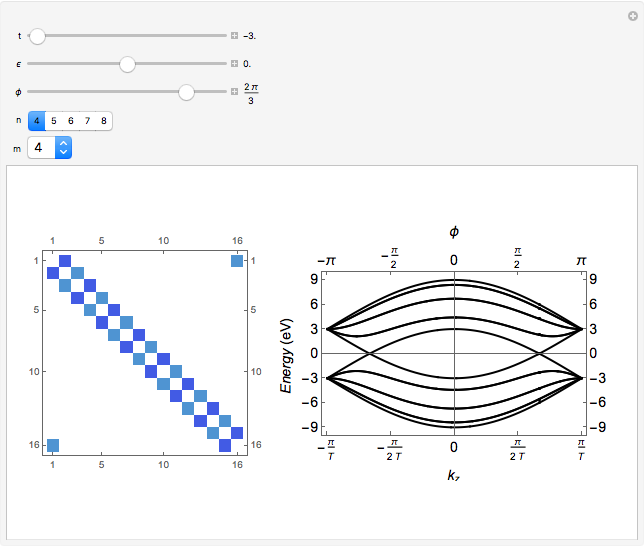
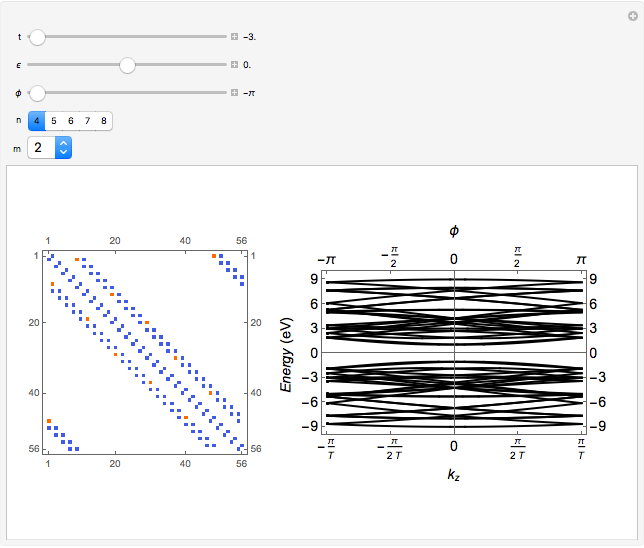
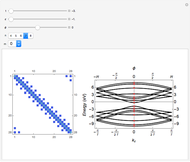
This Demonstration shows an alternative way to represent the reciprocal space zone-folding (ZF) method for computing the tight-binding (TB) electronic structure (right plot) of a single-walled carbon nanotube (SWNT) with given  chirality. The TB Hamiltonian
  is constructed in real space representation or Wannier representation and the electronic energy dispersion relation is obtained from the eigenvalues of the corresponding Hamiltonian matrix (left plot). The diagonal matrix elements are given by the on-site energy parameter
  , while the off-diagonal matrix elements are given by the hopping parameter
  . To find which of these matrix elements are nonzero, one has to consider the whole set of the atomic coordinates
  in one SWNT unit cell and the hopping of an electron from a given site with coordinates to each of its first three nearest neighbors with coordinates
  . Hence,
  for
for  , where
  is the carbon-carbon bond length. Periodic boundary conditions along the SWNT axis (for
  with
with  the axial period of the SWNT) can be expressed by multiplying the hopping parameter by the complex exponential phase factor
  . By changing the phase
  in the range
  , the whole 1D Brillouin zone can be sampled. This approach lets you sample a finite number
  of Brillouin zone
  -points by choosing a finite lattice model with sites; hence the term small crystal approach. In order to show the full equivalence of this method to the reciprocal space zone-folding method, the eigenvalues obtained from diagonalization of the Wannier Hamiltonian for a given are superimposed on the plot of the ZF band structure.
Contributed by: Jessica Alfonsi (University of Padova, Italy) (January 2010)
Open content licensed under CC BY-NC-SA
Snapshots
Details
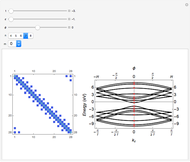
Snapshot 1: electronic structure of a zigzag semiconducting SWNT: 
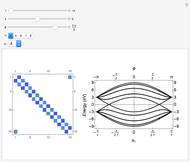
Snapshot 2: electronic structure of an armchair SWNT (always metallic)
Snapshot 3: electronic structure of a chiral semiconducting SWNT:
R. Saito, G. Dresselhaus, and M. S. Dresselhaus, Physical Properties of Carbon Nanotubes, London: Imperial College Press, 1998.
J. Alfonsi and M. Meneghetti, "Small Crystal Approach for the Electronic Properties of Double-Wall Carbon Nanotubes," New Journal of Physics, 11, 2009.
J. Alfonsi, "Small Crystal Models for the Electronic Properties of Carbon Nanotubes," PhD thesis, University of Padova, 2009. (chapters 2–4 and references therein)
Permanent Citation
 Electronic Band Structure of a Single-Walled Carbon Nanotube by the Zone-Folding Method
Jessica Alfonsi (University of Padova, Italy) Electronic Band Structure of Armchair and Zigzag Graphene Nanoribbons
Jessica Alfonsi Visualizing Atomic Orbitals
Guenther Gsaller Optical Matrix Elements of Single-Walled Carbon Nanotubes for Longitudinal Polarization of Light
Jessica Alfonsi (University of Padova, Italy) Brillouin Zone of a Single-Walled Carbon Nanotube
Jessica Alfonsi (University of Padova, Italy) Quantum Well Explorer
Richard Gass Hydrogen Orbitals
Michael Trott Nodal Surfaces of Degenerate States
Michael Trott Models for Edge States in the Electronic Spectra of Dimer Chains
Jessica Alfonsi Band Structures in Zigzag Graphene Nanoribbons and Armchair Carbon Nanotubes
Vasil Saroka
-
 Evolution in a Cellular-Automaton Model of Gray-Scott Reaction-Diffusion System
Jessica Alfonsi -
 Kuramoto Model for Phase Locking of Coupled Oscillators
Jessica Alfonsi -
 Topological Winding Number in 1D Su-Schrieffer-Heeger Model
Jessica Alfonsi -
Models for Edge States in the Electronic Spectra of Dimer Chains
Jessica Alfonsi -
 Moiré Patterns and Commensurability in Rotated Graphene Bilayers
Jessica Alfonsi -
 Electronic Structure of 1D and 2D Quasiperiodic Systems
Jessica Alfonsi -
 Labyrinth Tiling from Quasiperiodic Octonacci Chains
Jessica Alfonsi -
 Self-Similar Qubistic Plot of the S_z=0 Half-Filled Hubbard Model Basis States
Jessica Alfonsi -
Electronic Band Structure of Armchair and Zigzag Graphene Nanoribbons
Jessica Alfonsi -
 Electronic Structure of a Single-Walled Carbon Nanotube in Tight-Binding Wannier Representation
Jessica Alfonsi -
 Metallicity Condition and Electronic Density of States in Achiral Single-Walled Carbon Nanotubes
Jessica Alfonsi -
 Rate Equations for a Three-Level Model in Low-Dimensional Exciton Systems
Jessica Alfonsi -
 Hubbard Model Interactive Calculator for 1D Systems
Jessica Alfonsi -
Electronic Band Structure of a Single-Walled Carbon Nanotube by the Zone-Folding Method
Jessica Alfonsi -
Optical Matrix Elements of Single-Walled Carbon Nanotubes for Longitudinal Polarization of Light
Jessica Alfonsi -
 Optical Properties of Graphene
Jessica Alfonsi -
 Finite Element Solution of 1D Poisson Equation with Galerkin Spectral Decomposition
Jessica Alfonsi -
 Energy Levels of a Quantum Harmonic Oscillator in Second Quantization Formalism
Jessica Alfonsi -
 Brillouin Zone Sampling of Chain with N Sites and Modified Periodic Boundary Conditions
Jessica Alfonsi -
Brillouin Zone of a Single-Walled Carbon Nanotube
Jessica Alfonsi