
Impedance of a Micro-Disk Microelectrode



Requires a Wolfram Notebook System
Interact on desktop, mobile and cloud with the free Wolfram Player or other Wolfram Language products.
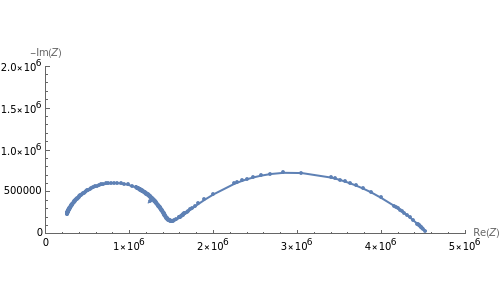
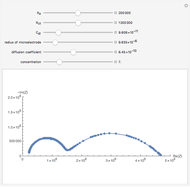
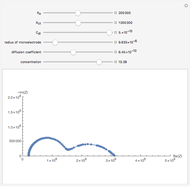
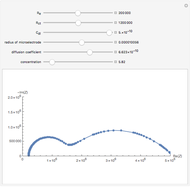
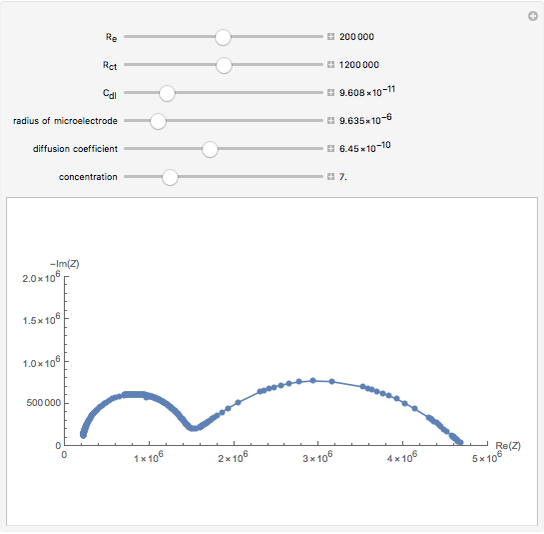
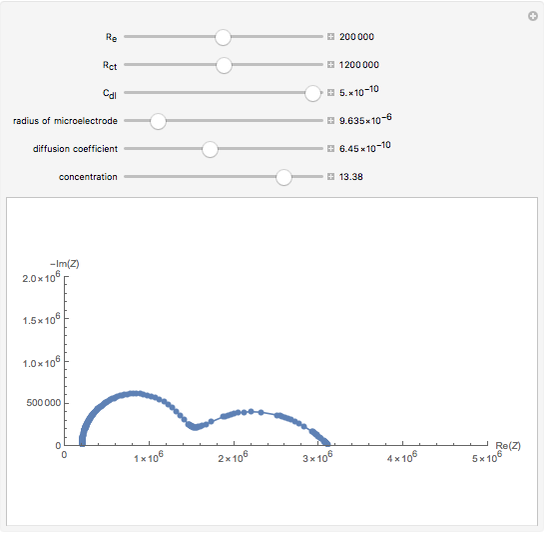
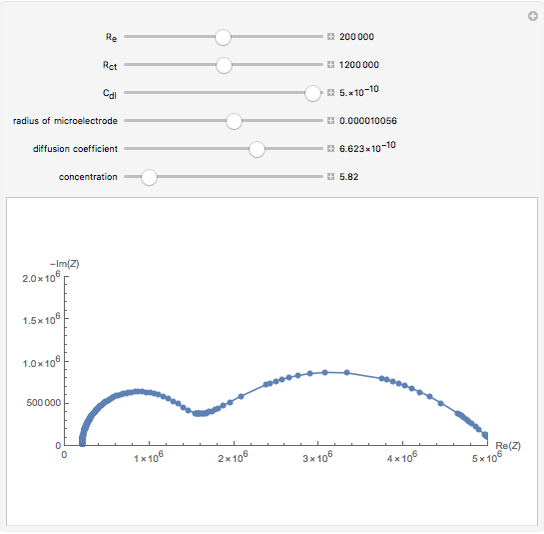
For the macroelectrode, one can use the Warburg impedance to describe the diffusion coefficient. This Demonstration shows the analytical solution for the diffusional impedance of a micro-disk electrode. It is a function of frequency, kinetics, concentration, and the radius of the microelectrode.
Contributed by: Quang-Dao Trinh (March 2011)
Open content licensed under CC BY-NC-SA
Snapshots
Details
Permanent Citation
"Impedance of a Micro-Disk Microelectrode"
http://demonstrations.wolfram.com/ImpedanceOfAMicroDiskMicroelectrode/
Wolfram Demonstrations Project
Published: March 7 2011
 Reversible Steady-State Voltammograms at Microelectrodes
Quang-Dao Trinh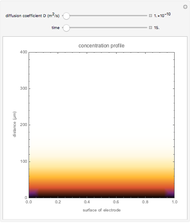 Diffusion on a Macro-Electrode
Quang-Dao Trinh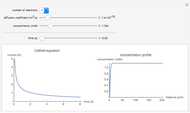 Cottrell Equation for the Potential-Step Experiment
Quang-Dao Trinh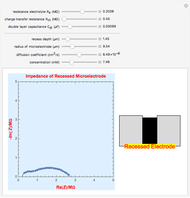 Diffusional Impedance of a Recessed Microelectrode
Quang-Dao Trinh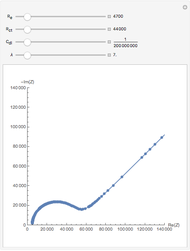 Warburg Impedance
Quang-Dao Trinh Electrochemical Impedance
Quang-Dao Trinh Simulation Domain for a Microelectrode: Is It Large Enough?
Quang-Dao Trinh Diffusion Impedance in a Thin Layer Cell
Quang-Dao Trinh Quasi-Reversible and Irreversible Voltammograms at Microelectrodes
Quang-Dao Trinh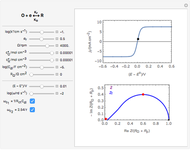 Impedance of a Redox Reaction (E) at a Rotating Disk Electrode (RDE)
Jean-Paul Diard and Claude Montella
-
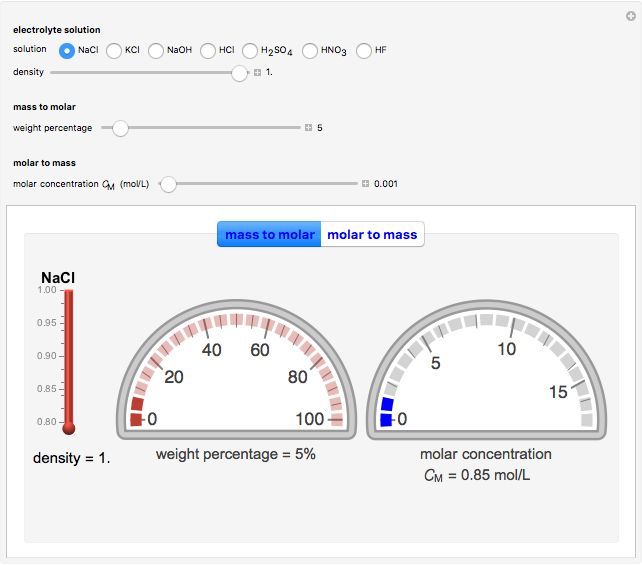 Molar and Mass Concentration Conversion for Electrolytes
Quang-Dao Trinh -
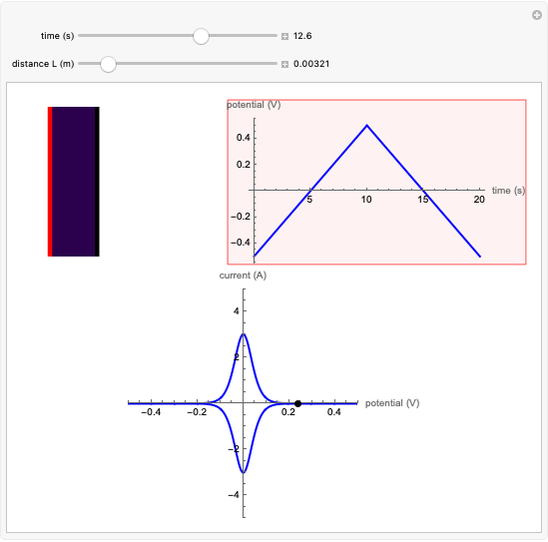 Electrochemical Thin-Film Cyclic Voltammetry
Quang-Dao Trinh -
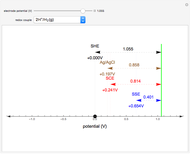 Converting Potentials between Different Reference Electrodes
Quang-Dao Trinh -
 Do the Rich Live Longer?
Quang-Dao Trinh -
 Time Constant in an Electrochemical Cell
Quang-Dao Trinh -
Simulation Domain for a Microelectrode: Is It Large Enough?
Quang-Dao Trinh -
 Butler-Volmer Equation for Electrochemical Reaction
Quang-Dao Trinh -
 Durometer Hardness of Rubber Table Tennis Blades
Quang-Dao Trinh -
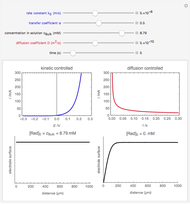 Diffusion and Kinetic Controlled Electrochemical Reactions
Quang-Dao Trinh -
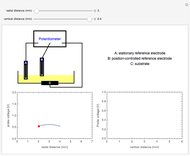 Scanning Reference Electrode Technique (SRET)
Quang-Dao Trinh -
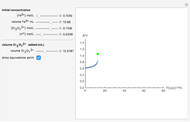 Potentiometric Titration of Fe (II)
Quang-Dao Trinh -
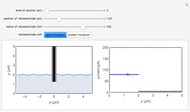 Verifying the Insulating State of a Nanoelectrode
Quang-Dao Trinh -
 Ohmic Drop and Uncompensated Electrolyte Resistance in an Electrochemical Cell
Quang-Dao Trinh -
 Boiling Point of Water on Several Planets
Quang-Dao Trinh -
 Electrode-Solution Interface: Distribution of Ions around an Electrode
Quang-Dao Trinh -
 Cyclic Voltammetry: Characteristic Points
Quang-Dao Trinh -
 Composition of a Table Tennis Blade
Quang-Dao Trinh -
Diffusional Impedance of a Recessed Microelectrode
Quang-Dao Trinh -
 Corrosion Mechanism for Stainless Steel
Quang-Dao Trinh -
 Current and Potential Distributions for a Freely Corroding Disk Electrode
Quang-Dao Trinh