
Movement of an Oloid


Requires a Wolfram Notebook System
Interact on desktop, mobile and cloud with the free Wolfram Player or other Wolfram Language products.
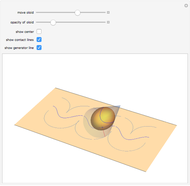
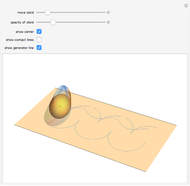
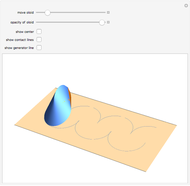
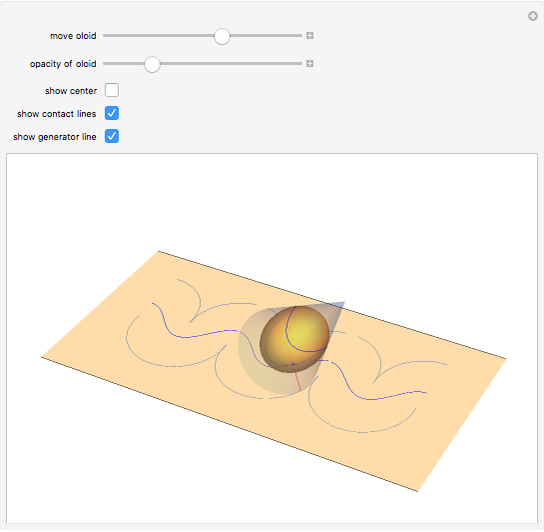
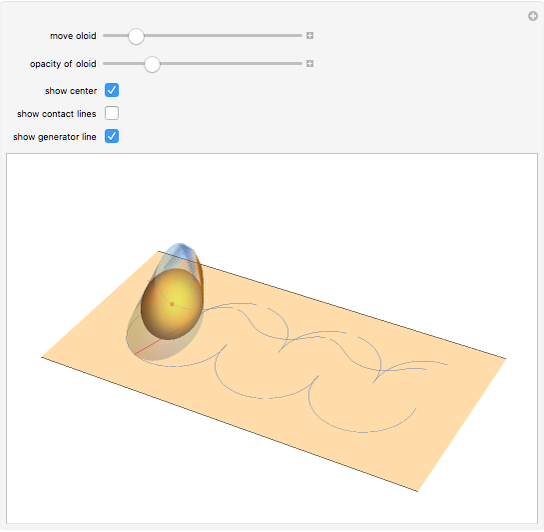
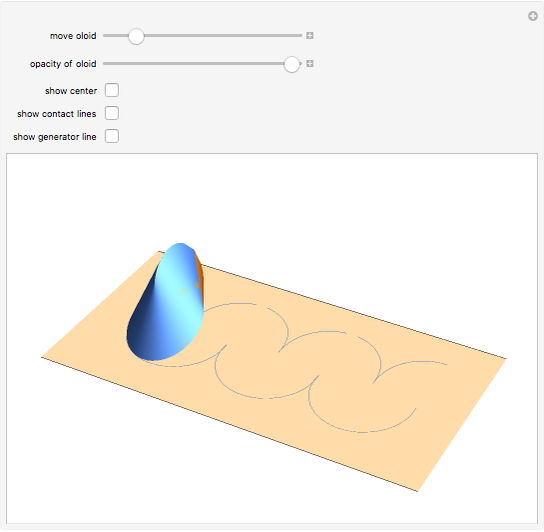
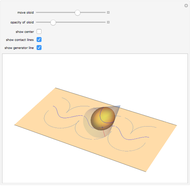
You see the wobbling motion of an oloid on a plane while making one-and-a-half turns, and can observe how this motion can be described by the locus of the brims in the plane. The plane is tangent to the surface of the oloid, and the set of all tangent planes can be used to define an inscribed body. When you reduce the opacity of the oloid, this inscribed body, an ellipsoid, becomes visible. The locus of the center of gravity of the oloid, the trajectories of the contact point between the ellipsoid and the plane, and the generator line can be shown.
Contributed by: Hans-Joachim Domke (January 2012)
Open content licensed under CC BY-NC-SA
Snapshots
Details
Permanent Citation
"Movement of an Oloid"
http://demonstrations.wolfram.com/MovementOfAnOloid/
Wolfram Demonstrations Project
Published: January 4 2012
 Vertex and Edge Truncations of the Platonic Solids
George Beck The Golden Ratio in Arrangements of Octahedron, Cube, Tetrahedron, and Sphere
Sándor Kabai Rings around the Vertices of a Polyhedron
Sándor Kabai Möbius Triangles
Izidor Hafner Powered Clique Polyhedra
Ed Pegg Jr Chemical Reactions Represented via a 3D Simplex
D. Meliga and S. Z. Lavagnino Tetrahedron Centers
Ed Pegg Jr The Klein Configuration
Ed Pegg Jr Projections of Cubes and Half-Cubes
Izidor Hafner Toroidal Helical Coils
Erik Mahieu
-
 Mapping Lines and Circles onto the Riemann Sphere
Hans-Joachim Domke -
 Movement of an Oloid
Hans-Joachim Domke -
 Cosmology of Einstein-de Sitter Universe
Hans-Joachim Domke -
 Kaleidocycles
Hans-Joachim Domke -
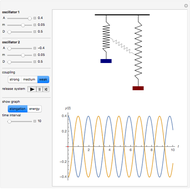 Coupled Oscillators
Hans-Joachim Domke -
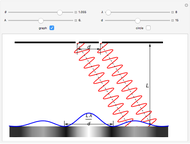 Fraunhofer Diffraction (Double Slit)
Hans-Joachim Domke -
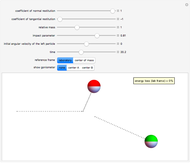 Inelastic Collisions of Two Rough Spheres
Hans-Joachim Domke -
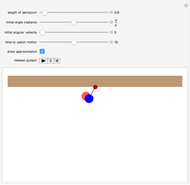 Nonlinearized Motion of a Simple Pendulum
Hans-Joachim Domke -
 Metamorphosis of a Cube
Hans-Joachim Domke -
 The Yoshimoto Cube
Hans-Joachim Domke -
 Enveloping the Oloid
Hans-Joachim Domke -
 Packing a Circle with Circles
Hans-Joachim Domke -
 Trajectory of a Harmonic Oscillator in Phase Space
Hans-Joachim Domke -
 Transforming a Tetrahedron into a Chestahedron
Hans-Joachim Domke -
 Trajectories of the Logistic Map
Hans-Joachim Domke -
 Single-Slit Diffraction Using Feynman's Method
Hans-Joachim Domke -
 Intensity Distribution for Multiple Slit Diffraction
Hans-Joachim Domke -
 Single-Slit Diffraction Pattern
Hans-Joachim Domke -
 Standing Waves and Chords
Hans-Joachim Domke -
 Representation of Diffraction by Vector Summation
Hans-Joachim Domke