
Optical Pumping: Visualization of Steady State Populations and Polarizations



Requires a Wolfram Notebook System
Interact on desktop, mobile and cloud with the free Wolfram Player or other Wolfram Language products.
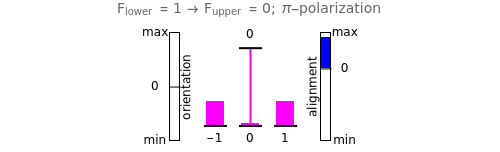
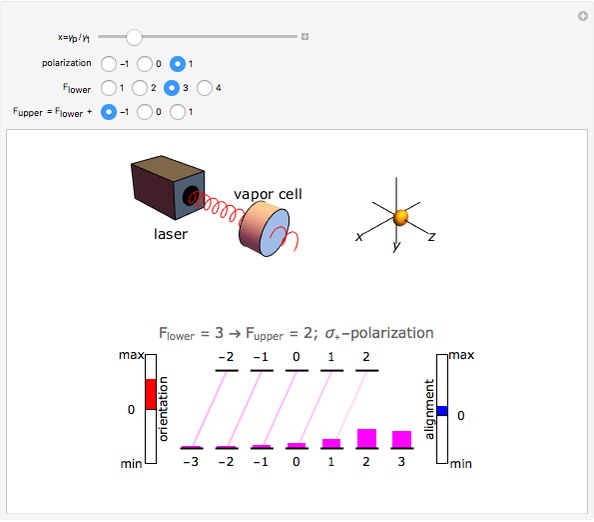
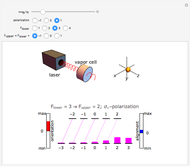
This Demonstration illustrates the rearrangement of Zeeman sublevel populations by the optical pumping of atoms with circularly or linearly polarized light. You can control the power and polarization of the light as well as the angular momenta of the states coupled by the light. The effect of optical pumping is illustrated by the relative sublevel populations, by the two lowest multipole moments (orientation and alignment), and by a probability surface.
Contributed by: Antoine Weis (Université de Fribourg) and Gianni Di Domenico (Université de Neuchâtel) (March 2011)
Open content licensed under CC BY-NC-SA
Snapshots


Details
When an atomic medium is irradiated with (circularly or linearly) polarized light that is resonant with a transition between states of angular momenta  and
and  , the medium becomes spin polarized. The origin of this polarization is a transfer of populations
 between the magnetic sublevels
  by subsequent cycles of light absorption and emission. In this Demonstration, the steady-state populations are inferred by solving the rate equations for the
  populations . Upward transitions are driven at a rate
  , and allowance is made for sublevel relaxation at a rate
  , so that the optical pumping can be parametrized in terms of a dimensionless variable that is proportional to the light intensity.
The light polarization can be chosen as  (linear polarization) or
  (left‐ or right‐handed circular polarization) that implies the selection rules
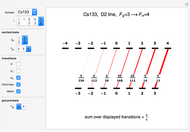
  , or ±1, respectively. The transitions between sublevels are shown by vertical (horizontal or skewed) lines whose intensity is proportional to the product of the sublevel population and the relative transition strength (itself proportional to a squared 3
 -symbol). In this way one sees how the absorbed (and hence also the re-emitted) light intensity changes as the pumping proceeds.
Sublevel populations are represented by vertical bars.
Depending on the relative sublevel populations, the polarized medium may either absorb less light than the unpolarized medium (dark state) or more light than the unpolarized medium (bright state). The former case occurs in  and
and  transitions, while the latter case is encountered in
  transitions (both with linear and circularly polarized light).
In thermal equilibrium, that is, in the absence of light, all levels have an identical population of  . Optical pumping leads to a nonequilibrium population distribution and the medium is said to be polarized. The polarization of a medium can be defined in terms of its longitudinal multipole moments
  (see also Polarized Atoms Visualized by Multipole Moments). The only longitudinal multipole moments to which light on an electric dipole transition couples are the orientation
  and the alignment
  ,which can be defined in terms of the sublevel populations as
 for the orientation, and
 for the alignment.
The state of polarization can also be represented in terms of a probability surface  that represents the probability of finding the system in the state
  when making a measurement with the quantization axis oriented along the spherical direction given by
  . In thermal equilibrium (
 ) this surface is a sphere of radius . Note that the probability surface reflects the (rotational and reflection) symmetry of the light polarization. For states with a pure longitudinal polarization (no coherences) the probability surface has a rotational symmetry around the
  axis. It can be expressed in terms of the sublevel populations
  and specific matrix elements of the Wigner rotation matrices
  as
as
 .
.
Note also that for pumping with circularly polarized light the quantization axis ( axis) is oriented along the direction of light propagation, while for pumping with linearly polarized light the quantization axis is along the direction of oscillation of the optical field.
For more details on probability surfaces see Polarized Atoms Visualized by Multipole Moments.
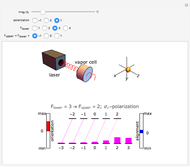
Snapshot 1: dark state prepared by  -pumping
Snapshot 2: bright state prepared by -pumping
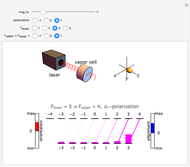
Snapshot 3: dark state prepared by  -pumping
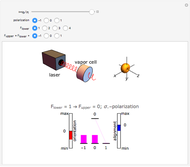
Snapshot 4: dark state with a pure positive alignment prepared by -pumping
Snapshot 5: bright state with a pure negative alignment prepared by -pumping
Permanent Citation
 Optical Pumping: Population Dynamics
Antoine Weis (Université de Fribourg) and Gianni Di Domenico (Université de Neuchâtel) Visualizing Atomic Orbitals
Guenther Gsaller Q-Representation of Number States
Reinhard Tiebel Degenerate Energy States
Douglas Kellis (Boise State University) Nodal Surfaces of Degenerate States
Michael Trott Hydrogen Orbitals
Michael Trott Bound States in a Square Potential Well
Mahn-Soo Choi P-Representation of Laser Light
Reinhard Tiebel Klein-Nishina Formula for Compton Effect
S. M. Blinder The Hydrogen Atom in Parabolic Coordinates
S. M. Blinder
-
 Magnetic Resonance and Bloch Equations
Gianni Di Domenico -
 Allan Plot of an Oscillator with Deterministic Perturbations
Gianni Di Domenico -
 Fresnel Equations
Gianni Di Domenico -
 Laser Lineshape and Frequency Fluctuations
Gianni Di Domenico -
 Static Equilibrium and Triangle of Forces
Gianni Di Domenico -
 Spectra of the D-Lines of Alkali Vapors
Gianni Di Domenico -
 Vapor Pressure and Density of Alkali Metals
Gianni Di Domenico -
 Boltzmann Gas
Gianni Di Domenico -
Optical Pumping: Population Dynamics
Gianni Di Domenico -
 Optical Pumping: Visualization of Steady State Populations and Polarizations
Gianni Di Domenico -
 Polarized Atoms Visualized by Multipole Moments
Gianni Di Domenico -
 Transition Strengths of Alkali-Metal Atoms
Gianni Di Domenico -
 Light Polarization and Stokes Parameters
Gianni Di Domenico