
Radius and Temperature of Main Sequence Stars


Requires a Wolfram Notebook System
Interact on desktop, mobile and cloud with the free Wolfram Player or other Wolfram Language products.
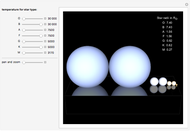
Stars constantly struggle to balance gravity and pressure throughout their lives. Main sequence stars fuse hydrogen in their cores in order to maintain this balance. For a main sequence star with a chemical composition similar to the Sun, the relationship between radius and effective surface temperature (in Kelvin) can be modeled fairly easily.
[more]
Contributed by: Jeff Bryant (January 2008)
Open content licensed under CC BY-NC-SA
Snapshots
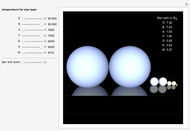
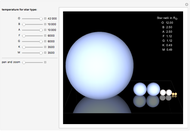
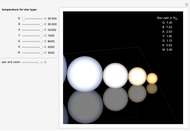
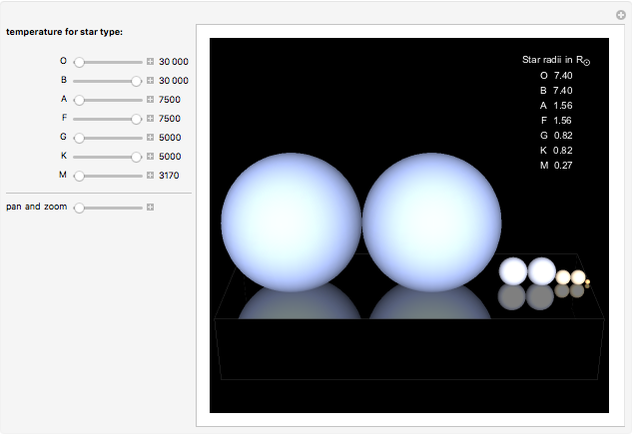
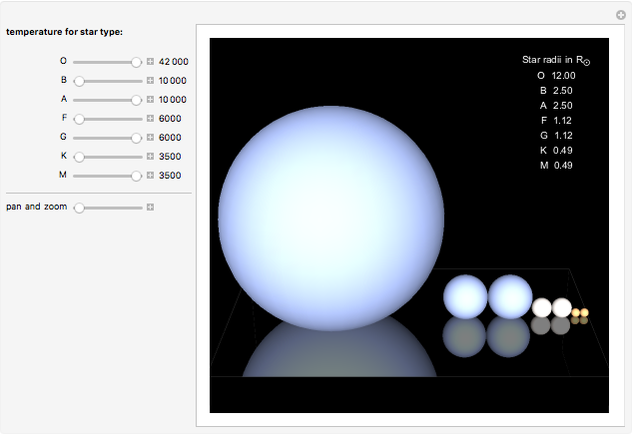
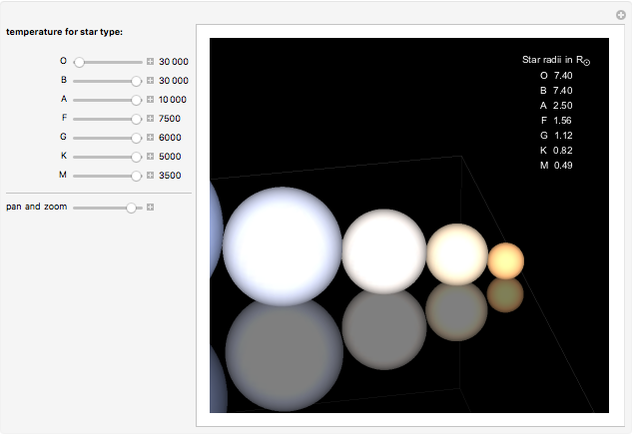
Details
The relationship shown in this Demonstration is based on data from A. N. Cox, ed., Allen's Astrophysical Quantities, 4th ed., New York: AIP Press (Springer), 2000.
Permanent Citation
"Radius and Temperature of Main Sequence Stars"
http://demonstrations.wolfram.com/RadiusAndTemperatureOfMainSequenceStars/
Wolfram Demonstrations Project
Published: January 24 2008
 Contact Binary Star Envelopes
Jeff Bryant Orbital Wobble
Jeff Bryant Pulsars
Jeff Bryant Stellar Luminosity
Jeff Bryant The Celestial Two-Body Problem
S. M. Blinder Colliding Galaxies
Jeff Bryant and Dale Horton Red Giant Stars and the Death of the Sun
Jeff Bryant Blackbody Spectrum
Jeff Bryant Mass Transfer in Binary Star Systems
Jeff Bryant Blackbody Radiation
Zach Heuman (Boise State University)
-
 Combining Two 3D Rotations
Jeff Bryant -
 Keplerian Orbital Elements
Jeff Bryant -
 Colored Lights
Jeff Bryant -
 Solar System Mandalas
Jeff Bryant -
 Three-Body Problem in 3D
Jeff Bryant -
 Stellar Nucleosynthesis
Jeff Bryant -
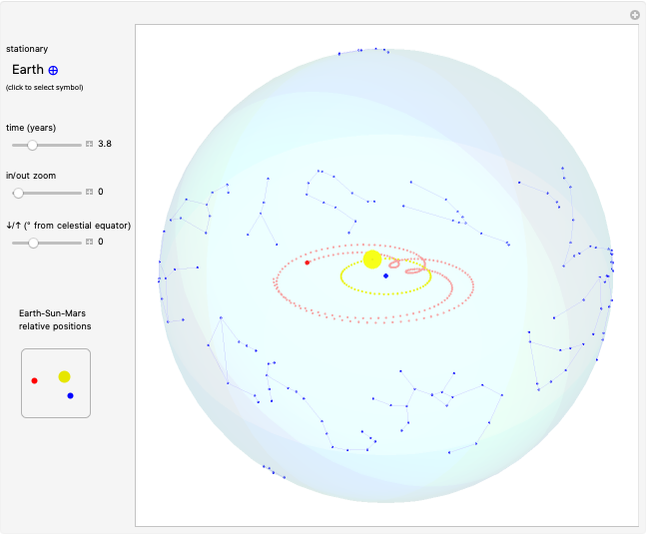 Three World Systems for Earth-Sun-Mars Kinematics
Jeff Bryant -
 Continental Plate Configurations through Time
Jeff Bryant -
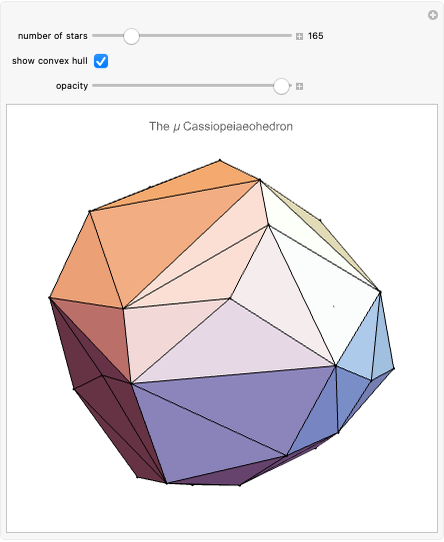 Galactohedra
Jeff Bryant -
 Oloid
Oloid
Jeff Bryant -
 Fundamental Law of Fractions
Jeff Bryant -
Blackbody Spectrum
Jeff Bryant -
 Great Circles on Mercator's Chart
Jeff Bryant -
 Broadcasting Satellite in a Geocentric Kepler Orbit
Jeff Bryant -
 Annual Sunspot Numbers
Jeff Bryant -
 Galactic Coordinate System
Jeff Bryant -
 Radius and Temperature of Main Sequence Stars
Jeff Bryant -
 Deltoidal Hexecontahedron
Jeff Bryant -
 Axial Tilts of Planets
Jeff Bryant -
 Pythagorean Theorem
Jeff Bryant