
Rotation of Spinors


Requires a Wolfram Notebook System
Interact on desktop, mobile and cloud with the free Wolfram Player or other Wolfram Language products.
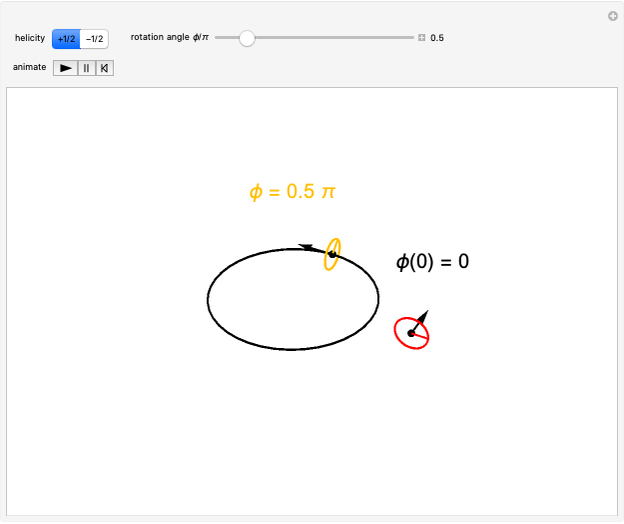
The electron, and other fermions with spin  , is described in relativistic quantum mechanics by a spinor. A distinguishing feature of spinors is their behavior under rotation. Whereas a vector boson, with spin 1, will return to its initial state after a rotation by
  , a spinor requires two full rotations, with the angle advancing by
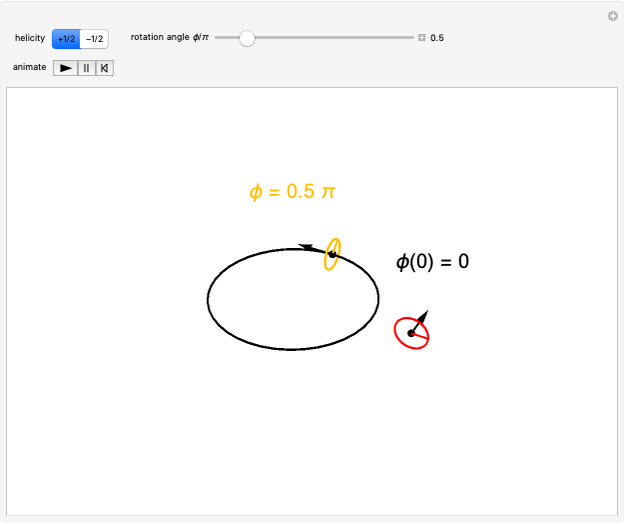
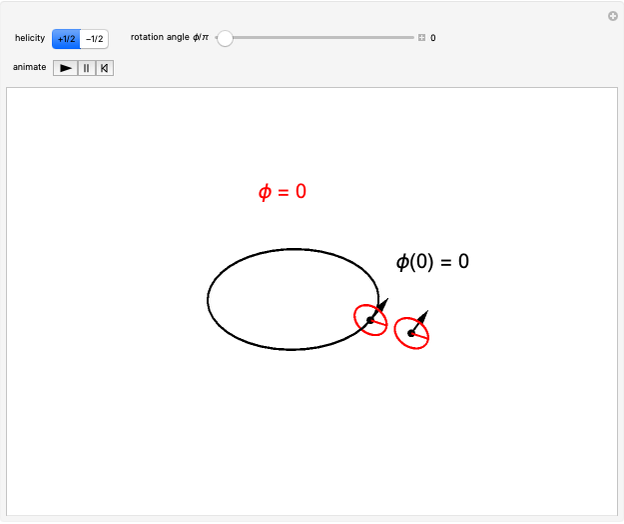
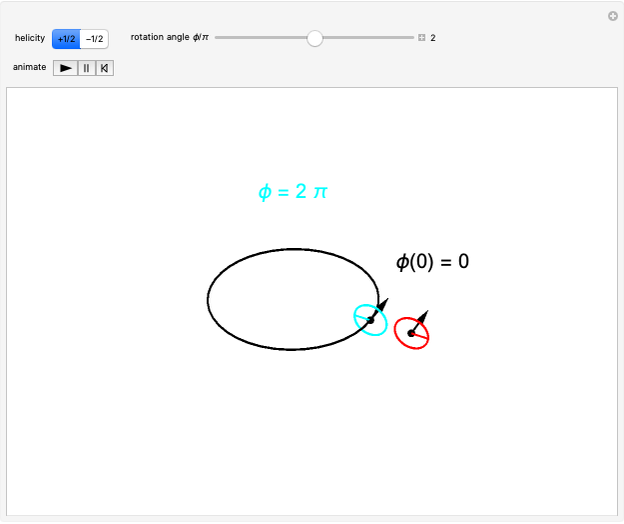
  to recover its initial state. A spinor is described by a complex phasor in addition to a helicity. This is represented in the graphic by rotation in a circle normal to its spin direction, with the complex phase color coded. A rotation in space by an angle
  is accompanied by a phase change of
  . Thus after rotation by
  , the spin direction of the particle is recovered but the phase changes by a factor
  . This can be observed experimentally in interference phenomena, most notably those done in neutron diffraction. In the course of rotation of
  by
by  , the phasor traces out a Möbius band. This accords with the fact that a point on the surface of a Möbius band must go around twice in order to return to its initial location.


Contributed by: S. M. Blinder (March 2011)
Open content licensed under CC BY-NC-SA
Snapshots
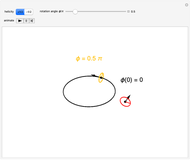
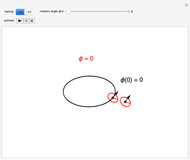
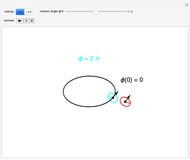
Details
Snapshot 1: starting point
Snapshot 2: rotation by  produces a phase difference of
Snapshot 3: rotation by  is required to recover the initial state
Reference
R. Penrose and W. Rindler, Spinors and Space-Time: Volume 2, Spinor and Twistor Methods in Space-Time Geometry, Cambridge: Cambridge University Press, 1988.
Permanent Citation
 Rotation-Vibration Energy Level Transitions of a Diatomic Rotor
Whitney R. Hess and Lisa M. Goss (Idaho State University) Rotation-Vibration Transitions of a Parallel Band of a Symmetric Rotor
Whitney R. Hess and Lisa M. Goss Rotation-Vibration Transitions for a Perpendicular Band of a Symmetric Rotor
Whitney R. Hess and Lisa M. Goss Gamow Model for Alpha Decay: The Geiger-Nuttall Law
S. M. Blinder Quantum Scattering by a Rigid Sphere
S. M. Blinder Scattering by a Symmetrical Eckart Potential
S. M. Blinder Three-Dimensional Isotropic Harmonic Oscillator
S. M. Blinder Particle in an Infinite Spherical Well
S. M. Blinder The Hydrogen Atom in Parabolic Coordinates
S. M. Blinder Particle in an Infinite Vee Potential
S. M. Blinder
-
 Kepler and Oscillator Elliptical Orbits
S. M. Blinder -
 Analytic Solutions of the Helmholtz Equation for Some Polygons with 45 Degree Angles
S. M. Blinder -
 Oscillator with Generalized Power-Law Damping
S. M. Blinder -
 Lower Excited States of the Helium Isoelectronic Series
S. M. Blinder -
 Hydrogen Atom in Varying Dimensions
S. M. Blinder -
 Rotation of Spinors
S. M. Blinder -
 Potential and Lines of Force for Two Parallel Infinite Line Charges
S. M. Blinder -
 Balanced Configurations of Multislot Centrifuges
S. M. Blinder -
 Eigenstates for the Hulthen Potential
S. M. Blinder -
 Closest Packing of Disks and Spheres; Kepler's Conjecture
S. M. Blinder -
 Classical and Quantum Hall Effects
S. M. Blinder -
 Diagrammatic Representations of Scientific Formulas
S. M. Blinder -
 Meissner Effect in Superconductors
S. M. Blinder -
 Quasi-Exact Solutions of Schrödinger Equation: Sextic Anharmonic Oscillator
S. M. Blinder -
 White Dwarfs and the Chandrasekhar Limit
S. M. Blinder -
 Dynamics of Free Particle and Harmonic Oscillator Using Propagators
S. M. Blinder -
 Schwinger's Oscillator Model for Angular Momentum
S. M. Blinder -
 Quantum Theory of the Damped Harmonic Oscillator
S. M. Blinder -
 Fry's Geometric Demonstration of the Sum of Cubes
S. M. Blinder -
 Polynomials in the Complex Plane
S. M. Blinder