
Sensitivity, Specificity, and Incidence

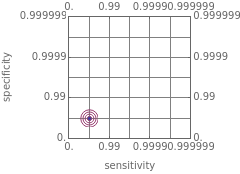

Requires a Wolfram Notebook System
Interact on desktop, mobile and cloud with the free Wolfram Player or other Wolfram Language products.
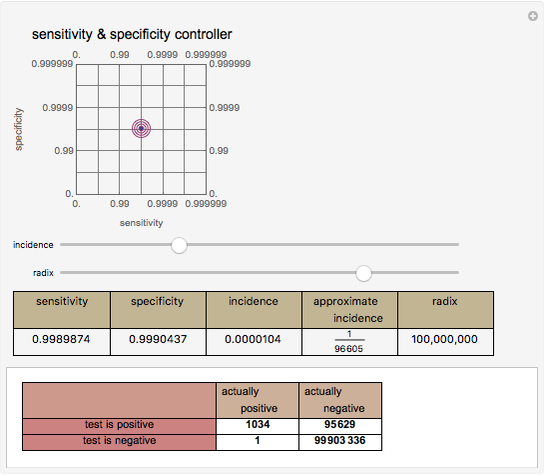
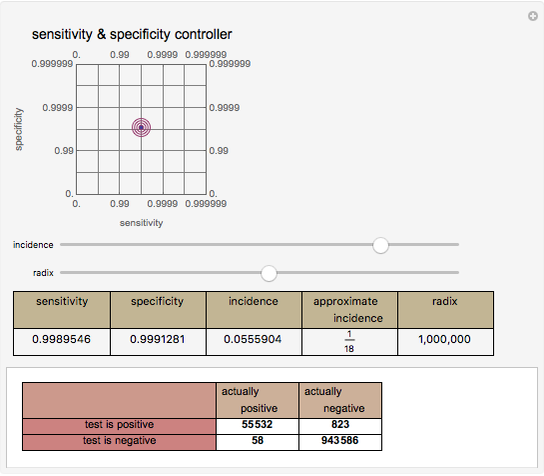
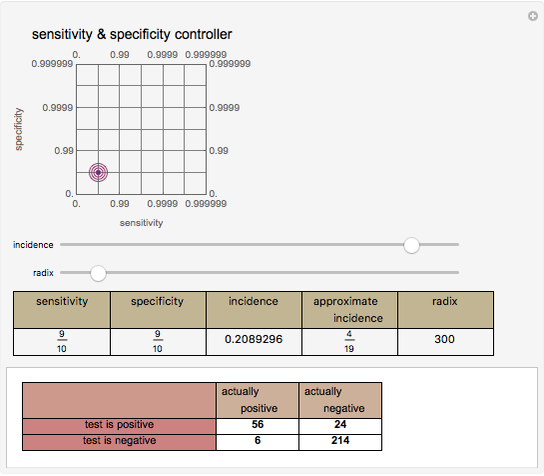
Testing, whether done in the medical field or elsewhere, generally has what is known as sensitivity and specificity. Sensitivity is the fraction of tested subjects who truly have some characteristic that the test will say they have. Specificity is the fraction of tested subjects who truly do not have some characteristic that the test will say they do not have. This Demonstration shows how the number of true positives, false positives, false negatives, and true negatives can be calculated by using data regarding sensitivity, specificity, and the incidence in the tested population of a particular characteristic.
Contributed by: Seth J. Chandler (March 2011)
Open content licensed under CC BY-NC-SA
Snapshots
Details
If the grid is represented as  , then sensitivity is
  and specificity is
  Incidence is
  .
.
The sliders do not have a linear response since it is often important to control fine levels of detail at the upper levels of sensitivity and specificity and at the lower levels of incidence.
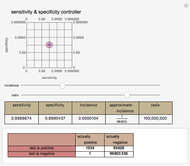
Snapshot 1: With low incidence conditions, a positive result on even a very sensitive test does not suggest by any means that a subject is truly positive.
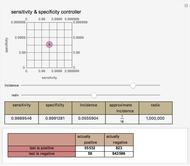
Snapshot 2: With high incidence conditions, a positive result on a very sensitive test strongly suggests that a subject is truly positive.
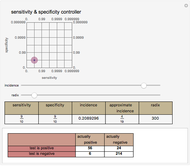
Snapshot 3: With very high incidence conditions, even not highly specific or sensitive tests are rather good predictors.
Permanent Citation
"Sensitivity, Specificity, and Incidence"
http://demonstrations.wolfram.com/SensitivitySpecificityAndIncidence/
Wolfram Demonstrations Project
Published: March 7 2011
 The Present Value of Future Gas Use
Seth J. Chandler Constant Risk Aversion Utility Functions
Seth J. Chandler The Edgeworth Box
Seth J. Chandler Merger Guidelines
Seth J. Chandler The Efficient Dual-Limit Liability Insurance Contract
Seth J. Chandler Moral Hazard
Seth J. Chandler Certainty Equivalent Wealth
Seth J. Chandler Cobb-Douglas Production Functions
Seth J. Chandler Bilateral Accident Model
Seth J. Chandler The Duty to Settle
Seth J. Chandler
-
 Post-Event Bonding
Seth J. Chandler -
 Emulating Land Use Evolution with a Cellular Automaton
Seth J. Chandler -
 General Assembly Resolution Viewer
Seth J. Chandler -
 Random Acyclic Networks
Seth J. Chandler -
 A Theory of Insurance Lapses
Seth J. Chandler -
 Asylum in the United States
Seth J. Chandler -
 Property Coinsurance
Seth J. Chandler -
 The Persuasion Effect: A Traditional Two-Stage Jury Model
Seth J. Chandler -
 Cellular Automata with Global Control
Seth J. Chandler -
 Sports Seasons Based on Score Distributions
Seth J. Chandler -
 Evidentiary Uncertainty
Seth J. Chandler -
 Spectral Measures
Seth J. Chandler -
 The Banzhaf Power Index of States for Presidential Candidates
Seth J. Chandler -
 Liability Insurance Desirability under Lognormal Loss Distributions
Seth J. Chandler -
 The Effects of Coinsurance and Deductibles on Optimal Precautions for Weibull-Distributed Loss
Seth J. Chandler -
 Collocation by Chi Square
Seth J. Chandler -
The Present Value of Future Gas Use
Seth J. Chandler -
 Visualizing Legal Rules: A Homicide Case
Seth J. Chandler -
 Communities of Nations Bridged by Language Similarity
Seth J. Chandler