
Steady-State Heat Transfer through an Insulated Wall

Requires a Wolfram Notebook System
Interact on desktop, mobile and cloud with the free Wolfram Player or other Wolfram Language products.
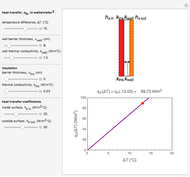
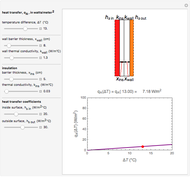
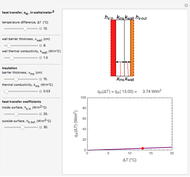
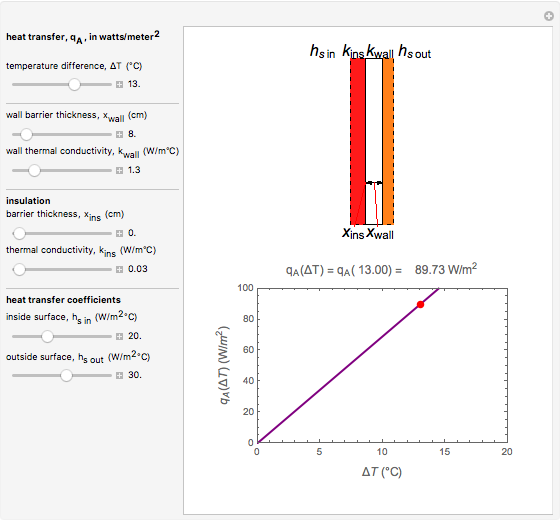
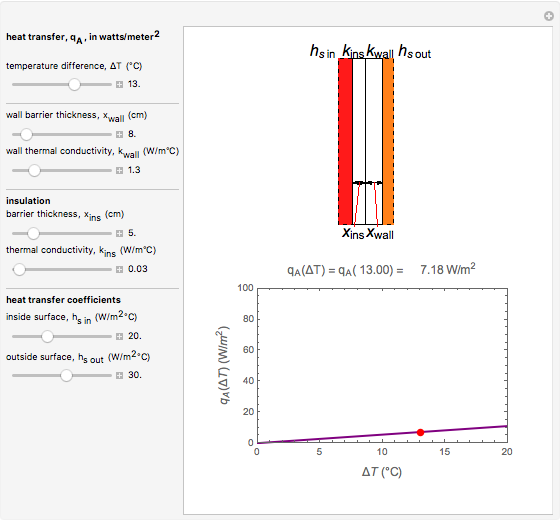
This Demonstration calculates and plots the steady-state heat flow per unit area through an insulated or uninsulated wall as a function of the insulation thickness and thermal conductivity, the surface heat transfer coefficients at either side of the insulated wall, and the temperature difference between the inside and outside. The top graphic depicts the heat resistances as a schematic diagram (not to scale).
Contributed by: Mark D. Normand and Micha Peleg (March 2011)
Open content licensed under CC BY-NC-SA
Snapshots

Details
Snapshot 1: no insulation
Snapshot 2: thin insulation
Snapshot 3: thick insulation
This Demonstration calculates and plots the steady state heat flow per unit area,  (in watts/
 ), through an insulated or uninsulated wall. You can choose the wall's thickness,
  (in cm), and its thermal conductivity,
  (in watts/m °C); the insulation's thickness,
  (in cm), and its thermal conductivity,
  (in watts/m °C); the surface heat transfer coefficients at either side of the wall,
  and
and  (in
(in  °C); and the temperature difference,
  (in °C), between the inside and outside. The calculations are done using the equation
  , whose parameters can be modified by moving the sliders. The red dot on the plot marks the flow rate per unit area for a
  chosen by moving the top slider. The top graphic depicts the heat resistances as a schematic diagram (not to scale).
Reference: R. L. Earle with M. D. Earle, Unit Operations in Food Processing, NZIFST, Inc., 1983.
Permanent Citation
"Steady-State Heat Transfer through an Insulated Wall"
http://demonstrations.wolfram.com/SteadyStateHeatTransferThroughAnInsulatedWall/
Wolfram Demonstrations Project
Published: March 7 2011
 Heat Transfer in a Heat Exchanger
Mark D. Normand, Maria G. Corradini, and Micha Peleg Steady-State 1D Conduction through a Composite Wall
Sara McCaslin and Fredericka Brown Steady-State Temperature Profile of Two-Layer Pipe
Fredericka Brown and Sara McCaslin Heat Diffusion in a Semi-Infinite Region
Brian Vick Latent Heats of Fusion and Vaporization
Enrique Zeleny Nonsteady-State Heat Conduction in a Cylinder
Housam Binous Transient Heat Conduction with a Nuclear Heat Source
Clay Gruesbeck Thermal Energy
Enrique Zeleny Heat Conduction in Some Standard Solids
Mikhail Dimitrov Mikhailov Thermal Distribution in an Optical Fiber with Heat Source
Brian G. Higgins and Housam Binous
-
 Ratkowski's Square Root Growth Rate Model for High Temperatures
Micha Peleg -
 Gordon-Taylor and Fox Equations for Glass Transition Temperature
Micha Peleg -
 Force to Overcome Vacuum Pull
Micha Peleg -
 Extending the Square Root Growth Rate Model to Lethal Low Temperatures
Micha Peleg -
 Probability of Being Strange According to Paulos
Micha Peleg -
 Successive Three-Point Method for Weibullian Chemical Degradation
Micha Peleg -
 Estimating Cohesion and Tensile Strength of Compacted Powders
Micha Peleg -
 Three-Endpoints Method for Isothermal Weibullian Chemical Degradation
Micha Peleg -
 Vitamin C Loss in Foods During Heat Processing and Storage
Micha Peleg -
 Parameterizing Temperature-Viscosity Relations
Micha Peleg -
 Laplace Distribution in Fluctuating Stock Index Records
Micha Peleg -
 Weibullian Chemical Degradation
Micha Peleg -
 Simulating Ascorbic Acid Degradation
Micha Peleg -
 Additive and Multiplicative Risks
Micha Peleg -
 Endpoints Method for Predicting Chemical Degradation in Frozen Foods
Micha Peleg -
 Exponential Model for Arrhenius Activation Energy
Micha Peleg -
 Prediction of Isothermal Degradation by the Endpoints Method
Micha Peleg -
 Risk Guesstimation from Factor Ranges
Micha Peleg -
 Volatiles Formation Kinetics in Stored Fish
Micha Peleg -
 Comparison of Six Sigmoid Growth Curve Models
Micha Peleg