
Touching Planar Polycubes


Requires a Wolfram Notebook System
Interact on desktop, mobile and cloud with the free Wolfram Player or other Wolfram Language products.
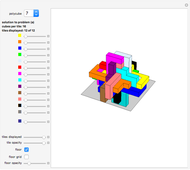
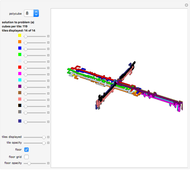
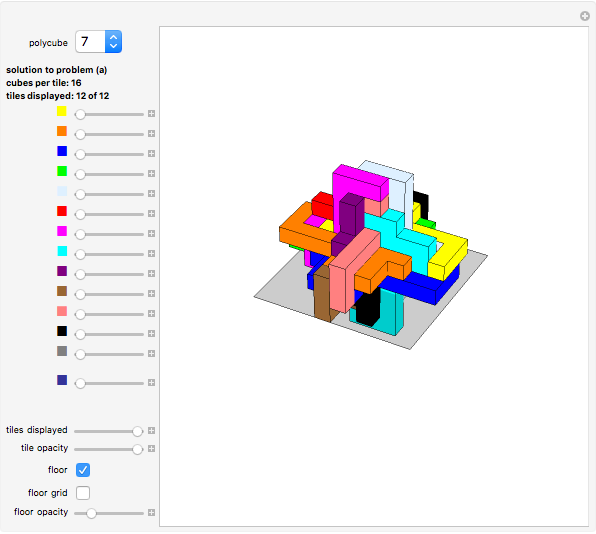
A planar polycube is a polycube that can be placed in such a way that it extends only one cube high into the third dimension. For each known integer  , here are the smallest known planar polycubes such that congruent copies all touch each other.
Contributed by: Karl Scherer (April 2008)
Additional contributions by: Erich Friedman
Open content licensed under CC BY-NC-SA
Snapshots
Details
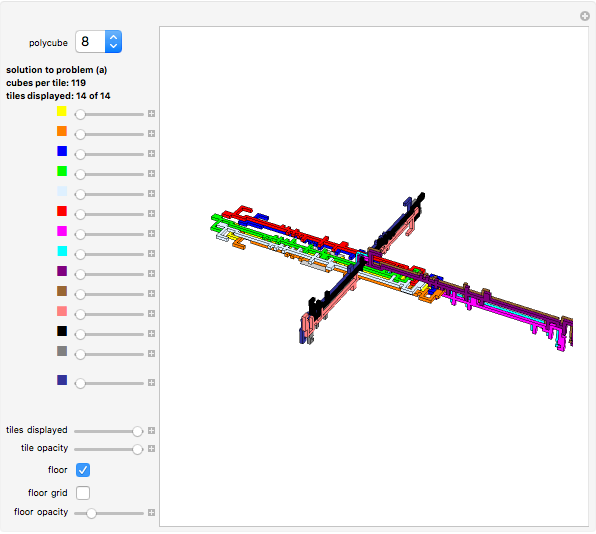
Problem a:
A "polycube" is a polyform based on cubes of the same size, the cubes being glued together on full faces. A  -cube is a polycube made from cubes. A planar -cube is one that can be placed in such a way that it extends only one cube high into the third dimension. Simple examples are rods
  and planar boxes
  .
.
For each given integer , the touching planar polycubes problem asks for the smallest such that congruent -cubes can mutually touch each other in three-dimensional space. It was researched first in 1986 by the author of this Demonstration. In 2005 Erich Friedman found the best solution for  (see case 5). All other solutions are by the author. The case
  (with 119 cubes in a very complex shape) is the highest ever solved. It is not known whether there are solutions for any
  . A definite insurmountable barrier is
  , so there is still some space for research.
All interesting answers are given as cases 1 to 8 in this Demonstration.
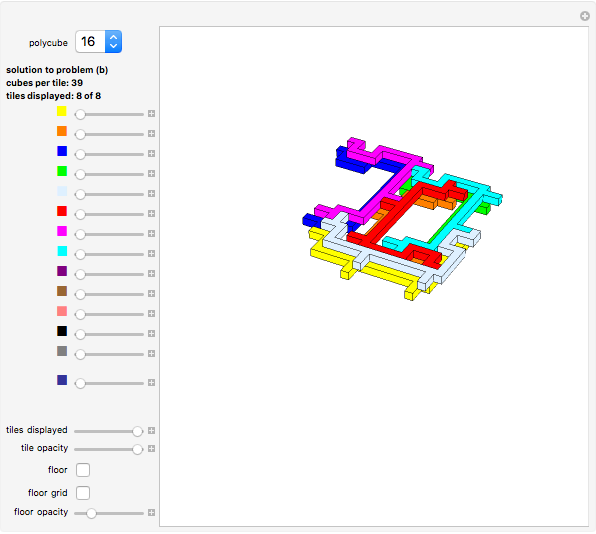
Problem b:
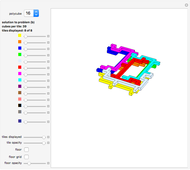
As an additional task one can ask the same question in the restricted  space, where the third dimension is only 2 units high. All interesting answers are given as cases 9 to 16 in this Demonstration.
This problem area is far from fully analyzed or understood and you might well find better solutions than the ones presented here for same cases.
If the polycube is allowed to be 2 units high instead of 1 unit, then for each we can find a such that copies of a certain -cube touch each other. The polycubes can simply be chosen to be the union of two joined rods which are at right angles to each other, one rod being positioned one unit higher than the other.
Best solutions :
The best known solutions for given (problem a):

The best known solutions for given (problem b):

Another area for further research: In all the solutions given in this Demonstration, the polycubes are placed on an orthogonal integral grid. Are the best solutions different if the polycubes are not restricted to such a grid?
Main manipulations:
The colored sliders move the polycubes apart, one slider per piece.
The "tiles displayed" slider builds up the assembly piece by piece.
The solution for  (problem a) was contributed by Erich Friedman.
Permanent Citation
 Seven Touching Cylinders Puzzle
Karl Scherer The Klein Configuration
Ed Pegg Jr Powered Clique Polyhedra
Ed Pegg Jr Biggest Little Polyhedron
Ed Pegg Jr Seven Cylinders
Sándor Kabai Turning a Punctured Torus Inside Out (Variation)
Karl Scherer Four Dividable Rhombohedra
Sándor Kabai 80 Golden Rhombohedra
Sándor Kabai and Lajos Szilassi Rhombic Triacosiohedron
Lajos Szilassi and Sándor Kabai Binomial Theorem (Step-by-Step)
Bruce Colletti
-
 Polyhedral Playground
Karl Scherer -
 Tiling Constructor, Tile-Dragging Variant
Karl Scherer -
 The Catenax Puzzle
Karl Scherer -
 Angel Puzzle
Karl Scherer -
 Constructing and Manipulating Graphs
Karl Scherer -
 3D Construction Set
Karl Scherer -
 Blended Quadrilaterals
Karl Scherer -
 Rotating Polyhedra in Space
Karl Scherer -
 The Misdirection Game
Karl Scherer -
 Tensegrity
Karl Scherer -
 Nowhere-Neat Tilings
Karl Scherer -
 Pocket Calculator
Karl Scherer -
 Area Puzzle
Karl Scherer -
 Molecule Construction Set
Karl Scherer -
 The Ray Puzzle
Karl Scherer -
 Animated Model of an Industrial Robot Arm
Karl Scherer -
 Model of an Industrial Robot Arm
Karl Scherer -
 Color-Blended Circular Tiles
Karl Scherer -
 Rep-Tiles
Karl Scherer -
 Armed Balloons Puzzle
Karl Scherer