Transient Response of a Semiconductor Laser


Requires a Wolfram Notebook System
Interact on desktop, mobile and cloud with the free Wolfram Player or other Wolfram Language products.
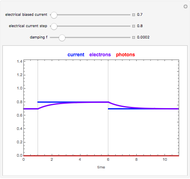
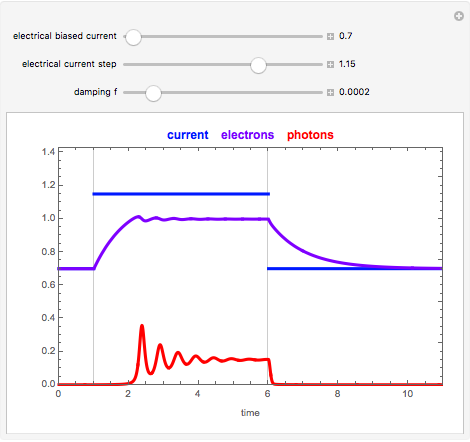
The transient response of a semiconductor laser is calculated by solving the coupled rate equations, which are two differential equations involving the electron and the photon densities. The normalized electrical current  injected into the laser suddenly increases from
  to
to  ; the electron and photon normalized densities are shown (in purple and red). Time is normalized by the lifetime of the electron. Photons are created by electron-hole recombination in the laser. The interaction between electrons and photons, described by the coupled rate equations, leads to damped relaxation oscillations.
The normalized time required to reach photon and electron density equilibrium values is around 1-3, and the actual time a few nanoseconds, since the typical value of the lifetime of the electron is around 1 nanosecond.
; the electron and photon normalized densities are shown (in purple and red). Time is normalized by the lifetime of the electron. Photons are created by electron-hole recombination in the laser. The interaction between electrons and photons, described by the coupled rate equations, leads to damped relaxation oscillations.
The normalized time required to reach photon and electron density equilibrium values is around 1-3, and the actual time a few nanoseconds, since the typical value of the lifetime of the electron is around 1 nanosecond.
Contributed by: Philippe Brosson (March 2011)
Open content licensed under CC BY-NC-SA
Snapshots
Details
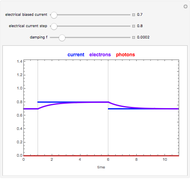
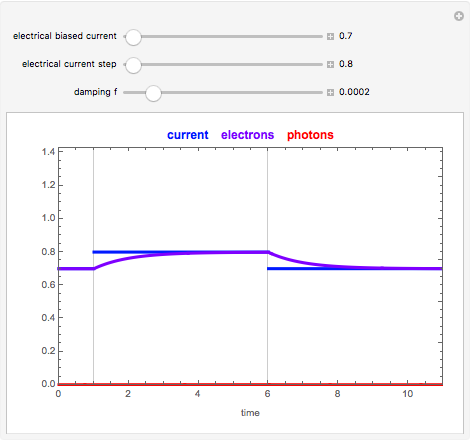
Snapshot 1: Transient response of the laser for  = 0.7 and
  =0.8 (below the threshold current
  =1). The photon density is very low (spontaneous emission) and the carrier density builds up to a value lower than threshold carrier density
  =1.
=1.
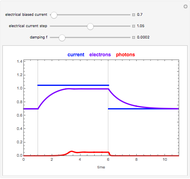
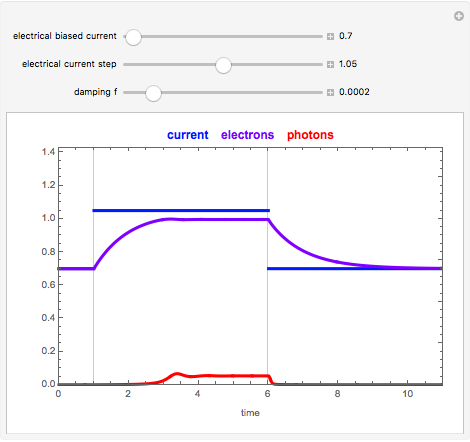
Snapshot 2: Transient response of the laser for  =0.7 and
  =1.05 (slightly above threshold). The photon density is higher compared to Snapshot 1 and the carrier density builds up towards 1.
Snapshot 3: Transient response of the laser for  =0.7 and
  (above threshold) . The photon density increases sharply when the carrier density reaches threshold. The time delay between the rising edge of the current step and the stimulated emission is around 1. Relaxation oscillations are due to interaction between electrons and photons. An increase of the photon density induces a reduction of the carrier density which in turn causes a decrease of the optical gain, resulting in a reduction of the photon density.
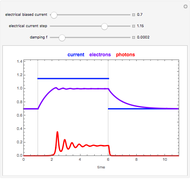
Snapshot 4: Transient response of the laser for  =0.98 and
  =1.15. The carrier density reaches threshold earlier, compared to Snapshot 3, resulting in an almost zero time delay between the rising edge of the current step and the stimulated emission.
Snapshot 5: Transient response of the laser in the case of low damping (0.0002) of the relaxation oscillations. The relaxation oscillations frequency is roughly proportional to  ;
;  =0.8 and
  =1.3.
=1.3.
Snapshot 6: Transient response of the laser in the case of strong damping (0.001) of the relaxation oscillations;  =0.8 and
  =1.3.
=1.3.
H. Kressel and J. K. Butler, Semiconductor Lasers and Heterojunction LEDs, Academic Press, 1977.
H. C. Casey, Jr. and M. B. Panish, Heterostructure Lasers, Academic Press, 1978.
G. H. B. Thomson, Physics of Semiconductor Laser Devices, John Wiley, 1980.
G. P. Agrawal and N. K. Dutta, Semiconductor Lasers, 2nd ed., Van Nostrand Reinhold, 1993.
P. Brosson, Semiconductor Lasers and Integrated Devices.
See Semiconductor Lasers operating principle (PDF) and High Speed Lasers (PDF) on the author's website for more information.
Permanent Citation
 Chaotic Dynamics of a Modulated Semiconductor Laser
Manu P. John and V. M. Nandakumaran Digital Filters with Windowed Sinc Finite Impulse Response
Dana Tremblay Frequency Response of an LCR Circuit
Contributed by: Kallol Das (St. Aloysius College, Jabalpur, India) Radially Polarized Laser Beam Intensity Distributions
Yousef I. Salamin Doped Silicon Semiconductors
S. M. Blinder Convolution with a Rectangular Pulse
Carsten Roppel A Rotating Waveplate Polarization Analyzer
Beth Schaefer and Edward Collett Variable States of Polarization Incident on a Wave Plate
Randall J. Hinton (Temple University) Polarization State Generator
Siva Perla Applications of Fresnel Equations for Light Intensities
Han Wang