
Using Zeta Zeros to Tally the Euler Phi Function

Requires a Wolfram Notebook System
Interact on desktop, mobile and cloud with the free Wolfram Player or other Wolfram Language products.
The Euler phi ( ) function (also called the totient function) is important in number theory;
  is the number of positive integers less than or equal to
  that have no factor in common with . For example,
  and
and  .
.


Contributed by: Robert Baillie (March 2011)
Open content licensed under CC BY-NC-SA
Snapshots

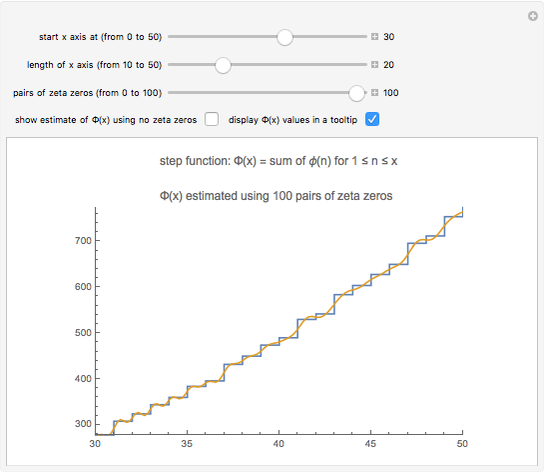
Details
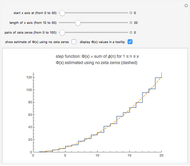
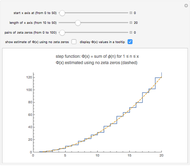
Snapshot 1: the graphs of the step function  and the formula using no zeta zeros
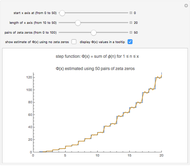
Snapshot 2: the graphs of and the formula using 30 pairs of zeta zeros
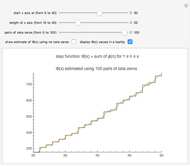
Snapshot 3: for larger  , we need more and more zeta zeros in order to closely match the step function
This Demonstration uses the following formula to calculate :
 ,
,
where  is the
  complex zero of the Riemann zeta function.
The first three complex zeros of the zeta function are approximately  ,
,  , and
, and  . The zeros occur in conjugate pairs, so if
  is a zero, then so is
  . The important Riemann hypothesis is the unproven conjecture that all these complex zeros have real part 1/2. So far, it has been verified that the first
  complex zeros do, indeed, have real part 1/2 (see [1]).
If you use the slider to choose, say, one pair of zeta zeros, then the first sum in the above formula, in effect, combines two terms corresponding to the first conjugate pair of zeta zeros and  . So, when these terms are added, their imaginary parts cancel while their real parts add. The
  applied to the first sum is simply an efficient way to combine the two terms for each pair of zeta zeros.
Notice that the second sum has the same form as the first, except that the second sum extends over the so-called "trivial" zeros of the zeta function, namely,  . The second sum is small when is large.
The dominant terms in the formula are  . This expression is fairly close to , but the accuracy of the formula improves as we include more terms with zeta zeros.
All known zeta zeros have multiplicity 1, which is assumed in the formula. At those values of where jumps from  to
to  , the formula converges to the midpoint,
  , as
, as  approaches infinity. You can see this in the graphs.
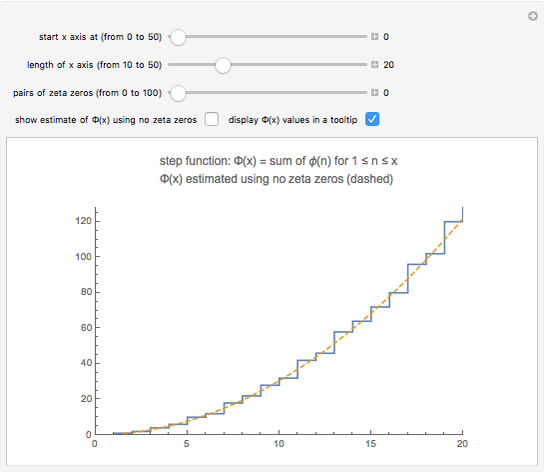
Also, you can use the tooltip to read off individual values from the graph. The definition of  means that
  . So, for example, at
  , the graph jumps from 28 to 32; this increase is simply
  .
.
To prove formulas like the one for  , see [3]. The key is to apply Perron's formula to the following identity, which holds for
  :
:
 .
.
This identity is in [2], or it may be derived (in Mathematica Version 7 or higher) from
DirichletTransform[EulerPhi[n], n, s].
References:
[1] X. Gourdon, "The 10^13 First Zeros of the Riemann Zeta Function, and Zeros Computation at Very Large Height."
[2] G. H. Hardy and E. M. Wright, The Theory of Numbers, 4th ed., Oxford: Oxford University Press, 1965 p. 250.
[3] H. L. Montgomery and R. C. Vaughan, Multiplicative Number Theory: I. Classical Theory, Cambridge: Cambridge University Press, 2007 p. 397.
Permanent Citation
 Using Zeta Zeros to Tally Squarefree Divisors
Robert Baillie Using Zeta Zeros to Tally Sigma Times Tau
Robert Baillie Using Zeta Zeros to Compute a Summatory Liouville Function
Robert Baillie Using Zeta Zeros to Compute the Mertens Function
Robert Baillie Using Zeta Zeros to Compute the Chebyshev Psi Function
Robert Baillie Using Zeta Zeros to Compute Tau Sums
Robert Baillie Using Zeta Zeros to Compute Sigma Sums
Robert Baillie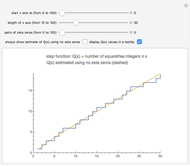 Using Zeta Zeros to Count the Squarefree Integers
Robert Baillie Dirichlet L-Functions and Their Zeros
Robert Baillie Euler Product for the Zeta Function
S. M. Blinder
-
Using Zeta Zeros to Compute Tau Sums
Robert Baillie -
Using Zeta Zeros to Compute Sigma Sums
Robert Baillie -
 The Sum of the Squares of the Distances to N Points
Robert Baillie -
 Why Pseudoprime Tests Work So Well
Robert Baillie -
Using Zeta Zeros to Tally Sigma Times Tau
Robert Baillie -
Using Zeta Zeros to Compute the Chebyshev Psi Function
Robert Baillie -
 How the Zeros of the Zeta Function Predict the Distribution of Primes
Robert Baillie -
Using Zeta Zeros to Tally Squarefree Divisors
Robert Baillie -
Using Zeta Zeros to Compute a Summatory Liouville Function
Robert Baillie -
 Using Zeta Zeros to Tally the Euler Phi Function
Robert Baillie -
Using Zeta Zeros to Count the Squarefree Integers
Robert Baillie -
Using Zeta Zeros to Compute the Mertens Function
Robert Baillie -
 A Formula for Primes in Arithmetic Progressions
Robert Baillie -
Dirichlet L-Functions and Their Zeros
Robert Baillie -
 State Transition Diagrams for Modular Powers
Robert Baillie -
 Sliding the Roots of Quadratics
Robert Baillie -
 Sliding the Roots of Cubics
Robert Baillie