Keplerian Orbital Elements


Requires a Wolfram Notebook System
Interact on desktop, mobile and cloud with the free Wolfram Player or other Wolfram Language products.
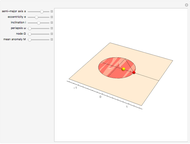
This Demonstration visualizes the influence of the Keplerian elements of a celestial body (e.g., a planet or asteroid orbiting around the Sun) on its orbit in 3-space.
Contributed by: Christoph Lhotka (January 2009)
Inspired by: Jeff Bryant
Open content licensed under CC BY-NC-SA
Snapshots


Details
Keplerian or osculating orbital elements are the natural set of variables to describe the motion of a celestial body (planet, asteroid, satellite) in 3-space: while in the 2-body problem the full set of Cartesian coordinates  changes with time, the corresponding Keplerian elements
  are all constant except for the mean anomaly
  . The semi-major axis
  and the eccentricity
  define the form of the ellipse; the inclination
  , periapsis
  , and node
  define the orientation of the ellipse in 3-space. The only variable to the system is the mean anomaly , defining the position of the planet in its orbit.
Snapshot 1: form of the ellipse (change  )
)
Snapshot 2: orientation of the ellipse in 3-space (change  )
)
Snapshot 3: position of the body in the ellipse (change )
Many more general  -body systems (solar system, lunar, or artificial satellite motion) can be modelled as perturbed two-body problems, where the Keplerian elements may oscillate around their mean values.
Permanent Citation
 Orbital Elements
Jeff Bryant Kepler's Second Law
Jeff Bryant Comet Tails
Jeff Bryant Sputnik 1 Orbiting the Earth
Steve VanWyk Enigmatic Comet Holmes
Jeff Bryant Axial Tilts of Planets
Jeff Bryant Seasons
Jeff Bryant Phases of Planets
Jeff Bryant Conic Sections: The Double Cone
Phil Ramsden The Uranus Puzzle
Ulrich Mutze