
The Simultaneous Contrast Effect


Requires a Wolfram Notebook System
Interact on desktop, mobile and cloud with the free Wolfram Player or other Wolfram Language products.
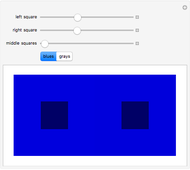
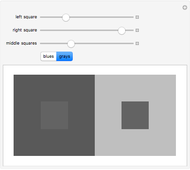
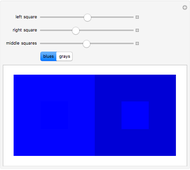
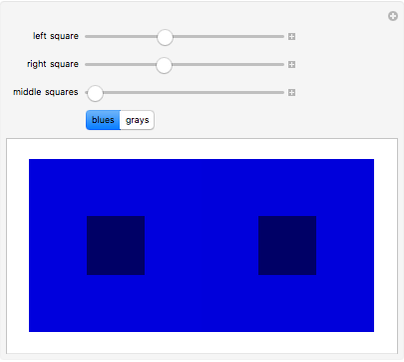
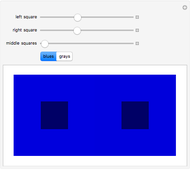
The two center squares have the same color. Change the colors behind them to see their apparent contrast.
Contributed by: Rob Morris (April 2007)
Additional contributions by: Sándor Kabai
Open content licensed under CC BY-NC-SA
Snapshots
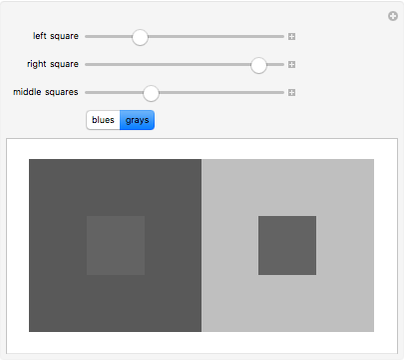
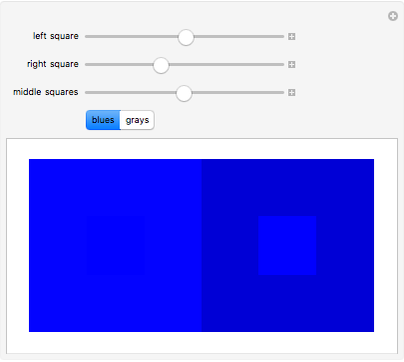
Details
This Demonstration was inspired by the work of Josef Albers.
Based on: A. Buhler-Allen, "The Math of Art: Exploring Connections between Math and Color Theory," in Proceedings of the Bridges London Conference, (R. Sarhangi and J. Sharp, eds.), Hertfordshire, UK: Tarquin Publications, 2006 p. 517.
Here is an excerpt from Buhler-Allen's paper:
In the mid 1800s a chemist with a specialty in dyes, Michael Eugene Chevreul, introduced his book, The Principles of Harmony and Contrast of Colors [1]. Chevreul noticed that a color's character changes; the same color can look lighter or darker depending on its juxtaposition to other colors. It is said that his "Law of Simultaneous Contrast" was conceived in the tapestry (Gobelin) factory where he noticed that the strength of the black depended on what colors were next to it. [1] M.E. Chevreul, The Principles of Harmony & Contrast of Colors, Faber Birren, first printed 1839
Permanent Citation
"The Simultaneous Contrast Effect"
http://demonstrations.wolfram.com/TheSimultaneousContrastEffect/
Wolfram Demonstrations Project
Published: April 27 2007
 Munker-White Illusion
Rob Morris Hering Illusion
Rob Morris Grids of Lines
Christopher Wolfram Wheel Illusion
Michael Schreiber Bullseye Illusion
Michael Schreiber Roget's Palisade
Kimee Moore Impossible Frames
Michael Schreiber Twelve-Tone Equal-Tempered Scales
Rob Morris and Michael Schreiber Wertheimer-Koffka Ring
Rob Morris Rotating Polygon Illusion
Sándor Kabai
-
 Chaos Game 2D/3D
Rob Morris -
 Self-Avoiding Random Walks
Rob Morris -
 Bounce Time for a Bouncing Ball
Rob Morris -
 Nonlinearized Motion of a Simple Pendulum
Rob Morris -
 Double Pendulum
Rob Morris -
 Maximum Fruit Salad
Rob Morris -
 The Simultaneous Contrast Effect
Rob Morris -
 How Far Can One See from a Height?
Rob Morris -
 Maze Generator and Solver
Rob Morris -
Twelve-Tone Equal-Tempered Scales
Rob Morris -
 Polyrhythyms
Rob Morris -
 Fraction Blocks
Rob Morris -
 Polynomial Fitter
Rob Morris -
 Digit Frequency Plot for Transcendental Numbers
Rob Morris -
 Everything about Gell-Mann Matrices (Part 1): Unary Operations
Rob Morris -
Wertheimer-Koffka Ring
Rob Morris -
 Oscillations of a Pogo Stick
Rob Morris -
 Forced Oscillator with Damping
Rob Morris -
 Refrigerator Poetry
Rob Morris -
 Self-Avoiding Random Walks in 3D
Rob Morris