
A Rolling Reuleaux Triangle
Initializing live version



Requires a Wolfram Notebook System
Interact on desktop, mobile and cloud with the free Wolfram Player or other Wolfram Language products.
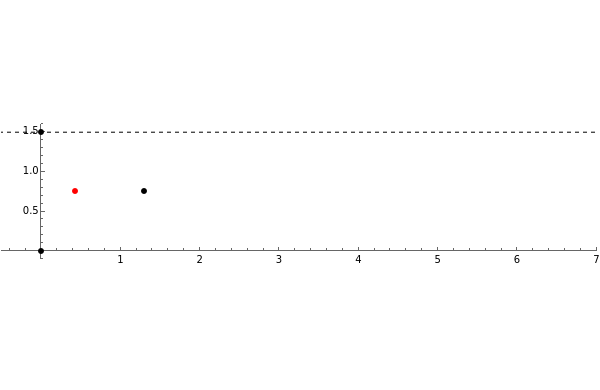
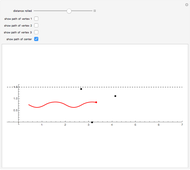
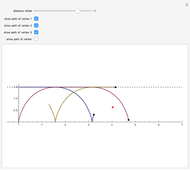
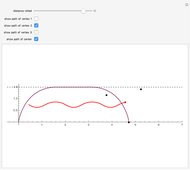
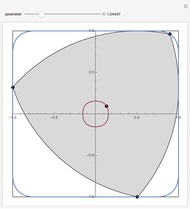
A Reuleaux triangle is constructed from an equilateral triangle by joining each pair of vertices with a circular arc centered at the third vertex (each radius is equal to the side length of the triangle).
[more]

Contributed by: Chris Boucher (March 2011)
Open content licensed under CC BY-NC-SA
Snapshots


Details
Permanent Citation
Related Demonstrations
More by Author
 A Rotating Reuleaux Triangle
Chris Boucher Projecting a Triangle
Eric Rowland A Visual Proof of Girard's Theorem
Okay Arik The Erdös-Mordell Inequality
Jay Warendorff Circumcircle and Incircle of a Triangle
Chris Boucher Witch of Agnesi
Chris Boucher Convolutions of Shifted Densities
Xiangjun Shao Point in Triangle
Michael John Twardos The Triangle Inequality
Chris Boucher Spieker Center Triangle Construction
Theodore Gray
-
 Hypothesis Tests about a Population Mean
Chris Boucher -
 Fair Sharing of an Equilateral Triangular Pizza
Chris Boucher -
 Using Rule 30 to Generate Pseudorandom Real Numbers
Chris Boucher -
 Circumscribing Polygons
Chris Boucher -
 Nine-Point Circle
Chris Boucher -
 The Birthday Problem
Chris Boucher -
Convolutions of Shifted Densities
Chris Boucher -
 Geometric Distribution
Chris Boucher -
 How Old Would You Be on Another Planet (or Pluto)?
Chris Boucher -
 Difference Formula for Cosine
Chris Boucher -
 The Arbelos
Chris Boucher -
 Confidence Intervals for a Mean
Chris Boucher -
 3x3 Matrix Explorer
Chris Boucher -
 Which Country Is Bigger?
Chris Boucher -
 Capacity Planning for Short Life Cycle Products: The Newsvendor Model
Chris Boucher -
 Numerical Instability in the Gram-Schmidt Algorithm
Chris Boucher -
 Poisson Distribution
Chris Boucher -
 Maximizing the Area of a Rectangle with Fixed Perimeter
Chris Boucher -
 Olympic Medal Times in the Men's 100 Meter
Chris Boucher -
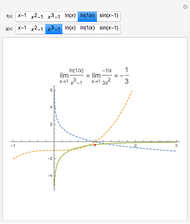 L'Hospital's Rule for 0/0 Forms
Chris Boucher