Birds on a Wire


Requires a Wolfram Notebook System
Interact on desktop, mobile and cloud with the free Wolfram Player or other Wolfram Language products.
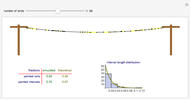
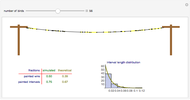
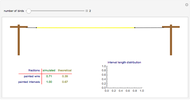
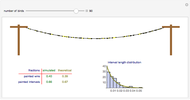
A number of birds randomly land on a telephone wire. If the intervals between each bird and its closest companion were painted, what would be the expected fraction of wire painted? And what proportion of the number of intervals would be painted? The key to answering these questions is to realize that the probability distribution of interval lengths is (approximately) exponential. Knowing that, these fractions can be calculated to be 7/18 and 2/3.
Contributed by: Jacqueline D. Wandzura and Stephen M. Wandzura (March 2011)
Open content licensed under CC BY-NC-SA
Snapshots


Details
This problem was inspired by Birds on a Wire.
If the mean density of birds is  , then the probability distribution of interval lengths
  is
is  . Integrating this, the probability that an interval is less than
  is
is  . Squaring that gives the probability that the two intervals on either side of a chosen interval are both smaller than the chosen interval, in which case it would not be painted. Thus, the probability that an interval of length
  will be painted is
  . Thus, the probability that a link will be painted is
  . Likewise, the average length of an interval weighted by the probability that it is painted is
  . Dividing by the average length of an interval λ gives the fraction of painted wire as
  .
.
Permanent Citation
"Birds on a Wire"
http://demonstrations.wolfram.com/BirdsOnAWire/
Wolfram Demonstrations Project
Published: March 7 2011
 Clean Tile Problem
Jacqueline D. Wandzura and Stephen M. Wandzura Central Limit Theorem Applied to Samples of Different Sizes and Ranges
Mark D. Normand and Micha Peleg Maximum Likelihood Estimation of Ordinary and Finite Mixture Distributions
Heikki Ruskeepää and M. A. Ghorbani Distribution of the Means of Samples Having Random Sizes
Mark D. Normand, Joseph Horowitz, and Micha Peleg Probabilistic Dartboard
Olivia M. Carducci (East Stroudsburg University) Joint Density of Trivariate Gaussian Random Variables
John M. Shea Joint Density of Bivariate Gaussian Random Variables
John M. Shea Dealer's Odds in Blackjack
D. Meliga and S. Z. Lavagnino Failure Probabilities from Quality Control Charts
Mark D. Normand and Micha Peleg Central Limit Theorem Illustrated with Four Probability Distributions
D. Meliga and S. Z. Lavagnino