
Mathematics of Tsunamis

Requires a Wolfram Notebook System
Interact on desktop, mobile and cloud with the free Wolfram Player or other Wolfram Language products.
Computer modeling and simulations lead to a better understanding of natural disasters, such as the Indian Ocean Tsunami of 2004, and may prevent loss of life in the future. Using the system of partial differential equations known as the shallow water wave equations, this Demonstration provides a reasonable approximation of the behavior of real ocean waves during a tsunami.
Contributed by: Yu-Sung Chang (March 2011)
After work by: Rob Knapp and Roger Germundsson
Open content licensed under CC BY-NC-SA
Snapshots
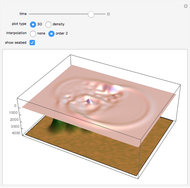
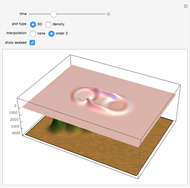
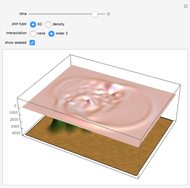
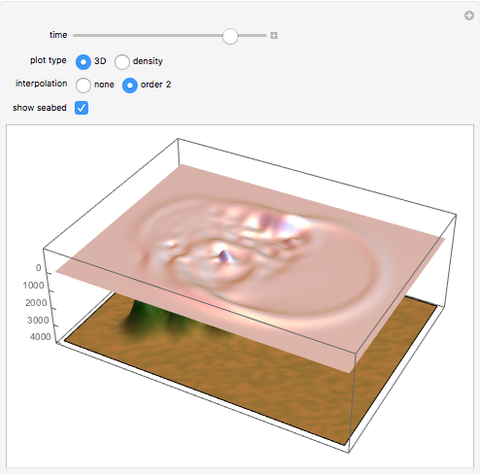
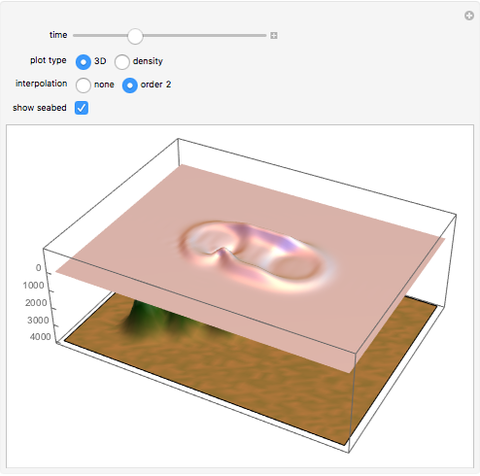
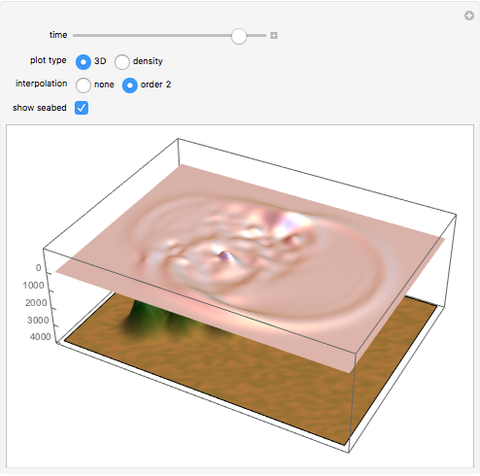
Details
The SWE model makes the following assumptions: hydrostatic pressure distribution; incompressible, homogeneous fluid; well-mixed-in-depth flows: uniform vertical mixing; small vertical scale relative to horizontal. The last assumption is certainly violated when a tsunami nears land.
The US NOAA (National Oceanic and Atmospheric Administration) uses a model they refer to as MOST (Method of Splitting Tsunami) that uses different computations and models for the three phases: generation, propagation, and inundation. The propagation phase is computed by solving the SWE on the globe.
Permanent Citation
"Mathematics of Tsunamis"
http://demonstrations.wolfram.com/MathematicsOfTsunamis/
Wolfram Demonstrations Project
Published: March 7 2011
 Tsunami Striking a Landscape
Quang-Dao Trinh Nonlinear Wave Equations
Stephen Wolfram and Rob Knapp Solitons from the Korteweg-de Vries Equation
S. M. Blinder Plane Seismic Waves
Yu-Sung Chang Rayleigh Waves
Enrique Zeleny Wave Generator
Mike Parenteau Vibrations of a Rectangular Membrane
Alain Goriely Travelling Pulses (Wave Packets)
Roger Beresford Spherical Seismic Waves
Yu-Sung Chang Tuned Mass Damper System
Enrique Zeleny
-
 Day and Night World Clock
Yu-Sung Chang -
 Foam Bubbles Simulating Voronoi Diagrams
Yu-Sung Chang -
 Surface Morphing
Yu-Sung Chang -
 Bernstein Polynomials
Yu-Sung Chang -
 Periodic Table in 3D
Yu-Sung Chang -
 Morphological Operations in Binary Images
Yu-Sung Chang -
Rayleigh Waves
Yu-Sung Chang -
 Picture Puzzle
Yu-Sung Chang -
 Straightening Up an Image
Yu-Sung Chang -
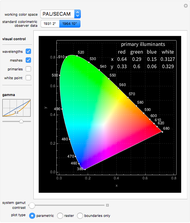 CIE Chromaticity Diagram
Yu-Sung Chang -
 Digital Tilt-Shift Photography
Yu-Sung Chang -
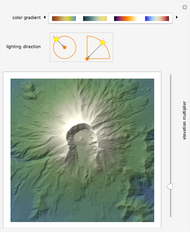 Relief-Shaded Elevation Map
Yu-Sung Chang -
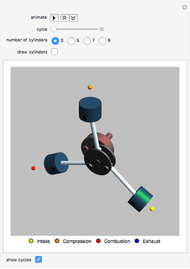 Radial Engine
Yu-Sung Chang -
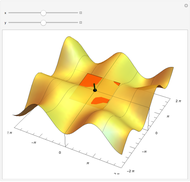 Tangent to a Surface
Yu-Sung Chang -
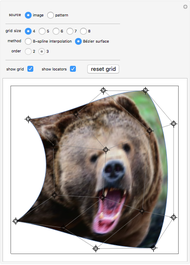 Image Warping
Yu-Sung Chang -
 Bump Map of Mars
Yu-Sung Chang -
 Bézier Curve Flowers
Yu-Sung Chang -
 Designing a Car Body with Splines
Yu-Sung Chang -
 Inspecting the Rosetta Stone
Yu-Sung Chang -
 Spline Sketchpad
Yu-Sung Chang