Multivariable Epsilon-Delta Limit Definitions


Requires a Wolfram Notebook System
Interact on desktop, mobile and cloud with the free Wolfram Player or other Wolfram Language products.
The definition of a limit:
The expression  is an abbreviation for: the value of the single-variable function
  approaches
 as
as  approaches the value
  . More formally, this means that
  can be made arbitrarily close to
  by making
  sufficiently close to
  , or in precise mathematical terms, for each real
  , there exists a
  such that
  . In other words, the inequalities state that for all
  except
  within
  of
of  ,
,  is within
  of
of  .
.


Contributed by: Spencer Liang (The Harker School) (March 2011)
Open content licensed under CC BY-NC-SA
Snapshots


Details
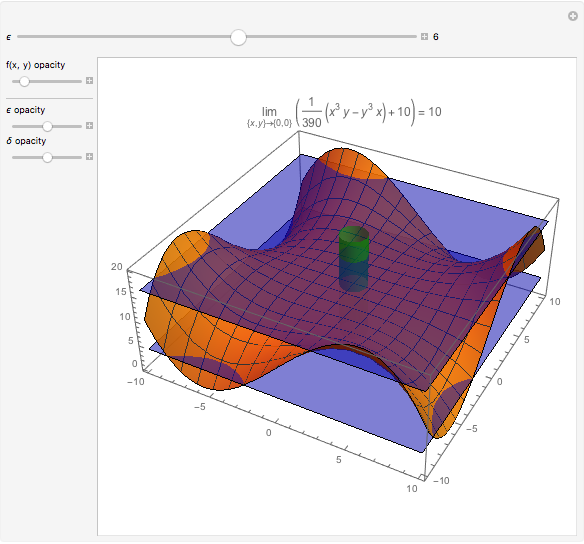
 For the limit of a multivariable function, consider the two-variable function
  . (Note that the following extends to functions of more than just two variables, but for the sake of simplicity, two-variable functions are discussed.) The same limit definition applies here as in the one-variable case, but because the domain of the function is now defined by two variables, distance is measured as
 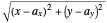 , all pairs
  within
  of are considered, and
  should be within
  of
of  for all such pairs
  .
As an example, here is a proof that the limit of
.
As an example, here is a proof that the limit of  is 10 as
  . Claim: for a given
  , choosing
  satisfies the appropriate conditions for the definition of a limit:
  (the given condition) reduces to
  , which implies that
  and
and  .
.
Now,  by the triangle inequality, and
  . If
. If  ,
,  , and if
  ,
,  . Thus by the choice of
  ,
,  , and because
  is arbitrary, an appropriate
  can be found for any value of
  ; hence the limit is 10.
Permanent Citation
 Nonexistence of a Multivariable Limit
Laura R. Lynch Epsilon-Delta Definition of Limit
Ferenc Beleznay Solids of Revolution
Abby Brown and MathematiClub (Torrey Pines High School) Solids of Known Cross Section
Abby Brown (Torrey Pines High School) Double Integral for Volume
Anton Antonov A Case of the Epsilon-Delta Definition of a Limit
Joseph F. Kolacinski Sine Wave Example of the Epsilon-Delta Definition of Limit
Geoffrey F. Miller, Daniel C. Cheshire, Nell H. Wackwitz, Joshua B. Fagan Volumes of Revolution Using Cylindrical Shells
Stephen Wilkerson (Towson University) Curvas de nivel (Spanish)
Jorge Gamaliel Frade Chávez Cone, Tent, and Cylinder
George Beck