The Headlight Effect



Requires a Wolfram Notebook System
Interact on desktop, mobile and cloud with the free Wolfram Player or other Wolfram Language products.
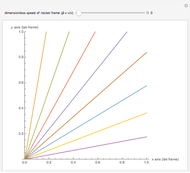
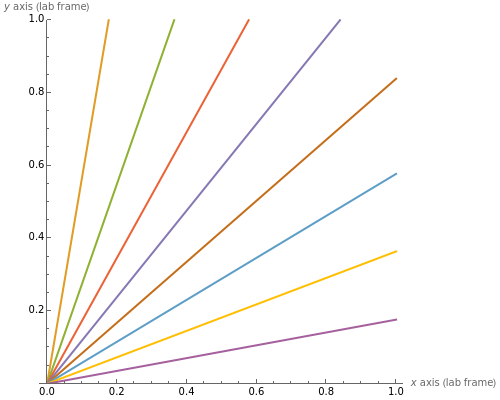
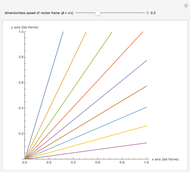
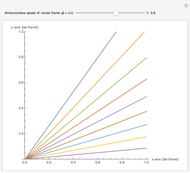
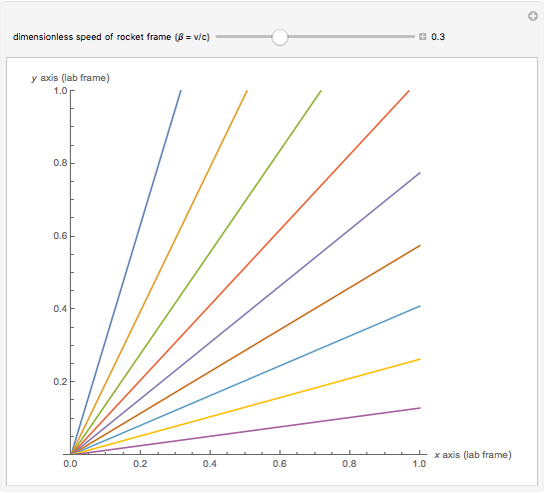
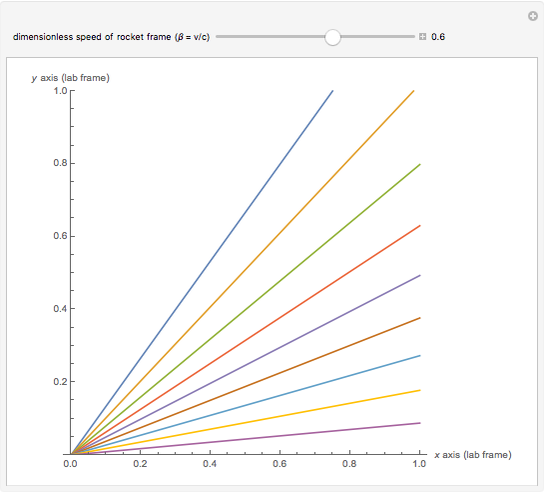
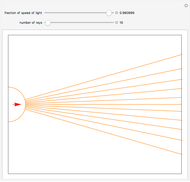
This Demonstration shows how nine light rays (emitted at angles from  to
to  in steps in the rocket frame) are measured by the laboratory observer as the rocket flies past at speed
  .
.
Contributed by: Paul A. Nakroshis (Department of Physics, University of Southern Maine, Portland, ME) (March 2011)
Open content licensed under CC BY-NC-SA
Snapshots

Details
A standard problem in special relativity asks you to consider light emitted uniformly in all directions from both the rocket frame (where the light is emitted from) and the laboratory frame (watching the rocket fly past). From the point of view of an observer in the laboratory frame, the light emitted from the rocket frame (in the forward hemisphere) is measured to be compressed into a cone in the forward direction. In the rocket frame, a particular light ray is emitted at an angle θ' such that
 .
.
Such a ray will be measured to have a different angle,  , in the laboratory frame, defined by
 .
.
Then use the Lorentz transformations  ,
,  to replace
  and
and  , yielding
 ,
,
or, more simply,
 .
.
To visualize this effect, define a ray as  , where the slope,
  , is given by the tangent of the angle .
Permanent Citation
 Relativistic Headlight Effect
Kenny F. Stephens II Russell's Thought Experiment in Special Relativity
Enrique Zeleny Schwarzschild Space-Time Embedding Diagram
Ben Langton Orbits around Schwarzschild Black Holes
David Saroff Orbits around a Spinning Black Hole
David Saroff, Glenna Clifton, and Janna Levin Light Cone Causality
Michael Schreiber Orbits around and through a Sphere
Michael Trott with permission of Springer Blackbody Radiation
Zach Heuman (Boise State University) Broadcasting Satellite in a Geocentric Kepler Orbit
Marty Scherr Gravitational Lensing by a Point Mass
Allison Hume (Baldwin School) and Jacek Guzik (University of Pennsylvania)