
Cellular Automaton Compressibility


Requires a Wolfram Notebook System
Interact on desktop, mobile and cloud with the free Wolfram Player or other Wolfram Language products.
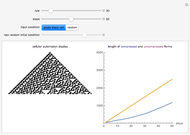
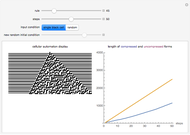
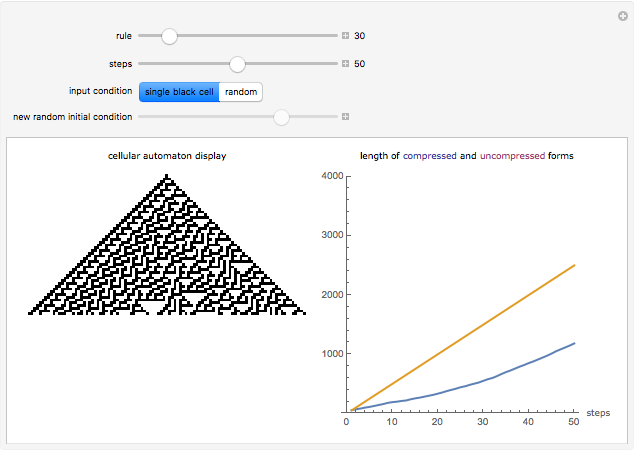
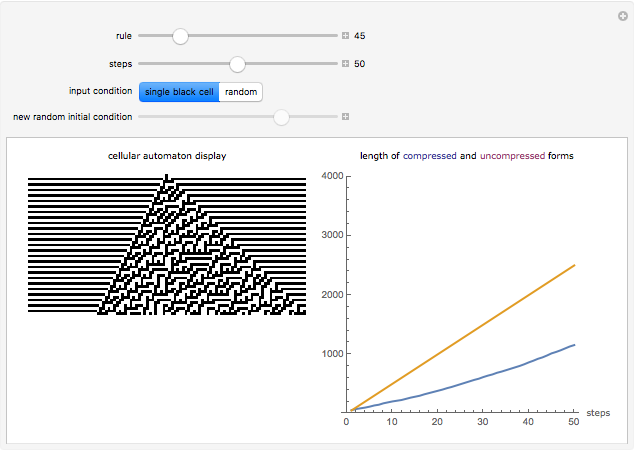
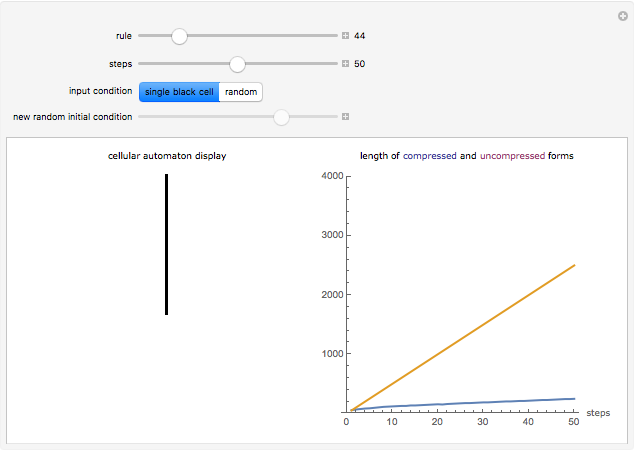
The difference in length between the compressed and uncompressed forms of the output of a cellular automaton is a good approximation of its algorithmic complexity. For most cases, the length of the compressed form levels off, indicating that the cellular automaton output is repetitive and can easily be described. However, in cases like rules 30, 45, 110, or 73, the length of the compressed form grows rapidly, corresponding to the apparent randomness and lack of structure in the display.
Contributed by: Hector Zenil (March 2011)
Open content licensed under CC BY-NC-SA
Snapshots
Details
One can also see the shortcomings of measuring algorithmic complexity by compressibility, since rule 30 is its own shortest description. Conversely, simple and nested ECAs are highly compressible, but the length of their generating rules is exactly the same as the rules that yield complex behavior. Nevertheless, the compressibility method is a good way to see the different types of behaviors according to Stephen Wolfram's classes.
Permanent Citation
"Cellular Automaton Compressibility"
http://demonstrations.wolfram.com/CellularAutomatonCompressibility/
Wolfram Demonstrations Project
Published: March 7 2011
 Compressing Elementary Cellular Automaton Rules
Daniel de Souza Carvalho Compressed Constrained Cellular Automaton Initialization
Michael Schreiber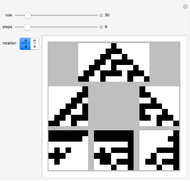 Semi-Rotation Automaton Plot
Michael Schreiber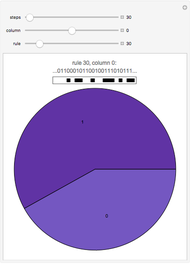 Digit Frequencies in the Columns of Cellular Automata
Hector Zenil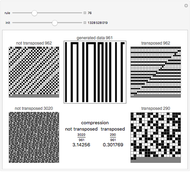 Oriented Run-Length Compression
Michael Schreiber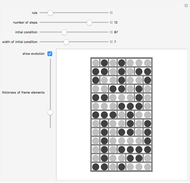 Latticework Design by Runs in Automaton States
Michael Schreiber Random Number Generation
Hector Zenil Domany-Kinzel Stochastic Cellular Automata
Jason Cawley Smooth Density Histograms for Cellular Automata
Daniel de Souza Carvalho Cellular Automaton Explorer
Stephen Wolfram
-
 Euler's Polyhedral Formula
Hector Zenil -
 Iterating the Collatz Map on Real and Complex Numbers
Hector Zenil -
 Country Data and Benford's Law
Hector Zenil -
 Fractal Dimension versus Time Complexity in Turing Machines
Hector Zenil -
 World Metro Networks
Hector Zenil -
 Random Walks in Elementary Cellular Automata
Hector Zenil -
 Cellular Automata Sensitivity to Initial Conditions
Hector Zenil -
 Network Motifs and Graphlets
Hector Zenil -
 Complex Networks
Hector Zenil -
 Infinite Monkey Theorem
Hector Zenil -
 Generating Random DNA Sequences
Hector Zenil -
 Kolmogorov Complexity of 3×3 and 4×4 Squares
Hector Zenil -
 Small Turing Machines with Halting State: Enumeration and Running on a Blank Tape
Hector Zenil -
 Fundamental Theorem of Arithmetic
Hector Zenil -
 Speedup and Slowdown Phenomena in Turing Machines
Hector Zenil -
 Prediction and Entropy of Languages
Hector Zenil -
 Shannon's Noisy-Channel Coding Theorem
Hector Zenil -
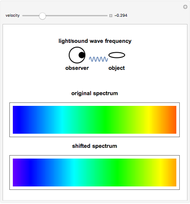 Doppler Effect
Hector Zenil -
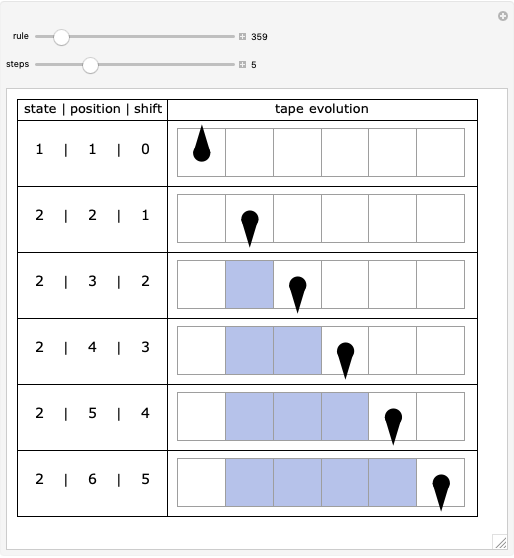 Unveiling Mathematica's TuringMachine Function Step by Step
Hector Zenil -
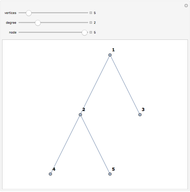 Breadth-First Search Enumeration
Hector Zenil