
Confidence Intervals for the Binomial Distribution



Requires a Wolfram Notebook System
Interact on desktop, mobile and cloud with the free Wolfram Player or other Wolfram Language products.
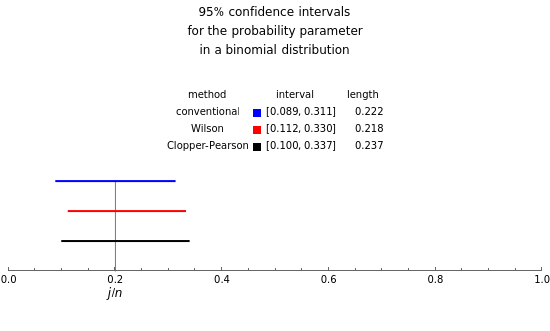
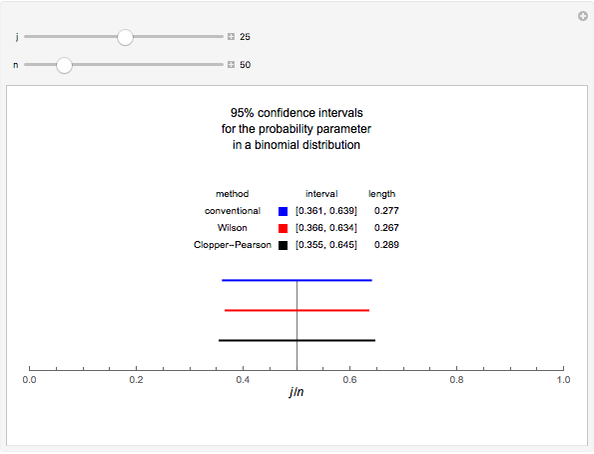
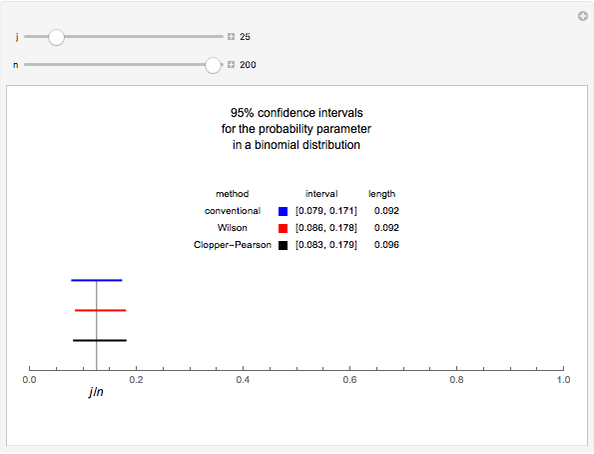
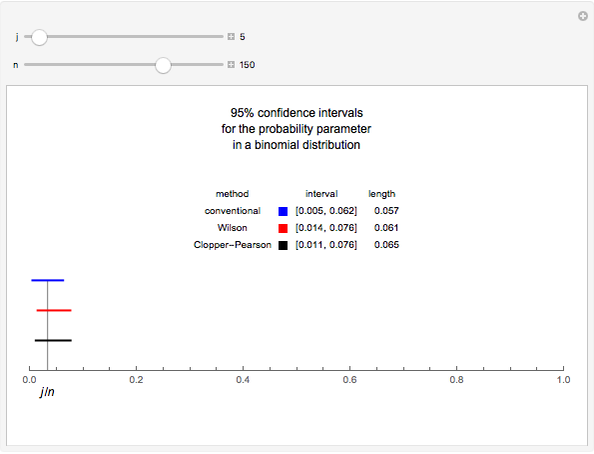
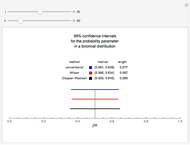
A confidence interval for estimating a parameter of a probability distribution must show two basic properties. First, it must contain the value of the parameter with a prescribed probability, and second, it must be as short as possible in order to be useful. Confidence intervals may be derived in different ways. In the case of a binomial distribution with  trials and probability parameter
  , the conventional method for estimating uses the normal approximation and produces an interval centered at the point
  , where
  is the number of successes obtained in the trials.
Contributed by: Tomas Garza (March 2011)
Open content licensed under CC BY-NC-SA
Snapshots
Details
The article on Binomial proportion confidence interval in Wikipedia gives the details for Wilson's method. Implementation of the Clopper–Pearson method is due to the author of this presentation.
Permanent Citation
 Confidence Intervals, Confidence Levels, and Average Interval Length
Tomas Garza Binomial Approximation to a Poisson Random Variable
Chris Boucher Mathematica 7's Discrete Distributions
Nasser M. Abbasi Exploring the Tails of the Normal Distribution
Joe O'Hara Sampling Distribution of the Sample Mean
Jim R Larkin Distribution of Normal Means with Different Sample Sizes
David Gurney Impact of Sample Size on Approximating the Normal Distribution
Paul Savory (University of Nebraska-Lincoln) Sampling Distribution of the Mean and Standard Deviation in Various Populations
Ian McLeod Simulating a Normal Process from Sums of Uniform Distributions
Jim Gerdy Convergence of the Empirical Distribution Function of a Sample
Tomas Garza
-
 Stratification as a Device for Variance Reduction
Tomas Garza -
 Intersection of Two Lines Using Vectors
Tomas Garza -
 Areas of the Lens and Two Lunes of Two Intersecting Circles
Tomas Garza -
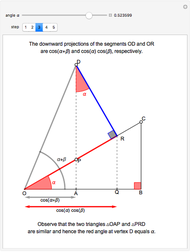 Cosine and Sine of the Sum of Two Angles
Tomas Garza -
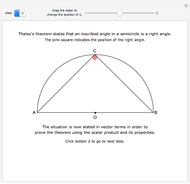 Thales's Theorem: A Vector-Based Proof
Tomas Garza -
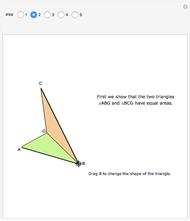 The Medians of a Triangle Divide It into Three Smaller Triangles of Equal Area
Tomas Garza -
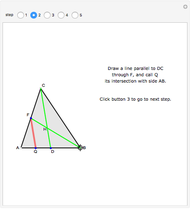 The Medians of a Triangle Are Concurrent: A Visual Proof
Tomas Garza -
 The Centroid of a Triangle Divides Each Median in the Ratio 1:2
Tomas Garza -
 Da Vinci's Proof of the Pythagorean Theorem
Tomas Garza -
Confidence Intervals, Confidence Levels, and Average Interval Length
Tomas Garza -
 Confidence Intervals for the Binomial Distribution
Tomas Garza -
 Monte Carlo Methods to Estimate Area
Tomas Garza -
 Least-Squares Estimation of an Ellipse
Tomas Garza -
Convergence of the Empirical Distribution Function of a Sample
Tomas Garza -
 The de Moivre-Laplace Theorem in Probability Theory
Tomas Garza -
 The Law of the Iterated Logarithm in Probability Theory
Tomas Garza -
 Ordinary Regression and Orthogonal Regression in the Plane
Tomas Garza