Positive Frobenius Numbers of Three Arguments


Requires a Wolfram Notebook System
Interact on desktop, mobile and cloud with the free Wolfram Player or other Wolfram Language products.
Let  ,
,  ,
,  be three positive integers with
  . It is well-known that all sufficiently large integers are representable as positive linear combinations of , , . Consider
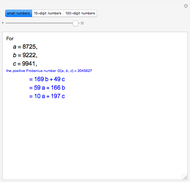
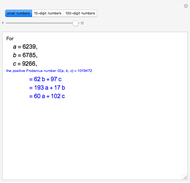
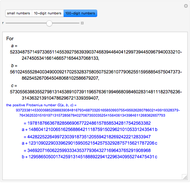
  , the positive Frobenius number of , , , defined to be the largest integer not representable as a positive linear combination of , , . Then
  is the usual Frobenius number, that is, the largest integer not representable as a non-negative linear combination , , . ( differs from the positive Frobenius number
  in that multipliers for linear combinations of larger integers are allowed to be zero.) The function
  corresponds to the Mathematica built-in function FrobeniusNumber[a,b,c].
Contributed by: Abdelwaheb Miled (March 2011)
Open content licensed under CC BY-NC-SA
Snapshots

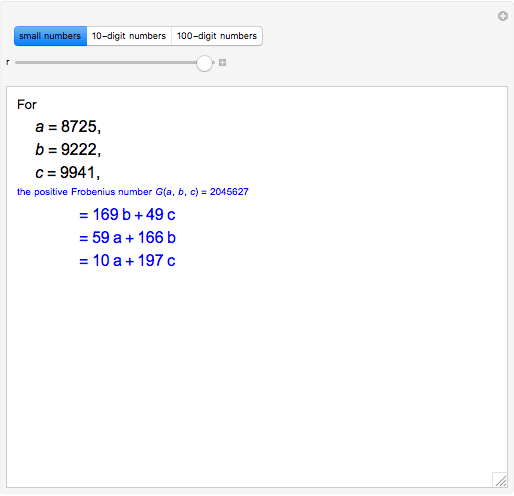
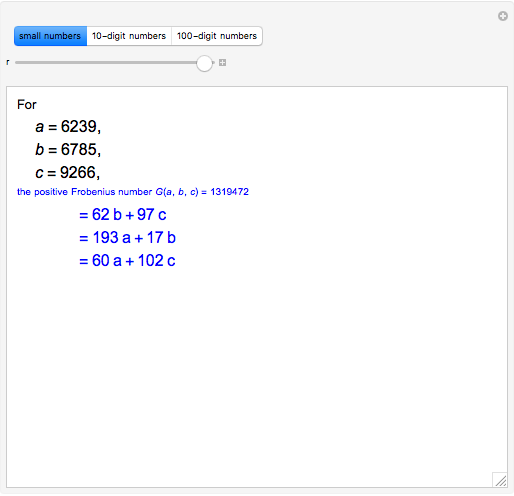
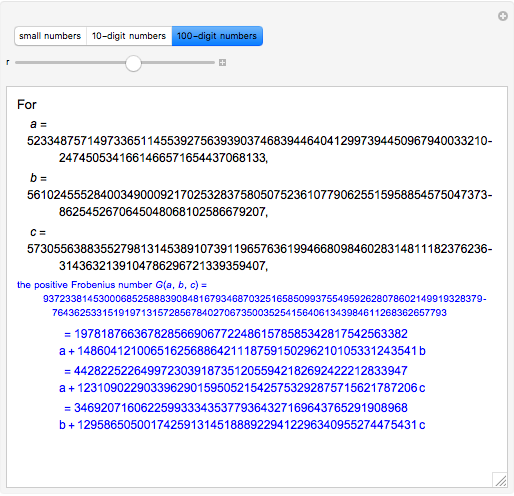
Details
S. M. Johnson, "A Linear Diophantine Problem," Canadian Journal of Mathematics, 12, 1960 pp. 390–398.
A. Miled, "On a Problem of Frobenius in Three Numbers," arXiv.org, 2009.
Permanent Citation
 McNugget Problem and Frobenius Numbers
Ed Pegg Jr Sum of Three Triangular Numbers
Ed Pegg Jr Frobenius Equation in Two Variables
Izidor Hafner Positive Integer Explorer
Chris Boucher Equivalence of Three Catalan Number Interpretations
Robert Dickau Cyclic Numbers
Izidor Hafner Congruent Numbers
Ed Pegg Jr Lah Numbers
Robert Dickau Ulam Numbers
Emmanuel Garces Medina Lucky Numbers
Enrique Zeleny