Qutrit States as Probability Vectors




Requires a Wolfram Notebook System
Interact on desktop, mobile and cloud with the free Wolfram Player or other Wolfram Language products.
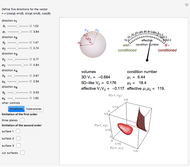
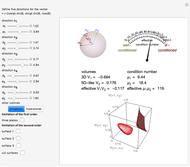
A particle with spin  can represent a qutrit. Any qutrit state can be associated with a 15-dimensional probability vector
  whose components
  have definite physical meaning. The discrete variable
  is the spin projection and
  defines a direction of spin projection measurement,
  . The ends of the vectors lie on the unit sphere
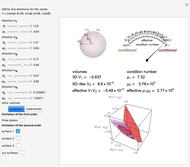
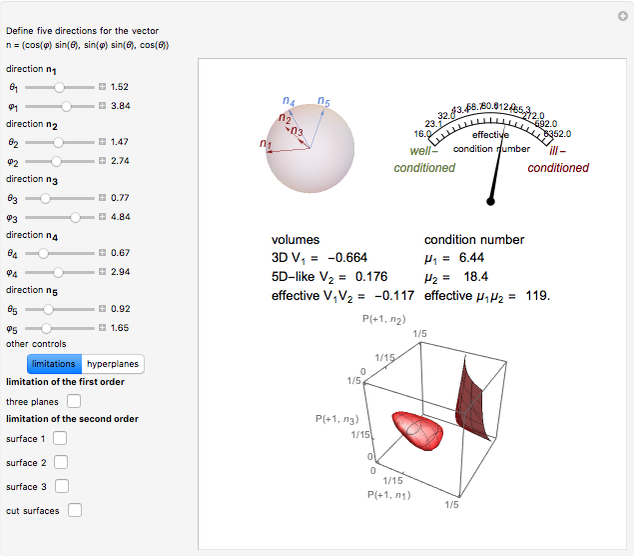
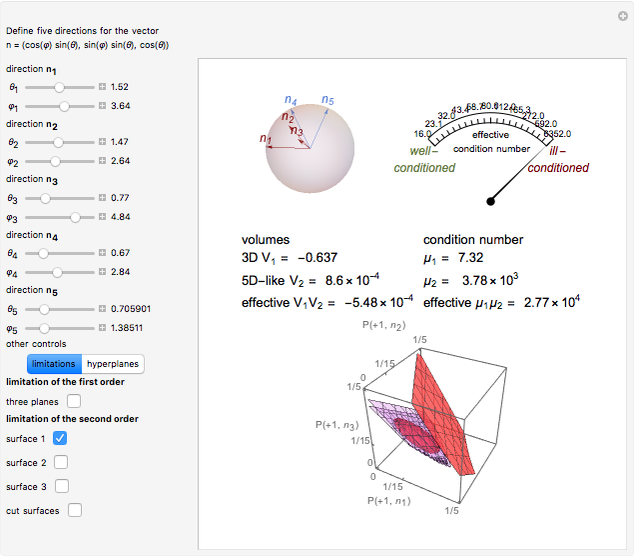
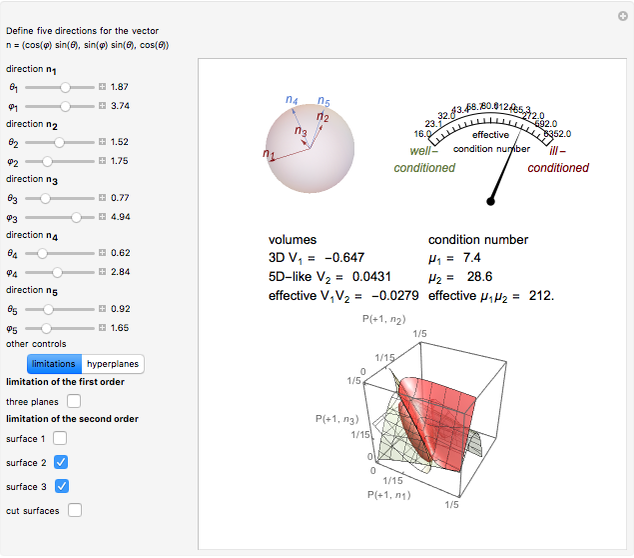
  , which is illustrated in the top-left corner. In general,
  is a probability distribution function of two discrete variables
  and
and  , and determines a point on the 14-simplex. If the directions are chosen with equal probability, then
  for all
  . In that case, the vectors can be labeled by 10 real non-negative numbers
  , . To illustrate such a probability vector we fix seven components, namely
  ,
,  , and
, and  , , that is, we determine a hyperplane that intersects the simplex, with the cut set depending on three real non-negative parameters
  ,
,  , and
, and  . The cut set is nothing else but a cube
  ,
,  . In other words, any qutrit state is associated with the probability vector of the form


Contributed by: Sergey Filippov and Vladimir I. Man'ko (February 2010)
Based on a program by: S. M. Blinder
Open content licensed under CC BY-NC-SA
Snapshots
Details
Representation of spin states by finite dimensional probability vectors is considered in
S. Filippov and V. Man'ko, "Inverse Spin-s Portrait and Representation of Qudit States by Single Probability Vectors," arXiv, 2010.
Permanent Citation
 Representation of Qubit States by Probability Vectors
Sergey Filippov and Vladimir I. Man'ko Swapping Qubit States
Brad Rubin CNOT and Toffoli Gates in Multi-Qubit Setting
Rudolf Muradian Simulated Quantum Computer Algorithm for Database Searching
S. M. Blinder Measuring Entangled Qubits
Brad Rubin Generating Entangled Qubits
Brad Rubin Heisenberg-Type Uncertainty Relation for Qubits
Johannes Biniok and Paul Busch Quantum Circuit Implementing Grover's Search Algorithm
Alexander Prokopenya Grover's Quantum Search Algorithm
Tad Hogg Coexistence of Qubit Effects
Peter Stano, Daniel Reitzner, and Teiko Heinosaari