
Euler Angles


Requires a Wolfram Notebook System
Interact on desktop, mobile and cloud with the free Wolfram Player or other Wolfram Language products.
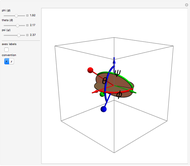
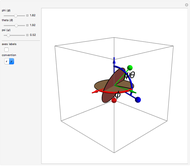
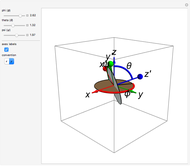
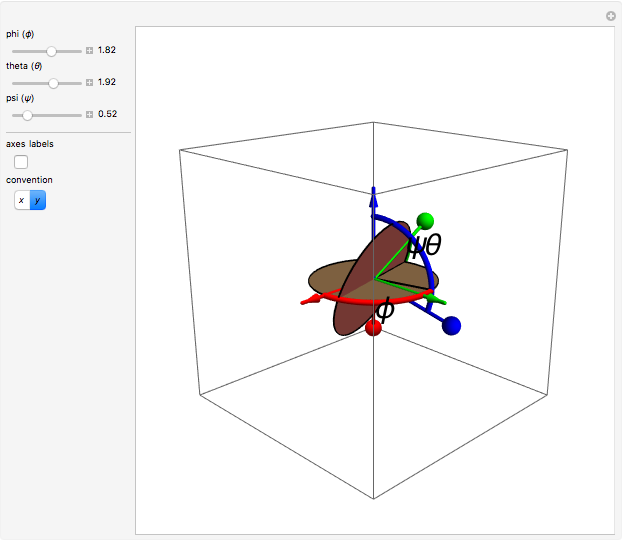
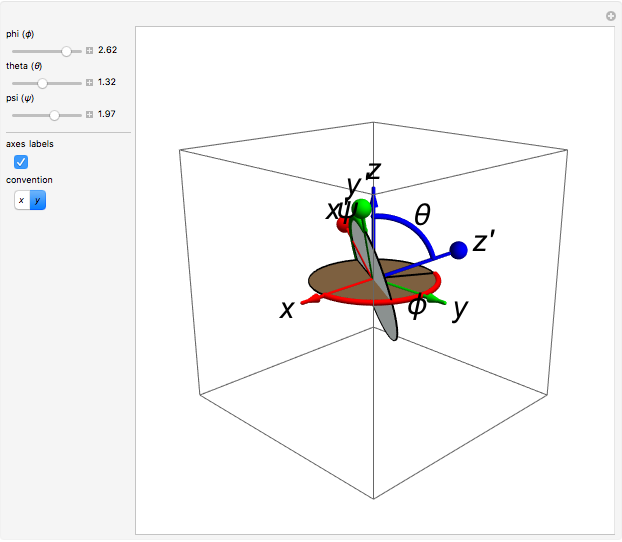
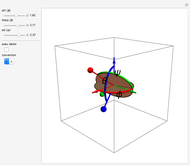
The Euler angles are a classical way to specify the orientation of an object in space with respect to a fixed set of coordinate axes. This Demonstration shows two of the several implementations of the Euler angles  . The initial
  axes are indicated by the red, green, and blue arrows, while the final
  axes are indicated by the red, green, and blue spheres.
Contributed by: Frederick W. Strauch (August 2011)
Open content licensed under CC BY-NC-SA
Snapshots

Details
The Euler angles are used to define a sequence of three rotations  , by the angles about the
  ,
,  , or
, or  , and
, and  axes, respectively. If the second rotation is about the axis, this is called the "
 convention". The net transformation is given by the matrix equation
 .
.
This convention is used by Thornton and Marion [1] in Chapter 11.
If the second rotation is about the axis, this is called the " convention". The net transformation is given by the matrix equation
 .
.
This convention is used by J. R. Taylor [2] in Chapter 10.
Both conventions are described by H. Goldstein [3] in Chapter 4.
See also Euler angles.
References
[1] S. T. Thornton and J. B. Marion, Classical Dynamics of Particles and Systems, Belmont, CA: Brooks/Cole, 2004.
[2] J. R. Taylor, Classical Mechanics, Mill Valley, CA: University Science Books, 2005.
[3] H. Goldstein, Classical Mechanics, Reading, MA: Addison-Wesley, 1980.
Permanent Citation
 Euler Angles: Precession, Nutation, and Spin
Kevin Hernandez Euler's Rotation Theorem
Tom Verhoeff (Eindhoven University of Technology) Controlling Airplane Flight
Enrique Zeleny Angular Momentum of a Rotating Rigid Body
Frederick W. Strauch Rectangular Slice Twist
Michael Schreiber Rotating a Cube in Space
Karl Scherer Iterated Matrix Operations in 3D
Ed Pegg Jr Vector Rotations in 3D
Stephen Wilkerson (Towson University) Rotating a Lattice of Points
George Beck Understanding 3D Rotation
Roger Germundsson
-
 Free Precession of a Rotating Rigid Body
Frederick W. Strauch -
Angular Momentum of a Rotating Rigid Body
Frederick W. Strauch -
 Angular Momentum of a Rotating Particle
Frederick W. Strauch -
 Understanding Special Relativity: The Lorentz Transformation, Time Dilation, and Length Contraction
Frederick W. Strauch -
 Euler Angles
Frederick W. Strauch