Fermat's Theorem on Stationary Points


Requires a Wolfram Notebook System
Interact on desktop, mobile and cloud with the free Wolfram Player or other Wolfram Language products.
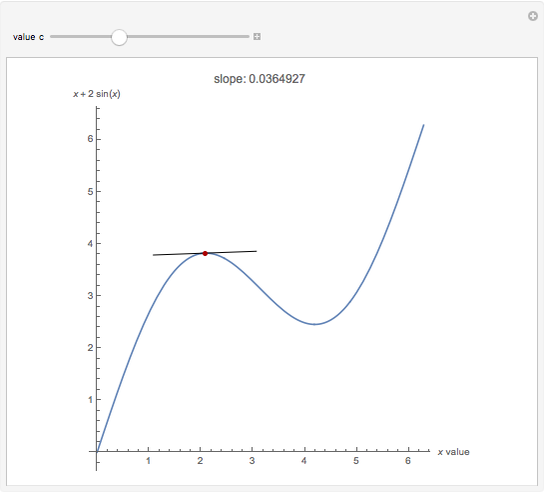
Fermat's theorem on stationary points states that if  is a local extremum in the interval
  and
and  is differentiable at
  , then
  .
.
Contributed by: Julio Cesar de la Yncera (March 2011)
Open content licensed under CC BY-NC-SA
Snapshots

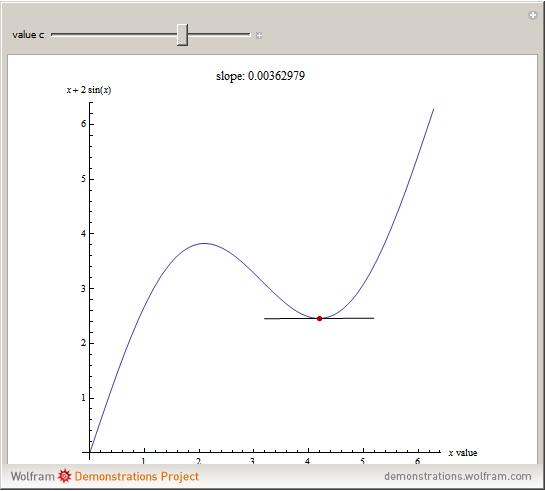
Details
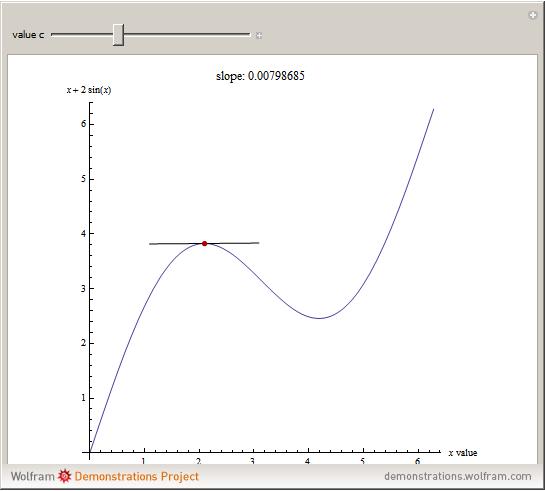
Snapshot 1: a local maximum; notice the slope is zero
Snapshot 2: a local minimum; the slope is also zero here; also notice the change of sign from positive to negative for the maximum and from negative slope to positive slope for the minimum
Permanent Citation
"Fermat's Theorem on Stationary Points"
http://demonstrations.wolfram.com/FermatsTheoremOnStationaryPoints/
Wolfram Demonstrations Project
Published: March 7 2011
 Cauchy Mean-Value Theorem
Soledad Mª Sáez Martínez and Félix Martínez de la Rosa Bolzano's Theorem
Julio Cesar de la Yncera Flett's Theorem
Soledad Mª Sáez Martínez and Félix Martínez de la Rosa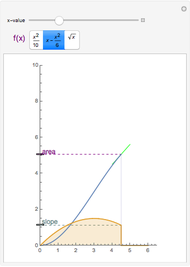 The Fundamental Theorem of Calculus
Chris Boucher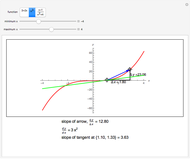 Slope between Two Points on a Curve
Trevor Cole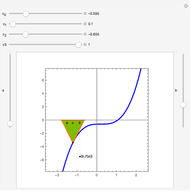 A Generalization of the Mean Value Theorem
Soledad Mª Sáez Martínez and Félix Martínez de la Rosa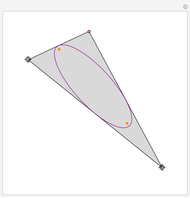 Marden's Theorem
Bruce Torrence Lucas-Gauss Theorem
Bruce Torrence Two Integral Mean Value Theorems
Soledad María Sáez Martínez and Félix Martínez de la Rosa Two Integral Mean Value Theorems of Flett Type
Soledad María Sáez Martínez and Félix Martínez de la Rosa