A Triangle Model of Criminality

Requires a Wolfram Notebook System
Interact on desktop, mobile and cloud with the free Wolfram Player or other Wolfram Language products.
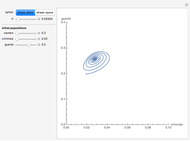
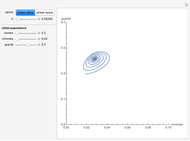
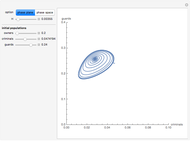
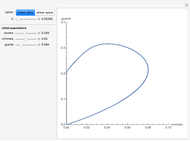
Consider a society divided into three classes: owners, criminals, and guards, in which two predators (criminals and security guards) compete for the same prey (owners). By tuning the efficiency  of the security guards, the behavior of this society varies, crossing several bifurcation points. Orbits can be drawn for different initial values of the population.
Contributed by: Silvia Pierazzini and Juan C. Nuño (March 2011)
After work by: Juan C. Nuño, Miguel A. Herrero, and Mario Primicerio
Open content licensed under CC BY-NC-SA
Snapshots
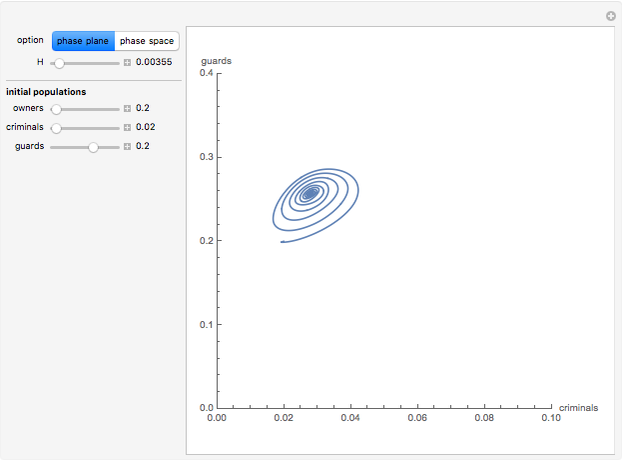
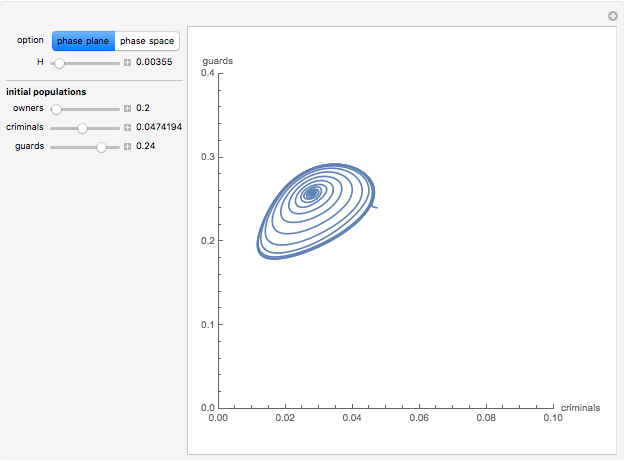
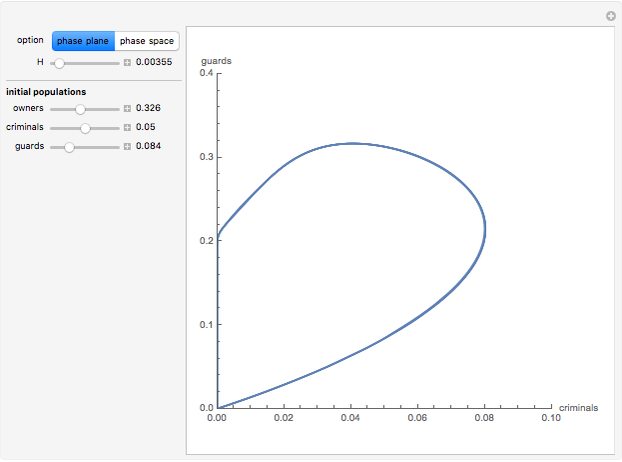
Details
Let the populations of the owners, criminals, and guards be  ,
,  , and
, and  .
.
Consider a society in which the criminal rate is  , where ξ is a proportionality constant, and the rate of arrests by guards is
The equations that describe the model are:
 .
.
In the absence of criminals and guards, the population of owners obeys a logistic-type dynamic (with maximum capacity 1). The presence of criminals hinders the growth of and the existence of security forces represents a cost for the owners.
 .
.
The criminal population increases at the rate and it decreases because of the predatory action of guards, the retirement of criminals, and the interspecific competition of criminals (the quadratic last term).
 .
.
The growth of the security forces is proportional to the crimes committed and decreases as a consequence of the casualties suffered in encounters with criminals and of natural decay.
For more details, see J. C. Nuño, M. A. Herrero, and M. Primicerio, "A Triangle Model of Criminality," Physica A, 387(12), 2008 pp. 2926–2936.
Permanent Citation
 Gavrilov-Shilnikov Model
Enrique Zeleny Logistic Model for Population Growth
Abby Brown Lorenz's Model of Global Atmospheric Circulation
Enrique Zeleny Chaos Induced by Delay in Model of the Immune Response
Clay Gruesbeck Chaotic Dynamics of a Bouncing Ball in a Sinusoidal Channel
Enrique Zeleny Phase Space of an Intermittently Driven Oscillator
Manu P. John and V. M. Nandakumaran Romeo and Juliet
Michael Trott A Third-Order Differential Equation with Chaotic Solutions
Clay Gruesbeck Some Partial Differential Equations with Chaotic Solutions
Enrique Zeleny Solution and Stability of a 1-Periodic Differential Equation
Brian G. Higgins and Housam Binous