
Approximating the Logarithm of Any Base with Continued Fractions


Requires a Wolfram Notebook System
Interact on desktop, mobile and cloud with the free Wolfram Player or other Wolfram Language products.
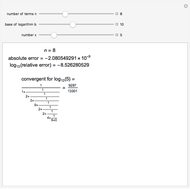
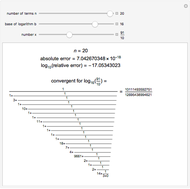
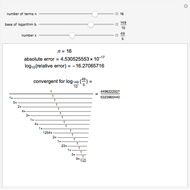
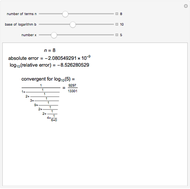
Continued fractions provide a very effective toolset for approximating functions. Usually the continued fraction expansion of a function approximates the function better than its Taylor or Fourier series. This Demonstration shows the high quality of a continued fraction expansion to approximate the logarithm to an arbitrary real base greater than 1. It uses the Shanks method and is very efficient due to its adaptability for high-speed numerical computer code.
[more]


Contributed by: Andreas Lauschke (March 2011)
Open content licensed under CC BY-NC-SA
Snapshots


Details
To compute the approximation of the logarithm  , two sequences of numbers
  and
and  are computed as follows:
 ,
,

 ,
,
...
 .
.
Then
 .
.
Permanent Citation
 Natural Logarithm Approximated by Continued Fractions
Andreas Lauschke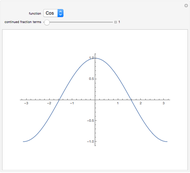 Continued Fraction Approximations
Michael Trott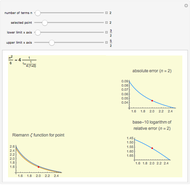 Approximating the Riemann Zeta Function with Continued Fractions
Andreas Lauschke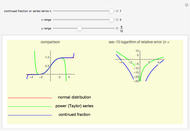 Normal Distribution with Continued Fractions
Andreas Lauschke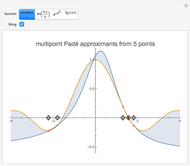 Multipoint Padé Approximants
Blazej Radzimirski Padé Approximants
Oleksandr Pavlyk Polynomial Approximation of the Exponential Function
Hein Hundal Euler's Method for the Exponential Function
Arnaud Crouzet The Prime Number Theorem
Stephen Wolfram Accuracy of Series Approximations
Fred E. Moolekamp III and Kevin L. Stokes
-
 Repeating Continued Fractions
Andreas Lauschke -
 Boole Differential Equation with Continued Fractions
Andreas Lauschke -
 Practicing Aircraft Holding Pattern Entries
Andreas Lauschke -
 Analysis of Minimum Credit Card Payments
Andreas Lauschke -
 Incomplete Gamma Function with Continued Fractions
Andreas Lauschke -
Natural Logarithm Approximated by Continued Fractions
Andreas Lauschke -
 Approximating Pi with Continued Fractions
Andreas Lauschke -
Normal Distribution with Continued Fractions
Andreas Lauschke -
 Riccati Differential Equation with Continued Fractions
Andreas Lauschke -
 Approximating the Logarithm of Any Base with Continued Fractions
Andreas Lauschke -
Approximating the Riemann Zeta Function with Continued Fractions
Andreas Lauschke -
 Affine-Scaling Interior Point Method
Andreas Lauschke