
Repeating Continued Fractions


Requires a Wolfram Notebook System
Interact on desktop, mobile and cloud with the free Wolfram Player or other Wolfram Language products.
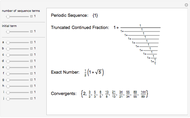
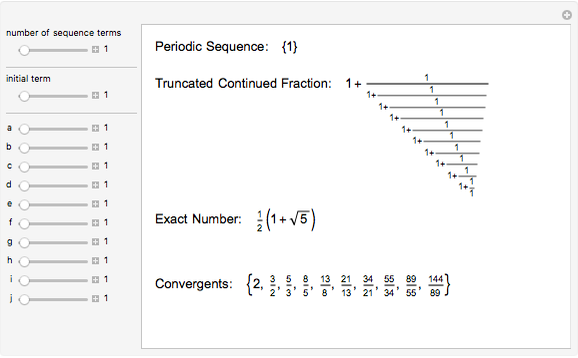
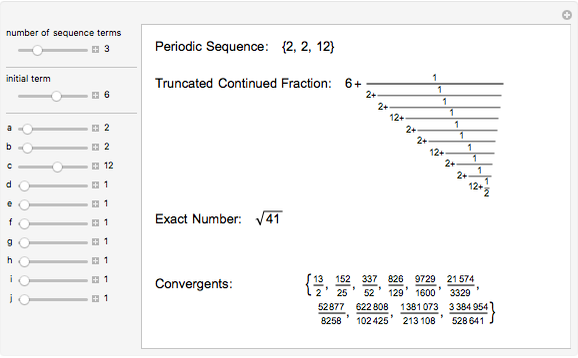
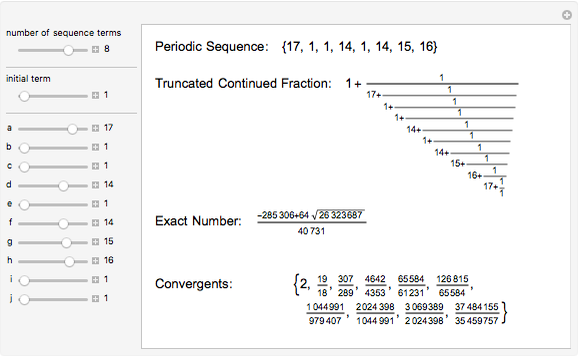
The continued fraction expansion of a quadratic irrational is eventually periodic; the converse is also true.
[more]
Contributed by: Ed Pegg Jr (December 2008)
Additional contributions by: Andreas Lauschke
Open content licensed under CC BY-NC-SA
Snapshots
Details
The continued fraction expansions of the square roots of the integers that are not perfect squares possess the so-called "palindromic property". That means that their periodic element sequences without the last element are palindromic (i. e., can be reversed), and the last element is twice the initial term. For example, the continued fraction expansion of  is {5, {1, 1, 3, 5, 3, 1, 1, 10}}. The sequence 1, 1, 3, 5, 3, 1, 1 is palindromic, and the 10 is two times the initial 5.
The following shows this for the first 200 integers:
DeleteCases[ContinuedFraction@Sqrt@Range@200, {_}]
For more, see A Tail of Two Palindromes.
Permanent Citation
 Continued Fractions
Stephen Wolfram Instantly Periodic General Continued Fraction Representations of Square Roots
Michael Morrison Graphing Continued Fractions of Quadratic Irrationals
George Beck Recurrence Table Attractors
Ed Pegg Jr Normal Distribution with Continued Fractions
Andreas Lauschke Discrete Number Theory Plots
Ed Pegg Jr Resizable Number Theory Tables
Ed Pegg Jr Fitting Primes to a Linear Model
Darren Glosemeyer Natural Logarithm Approximated by Continued Fractions
Andreas Lauschke Approximating the Logarithm of Any Base with Continued Fractions
Andreas Lauschke
-
 Right Pyramid Volume and Surface Area
Ed Pegg Jr -
 Right Cone Volume and Area
Ed Pegg Jr -
 Hemisphere Volume and Surface Area
Ed Pegg Jr -
 Cylinder Volume and Area
Ed Pegg Jr -
 Regular Prism Volume and Surface Area
Ed Pegg Jr -
 Box Volume and Surface Area
Ed Pegg Jr -
 Orthopolar Lines for a Quadrilateral
Ed Pegg Jr -
 The Nine 10_3 Configurations
Ed Pegg Jr -
 Bed of Nails
Ed Pegg Jr -
 Box Toppling Patterns
Ed Pegg Jr -
 Box Packing
Ed Pegg Jr -
 Sphere Volume and Area
Ed Pegg Jr -
 2D CA Glider Database
Ed Pegg Jr -
 Constructing and Manipulating Graphs
Ed Pegg Jr -
 Acute Sets in Euclidean Spaces
Ed Pegg Jr -
 Moser Spindles, Golomb Graphs and Root 33
Ed Pegg Jr -
 GL(3,n) Acting on 3D Points
Ed Pegg Jr -
 Sylvester's Four-Point Problem
Ed Pegg Jr -
 Three Points Determine a Plane
Ed Pegg Jr -
 Polyhedra Copied to the Vertices of the Same Kind of Polyhedron
Ed Pegg Jr