
Colliding Cars



Requires a Wolfram Notebook System
Interact on desktop, mobile and cloud with the free Wolfram Player or other Wolfram Language products.
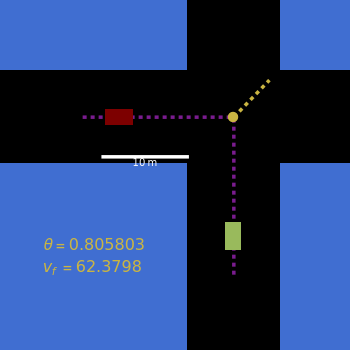
Two cars collide at an intersection as shown in the figure. They have masses  and
and  and velocities
  and
and  ;
;  is time. Assume that the collision is perfectly inelastic in two dimensions—the two objects stick together with a great deal of kinetic energy lost. The final velocity and the angle that the cars follow when they move off after the crash are calculated using the law of conservation of momentum.
Contributed by: Enrique Zeleny (March 2011)
Open content licensed under CC BY-NC-SA
Snapshots
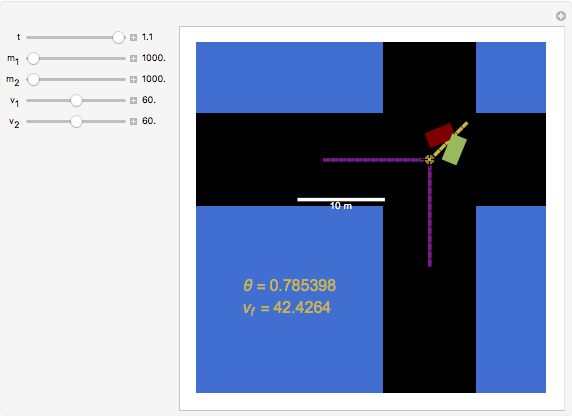
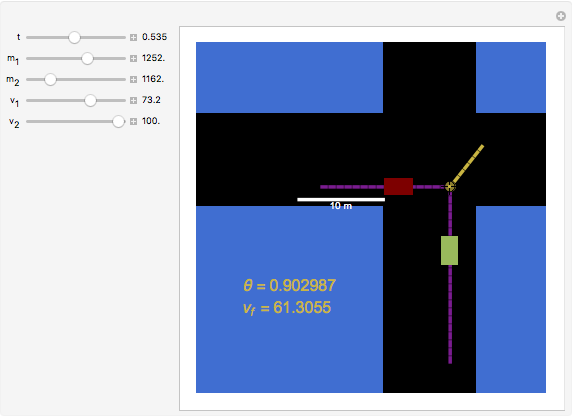
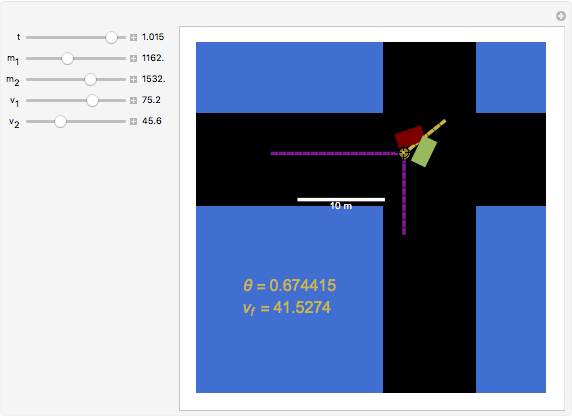
Details
The expressions for the angle and final velocity are

and
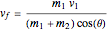 .
.
At 100 km/hr (equivalent to 27.8 m/s), a car traveling for 0.75 seconds moves almost 21 meters; the length of the car is taken as 3.3 m.
Further details that are important in real crashes, such as reaction time, braking, friction, center of mass, etc., are ignored in this Demonstration.
Permanent Citation
 Braking a Car
Enrique Zeleny Car on a Banked Road
Enrique Zeleny Frictional Force on a Car in a Turn
Enrique Zeleny Relative Motion of Two Cars
Enrique Zeleny Jumping over Row of Parked Cars
Enrique Zeleny Conservation of Momentum in a Canoe
Enrique Zeleny Deformation of a Tennis Ball and Racket Strings
Enrique Zeleny Physics of a Rear-End Collision
Enrique Zeleny Trajectory of a Bomb
Enrique Zeleny Uniform Circular Motion
Enrique Zeleny
-
 Sign of a Function
Enrique Zeleny -
 Length of the Perpendicular from a Point to a Straight Line
Enrique Zeleny -
 Van de Graaff Generator
Enrique Zeleny -
 Equilibrium of a Suspended Mobile
Enrique Zeleny -
 Rømer's Measurement of the Speed of Light
Enrique Zeleny -
 Charles's Law
Enrique Zeleny -
 Forces Acting on a Ladder
Enrique Zeleny -
 Density
Enrique Zeleny -
 Tumor Growth Model
Enrique Zeleny -
 Newton's Second Law
Enrique Zeleny -
 Weight of a Person Riding in an Elevator
Enrique Zeleny -
 Active Shock Absorbers
Enrique Zeleny -
 Bragg's Law
Enrique Zeleny -
 Projectile with Air Drag
Enrique Zeleny -
 Coulomb Wavefunctions
Enrique Zeleny -
 Jorge-Meeks K-Noids
Enrique Zeleny -
 Motion of a Parachuter
Enrique Zeleny -
 Asimov's Ladder of Physical Constants
Enrique Zeleny -
 Solutions of the Elliptic Membrane Problem
Enrique Zeleny -
 Lagrange Points
Enrique Zeleny