
Equatorial Telescope Mounts


Requires a Wolfram Notebook System
Interact on desktop, mobile and cloud with the free Wolfram Player or other Wolfram Language products.
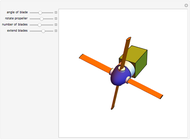
To keep an astronomical object within the field of view, telescopes need to be able to compensate for the Earth's rotation. Some telescopes use an equatorial mount, which allows the telescope to track an object along a parallel to the celestial equator. This kind of telescope mount is particularly useful for astrophotography.
[more]
Contributed by: Jeff Bryant (March 2011)
Open content licensed under CC BY-NC-SA
Snapshots


Details
As a result of the Earth's rotation, the right ascension coordinate drifts across the sky along a path parallel to the celestial equator. Once the telescope is adjusted to point at an object's sky coordinates (right ascension and declination), it is simply a matter of driving the right ascension axis with a motor to keep up with the object as it moves.
Permanent Citation
"Equatorial Telescope Mounts"
http://demonstrations.wolfram.com/EquatorialTelescopeMounts/
Wolfram Demonstrations Project
Published: March 7 2011
-
 Combining Two 3D Rotations
Jeff Bryant -
 Keplerian Orbital Elements
Jeff Bryant -
 Colored Lights
Jeff Bryant -
 Solar System Mandalas
Jeff Bryant -
 Three-Body Problem in 3D
Jeff Bryant -
 Stellar Nucleosynthesis
Jeff Bryant -
 Three World Systems for Earth-Sun-Mars Kinematics
Jeff Bryant -
 Continental Plate Configurations through Time
Jeff Bryant -
 Galactohedra
Jeff Bryant -
 Oloid
Oloid
Jeff Bryant -
 Fundamental Law of Fractions
Jeff Bryant -
 Blackbody Spectrum
Jeff Bryant -
 Great Circles on Mercator's Chart
Jeff Bryant -
 Broadcasting Satellite in a Geocentric Kepler Orbit
Jeff Bryant -
 Annual Sunspot Numbers
Jeff Bryant -
 Galactic Coordinate System
Jeff Bryant -
 Radius and Temperature of Main Sequence Stars
Jeff Bryant -
 Deltoidal Hexecontahedron
Jeff Bryant -
 Axial Tilts of Planets
Jeff Bryant -
 Pythagorean Theorem
Jeff Bryant