
Inelastic Collisions of Two Spheres


Requires a Wolfram Notebook System
Interact on desktop, mobile and cloud with the free Wolfram Player or other Wolfram Language products.
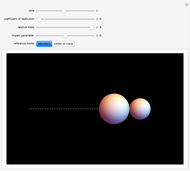
In an elastic collision, both momentum and kinetic energy are conserved. However, in an inelastic collision (where the coefficient of restitution is smaller than 1) only momentum is conserved.
Contributed by: Andrés Santos (August 2008)
Based on a program by: S. M. Blinder
Open content licensed under CC BY-NC-SA
Snapshots
Details
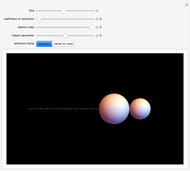
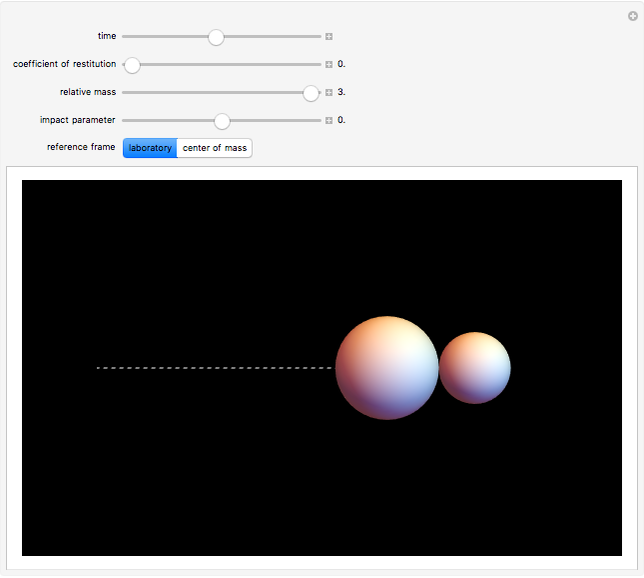
Snapshot 1: After a completely inelastic head-on collision both spheres move together.
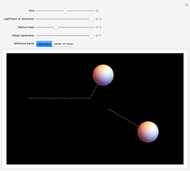
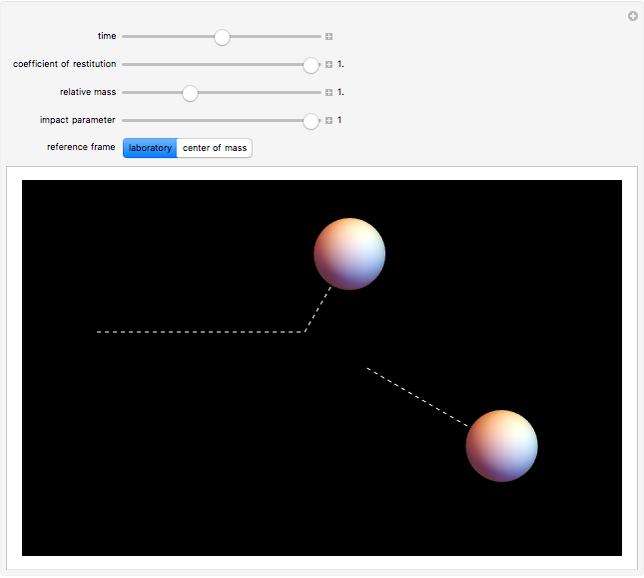
Snapshot 2: In an elastic collision, the trajectories of two identical spheres in any angular collision are exactly perpendicular.
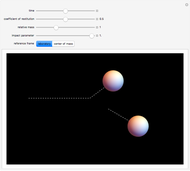
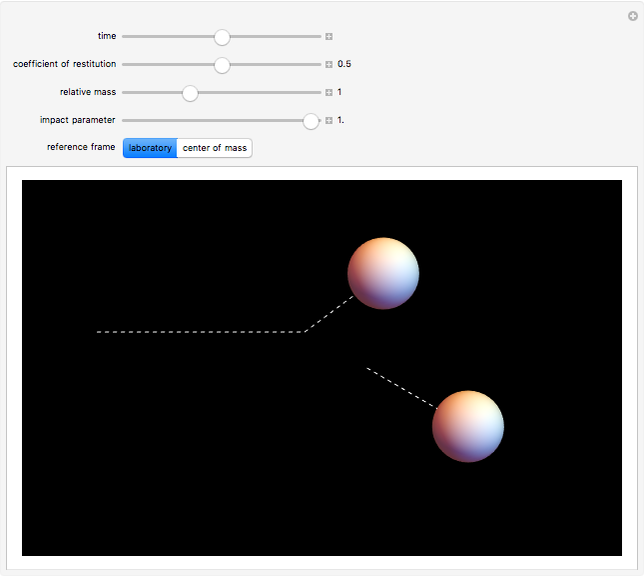
Snapshot 3: However, if the collision is inelastic the angle between the trajectories is smaller than 90°.
Snapshot 4: Here is the same collision as in snapshot 2, viewed in center-of mass frame.
Snapshot 5: The same collision as in snapshot 3, viewed in center-of mass frame.
Permanent Citation
"Inelastic Collisions of Two Spheres"
http://demonstrations.wolfram.com/InelasticCollisionsOfTwoSpheres/
Wolfram Demonstrations Project
Published: August 27 2008
 Elastic Collisions of Two Spheres
S. M. Blinder Inelastic Collisions of Two Rough Spheres
Andrés Santos Combining Quarks into Hadrons
S. M. Blinder Wave-Particle Duality in the Double-Slit Experiment
S. M. Blinder The Celestial Two-Body Problem
S. M. Blinder Free Rotation of a Rigid Body: Poinsot Constructions
S. M. Blinder Tipping Point of a Cylinder
S. M. Blinder Phenomenological Approximation to Newton's Cradle
S. M. Blinder Pendulum Waves
Stan Wagon (Macalester College) and S. M. Blinder Broadcasting Satellite in a Geocentric Kepler Orbit
Marty Scherr
-
 Radial Distribution Function for One-Dimensional Triangle Well and Ramp Fluids
Andrés Santos -
 Radial Distribution Function for Hard Spheres
Andrés Santos -
 Bound-State Solutions of the Schrödinger Equation by Numerical Integration
Andrés Santos -
 The Kac Ring Model
Andrés Santos -
 Radial Distribution Function for Sticky Hard Rods
Andrés Santos -
 Radial Distribution Functions for Nonadditive Hard-Rod Mixtures
Andrés Santos -
 Radial Distribution Function for One-Dimensional Square-Well and Square-Shoulder Fluids
Andrés Santos -
 Virial Coefficients for a Hard-Sphere Mixture
Andrés Santos -
Inelastic Collisions of Two Rough Spheres
Andrés Santos -
 Plots of Quantum Probability Density Functions in the Hydrogen Atom
Andrés Santos -
 Second Virial Coefficients for the Lennard-Jones (2n-n) Potential
Andrés Santos -
 Wave Packets for Particle in a Box
Andrés Santos -
 Classical Scattering with a Penetrable Square-Well Potential
Andrés Santos -
 Wavepacket for a Free Particle
Andrés Santos -
 Inelastic Collisions of Two Spheres
Andrés Santos