
Linear Congruential Sequences





Requires a Wolfram Notebook System
Interact on desktop, mobile and cloud with the free Wolfram Player or other Wolfram Language products.
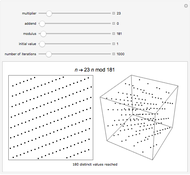
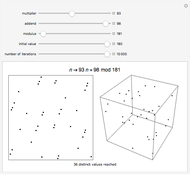
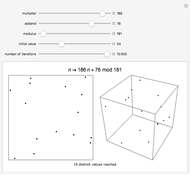
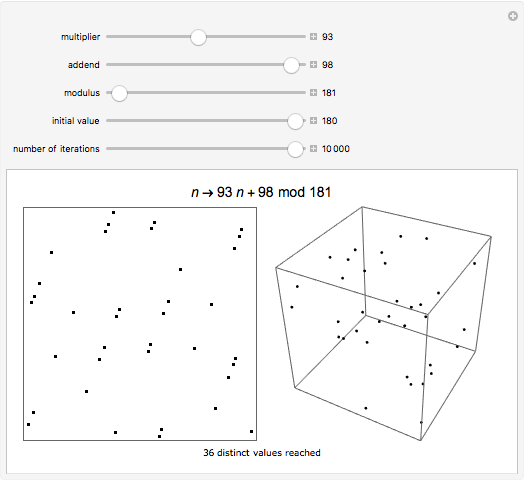
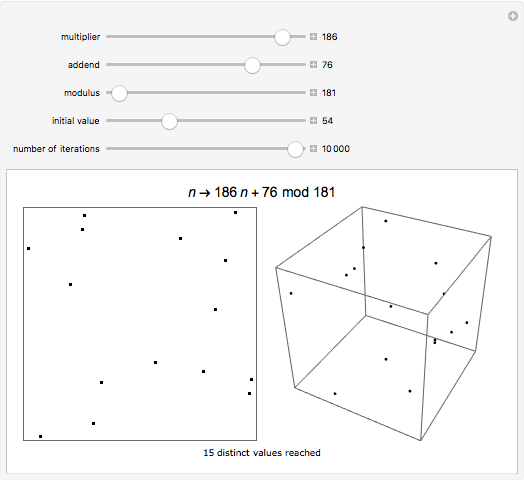
Linear congruential sequences are often used to make pseudorandom numbers. Try to pick moduli where the points lie as randomly as possible. Increasing the number of iterations often does not in fact increase the number of distinct points.
Contributed by: Stephen Wolfram (March 2011)
Open content licensed under CC BY-NC-SA
Snapshots

Details
Each sequence starts with the number 1, then successively multiplies it by the specified multiplier, keeping only the rightmost 31 digits in the base 2 representation of the number obtained at each step. Multiplier 65539 was used as the random number generator on many computer systems, starting with mainframes in the 1960s. If the output from the generator were perfectly random, then in each case these points would be uniformly distributed. But, as the pictures demonstrate, stripes are visible in either two or three dimensions, or both.
Permanent Citation
 String Matching Automaton
Michael Schreiber State Sequences in the Wolfram 2,3 Turing Machine
Jesse Nochella State Emphasis for 2,3 Turing Machine 596440
Michael Schreiber Balanced Annihilation
Michael Schreiber Small Turing Machines with Halting State: Enumeration and Running on a Blank Tape
Fernando Soler-Toscano, Hector Zenil, Jean-Paul Delahaye, and Nicolas Gauvrit Decomposition of 2,3 Turing Machine Evolutions
Michael Schreiber Tree Form of Recursive Function Evaluation Steps
Enrique Zeleny Bitwise Operations Mod n
Enrique Zeleny 2,2 Turing Machines
Stephen Wolfram Rule Case Transition Diagrams for the Wolfram 2,3 Turing Machine
Stephen Wolfram and Jesse Nochella
-
 Graphs of Random Permutations
Stephen Wolfram -
 Cellular Automaton Fonts
Stephen Wolfram -
 Convergence of Minimization Methods
Stephen Wolfram -
 Diagonals of Polyhedra
Stephen Wolfram -
 Platonic Solids
Stephen Wolfram -
 Penrose Tiles
Stephen Wolfram -
 Planar Three-Body Problem in Phase Space
Stephen Wolfram -
 Local Regression for Country Data
Stephen Wolfram -
 Balloon Dog
Stephen Wolfram -
 Fractions
Stephen Wolfram -
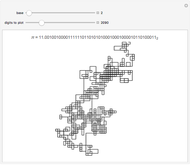 Random Walk Generated by the Digits of Pi
Stephen Wolfram -
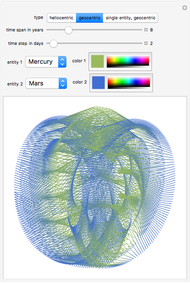 Solar System Mandalas
Stephen Wolfram -
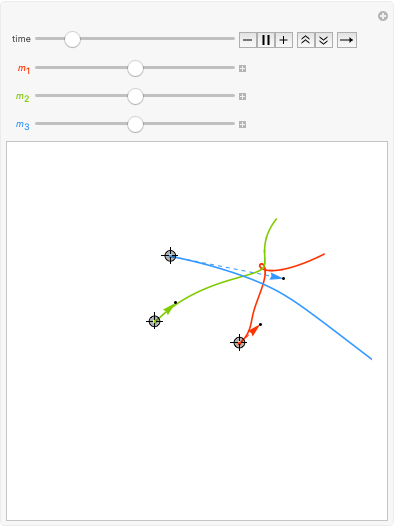 Planar Three-Body Problem
Stephen Wolfram -
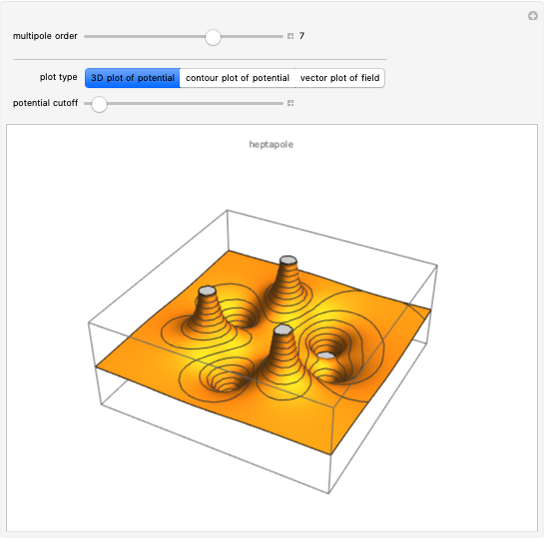 Multipole Fields
Stephen Wolfram -
 k-Cayley Trees
Stephen Wolfram -
 Iterating the Collatz Map on Real and Complex Numbers
Stephen Wolfram -
 Binary Coding Functions for Generalized Logistic Maps with z-Unimodality
Stephen Wolfram -
 Factoring Time
Stephen Wolfram -
 Smoothly Interpolating a Set of Data
Stephen Wolfram -
 Binding Energies of Isotopes
Stephen Wolfram