
Olympic Pole Vaulting



Requires a Wolfram Notebook System
Interact on desktop, mobile and cloud with the free Wolfram Player or other Wolfram Language products.
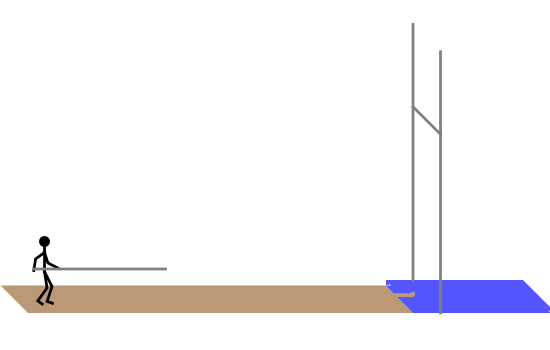
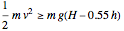
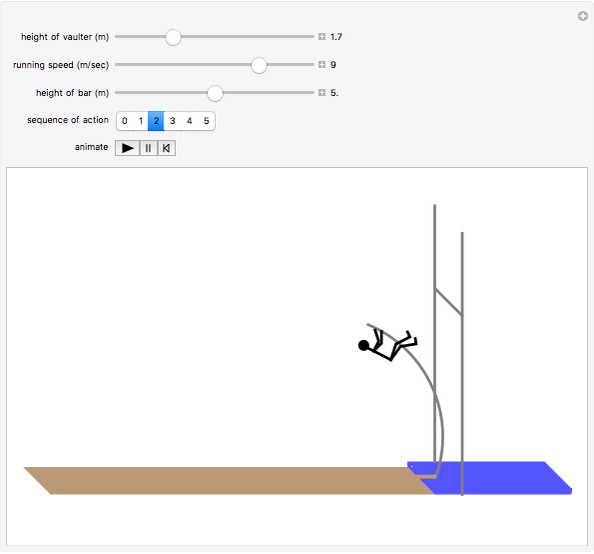
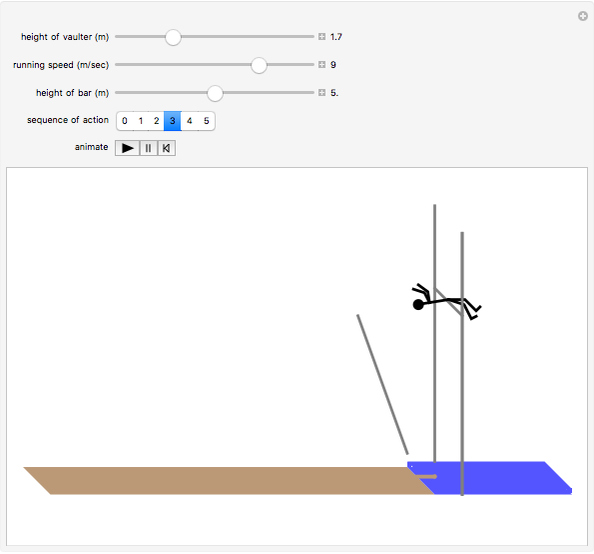
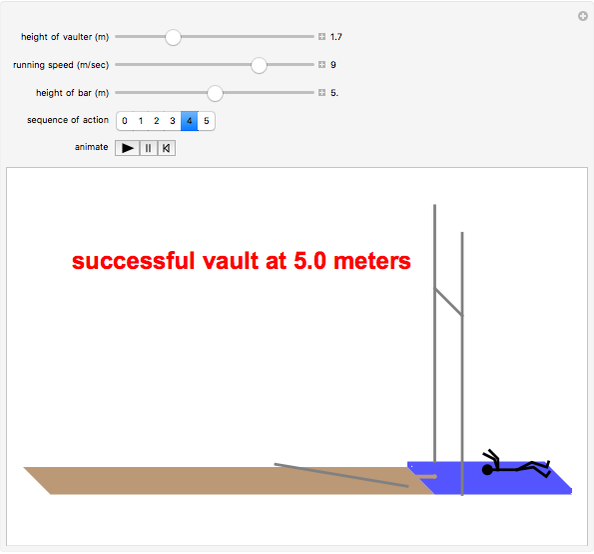
The pole vault is an Olympic event that demands a very high level of athletic ability. Nevertheless, it illustrates very simply the law of conservation of energy. The vaulter tries to achieve maximum kinetic energy by sprinting down the runway. At the end of the approach, the flexible fiberglass pole is planted in the box at the base of the pit. The kinetic energy gained in the sprint is converted into potential energy stored by elastic deformation of the pole. This, in turn, is converted into gravitational potential energy as the vaulter attempts to clear the crossbar.
[more]




Contributed by: S. M. Blinder (June 2008)
Open content licensed under CC BY-NC-SA
Snapshots
Permanent Citation
"Olympic Pole Vaulting"
http://demonstrations.wolfram.com/OlympicPoleVaulting/
Wolfram Demonstrations Project
Published: June 26 2008
 Gravitational Slingshot Effect
S. M. Blinder The Runge-Lenz Vector
S. M. Blinder Block and Tackle
S. M. Blinder Tipping Point of a Cylinder
S. M. Blinder Principle of the Lever
S. M. Blinder Pendulum Waves
Stan Wagon (Macalester College) and S. M. Blinder The Celestial Two-Body Problem
S. M. Blinder Phenomenological Approximation to Newton's Cradle
S. M. Blinder Conservation of Energy with a Simple Pendulum
S. E. McCaslin Free Response in a Second-Order System
Nasser M. Abbasi
-
 Ice Cube Melting in Water
S. M. Blinder -
 Absorption Spectroscopy
S. M. Blinder -
 Height of Object from Angle of Elevation Using Tangent
S. M. Blinder -
 Internal Rotation in Ethane and Substituted Analogs
S. M. Blinder -
 Topological Spaces on Three Points
S. M. Blinder -
 Hydrogen Atom in Curved Space
S. M. Blinder -
 Multipurpose Tool
S. M. Blinder -
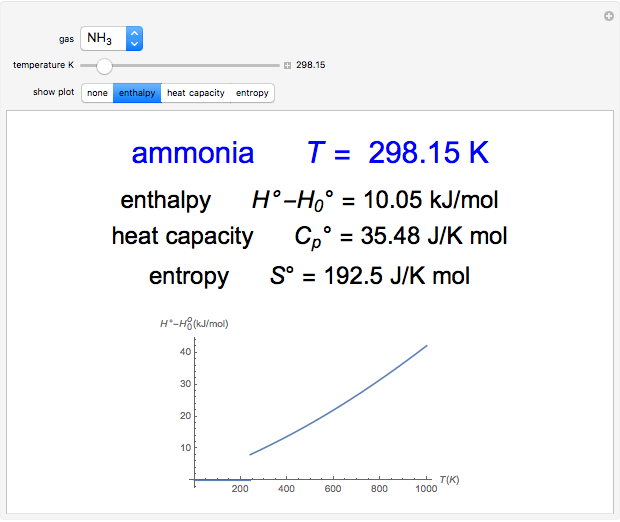 Statistical Thermodynamics of Ideal Gases
S. M. Blinder -
 Bell's Theorem
S. M. Blinder -
 Kepler's Mysterium Cosmographicum
S. M. Blinder -
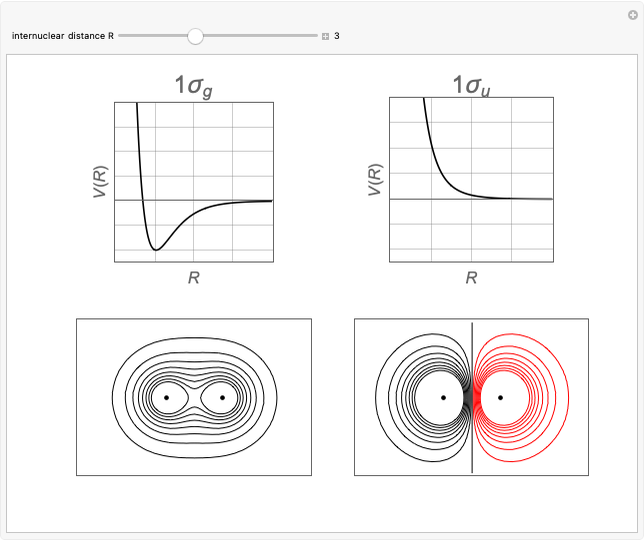 Bonding and Antibonding Molecular Orbitals
S. M. Blinder -
 Visible and Invisible Intersections in the Cartesian Plane
S. M. Blinder -
 Heron's Formula
S. M. Blinder -
 How Zippers Work
S. M. Blinder -
 Mittag-Leffler Expansions of Meromorphic Functions
S. M. Blinder -
 Orbital Resonance in the Asteroid Belt
S. M. Blinder -
 Jordan's Lemma Applied to the Evaluation of Some Infinite Integrals
S. M. Blinder -
 Configuration Interaction for the Helium Isoelectronic Series
S. M. Blinder -
 Structure and Bonding of Second-Row Hydrides
S. M. Blinder -
 DNA Base Pairing
S. M. Blinder