
Series Solution of a Cauchy-Euler Equation


Requires a Wolfram Notebook System
Interact on desktop, mobile and cloud with the free Wolfram Player or other Wolfram Language products.
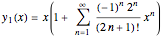
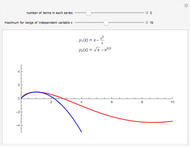
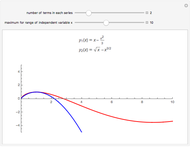
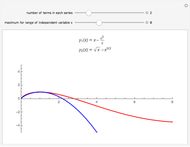
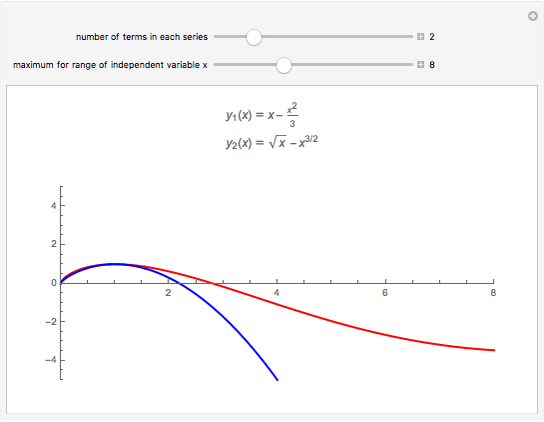
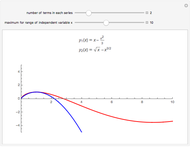
This Demonstration shows the solution to the Cauchy–Euler equation  with initial conditions
  and
and  and approximations to it using truncated series.





Contributed by: Stephen Wilkerson (December 2010)
(United States Military Academy West Point, Department of Mathematics)
Open content licensed under CC BY-NC-SA
Snapshots


Details
This example comes from Chapter 8 of [1] on series solutions and the Cauchy–Euler equation.
Reference
[1] J. R. Brannan and W. E. Boyce, Differential Equations with Boundary Value Problems: An Introduction to Modern Methods and Applications, New York: John Wiley and Sons, 2010.
Permanent Citation
 Fourier Series for Three Periodic Functions
Stephen Wilkerson Boundary Value Problem Using Series of Bessel Functions
Stephen Wilkerson Heat Transfer along a Rod
Stephen Wilkerson Gibbs Phenomenon in Laplace's Equation for Heat Transfer
Stephen Wilkerson Cauchy's Problem
Pablo Alberca Bjerregaard (University of Malaga, Spain) Euler Transformation
Eliot Ball Euler's Identity
Jim Kaiser Finite Element Solution of 1D Poisson Equation with Galerkin Spectral Decomposition
Jessica Alfonsi (University of Padova, Italy) Visualizing Euler's Constant
Soledad Mª Sáez Martínez and Félix Martínez de la Rosa Geometric Series
Michael Schreiber
-
 Solar Energy Incident on Earth's Surface
Stephen Wilkerson -
 Series Solution of a Cauchy-Euler Equation
Stephen Wilkerson -
 Volumes of Revolution Using Cylindrical Shells
Stephen Wilkerson -
 Dynamics of Coupled Pendulums
Stephen Wilkerson -
 Torricelli's Law for Tank Draining
Stephen Wilkerson -
 Area between Curves
Stephen Wilkerson -
 Direction Fields for Differential Equations
Stephen Wilkerson -
 Fundamental Theorem of Calculus
Stephen Wilkerson -
Heat Transfer along a Rod
Stephen Wilkerson -
 Phase Portraits, Eigenvectors, and Eigenvalues
Stephen Wilkerson -
 Predator-Prey Model
Stephen Wilkerson -
 An Oscillating Pendulum
Stephen Wilkerson -
 Homogeneous Linear System of Coupled Differential Equations
Stephen Wilkerson -
 Using an Integrating Factor to Solve a Separable Equation
Stephen Wilkerson -
Gibbs Phenomenon in Laplace's Equation for Heat Transfer
Stephen Wilkerson -
Boundary Value Problem Using Series of Bessel Functions
Stephen Wilkerson -
 Mass Oscillating between a Spring and a Damper
Stephen Wilkerson -
 Using Eigenvalues to Solve a First-Order System of Two Coupled Differential Equations
Stephen Wilkerson -
 Two Masses with Forcing Functions Oscillating between Three Springs
Stephen Wilkerson -
 Differential Equation with a Discontinuous Forcing Function
Stephen Wilkerson