
Shell Space: The 'Snugness' Condition


Requires a Wolfram Notebook System
Interact on desktop, mobile and cloud with the free Wolfram Player or other Wolfram Language products.
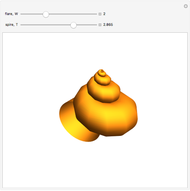
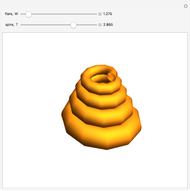
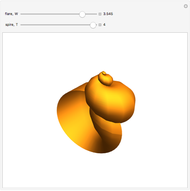
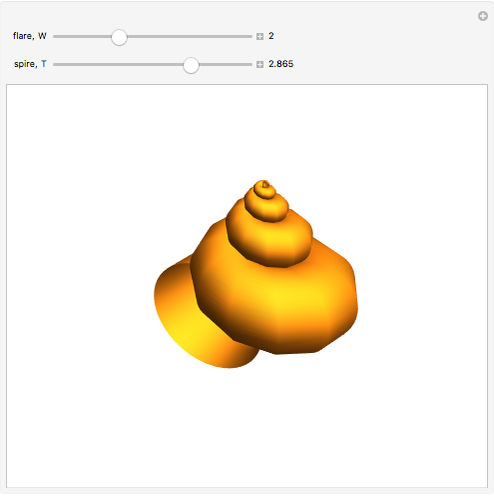
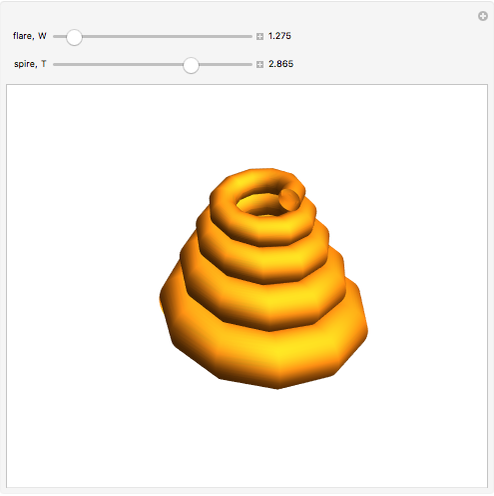
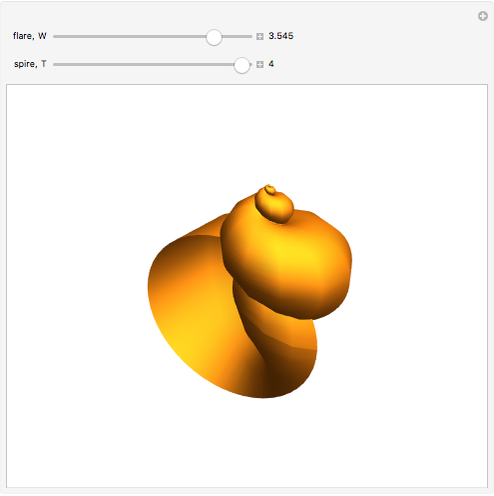
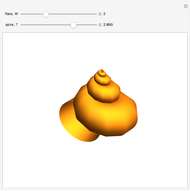
David Raup (among others, including Stephen Wolfram) proposes that all naturally occurring shells conform to the same basic design, varying only in a limited number of quantifiable ways. In Raup's simple model, you can specify a shell by setting the flare,  (the rate of growth of the spiral), the verm,
  (the "tightness" of the shell cavity), and the spire,
  (the rate of creep parallel to the spiral axis). If we insist that shells are snug (that is, the shell cavity is just loose enough so that each wind touches the previous and the next exactly), then the space of shells can be parametrized by flare and spire alone.
Contributed by: Phil Ramsden (March 2011)
Open content licensed under CC BY-NC-SA
Snapshots
Details
This simplified model of "shell space" was later adopted by Richard Dawkins, who coined the terms "flare," "verm," and "spire" for the parameters  ,
,  and
and  , respectively, as an illustration of the notion of "design space" in the book Climbing Mount Improbable.
Here are precise definitions of the parameters.
1. If
, respectively, as an illustration of the notion of "design space" in the book Climbing Mount Improbable.
Here are precise definitions of the parameters.
1. If  is the distance between a point
  on the generating spiral and that spiral's axis, and
  the distance from the corresponding point
  one turn later, then
  , which is strictly greater than 1.
2. If
, which is strictly greater than 1.
2. If  is the distance between the spiral axis and the inner edge of the shell cavity, and
  the distance between the spiral axis and the outer edge on the same turn, then
  , which is greater than or equal to 0 and strictly less than 1.
3. If the acute angle between the line
, which is greater than or equal to 0 and strictly less than 1.
3. If the acute angle between the line  and the horizontal is
  , then
  .
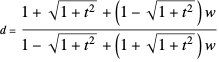
The "snugness" condition states that
.
The "snugness" condition states that
 .
.
Permanent Citation
 Shell Space: Flare, Verm, and Spire
Phil Ramsden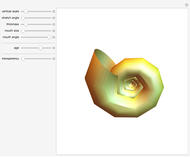 Model of Shell Growth
Stephen Wolfram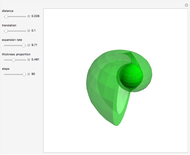 Shell Parameter Space
Jayna Resman, Michelle Winerip, Elizabeth Cowdery, and Allison Reed-Harris Phyllotaxis Spirals in 3D
Stephen Wolfram Diffusion-Limited Clogging
Michael Schreiber Snowflake-Like 3D Growth
Michael Schreiber Random Natural 3D tree
Cedric Voisin On the Fundamental Theorem of Phyllotaxis
Dmitry Weise Phyllotaxis Spirals
Stephen Wolfram Growth Model for the Blue-Green Alga Anabaena catenula
Enrique Zeleny
-
 The Joukowski Mapping: Airfoils from Circles
Phil Ramsden -
 Deciding Rain-Affected Cricket Matches: The Duckworth-Lewis Method
Phil Ramsden -
 The Great Brachistochrone Race
Phil Ramsden -
 Electric Field around a Charged Ring
Phil Ramsden -
 The Parabola's Evil Twin: Real and Nonreal Roots of a Real Quadratic
Phil Ramsden -
 Fixed Point of a 2x2 Linear System of ODEs
Phil Ramsden -
 Conic Sections: The Double Cone
Phil Ramsden -
 Discrete Logistic Equation
Phil Ramsden -
 Riemann Sums: A Simple Illustration
Phil Ramsden -
 Shell Space: The 'Snugness' Condition
Phil Ramsden -
Shell Space: Flare, Verm, and Spire
Phil Ramsden -
 Logistic Map: Onset of Chaos
Phil Ramsden -
 IFS: Rotation, Translation, and Scaling
Phil Ramsden -
 Cumulative Frequency Curves
Phil Ramsden