
Convolution Sum


Requires a Wolfram Notebook System
Interact on desktop, mobile and cloud with the free Wolfram Player or other Wolfram Language products.
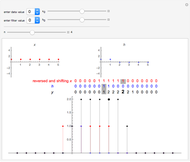
The  component of the convolution of
  and
and  is defined by
  . Note that
  is the sequence
  written in reverse order, and
  shifts this sequence
  units right for positive . Thus one can think of the component
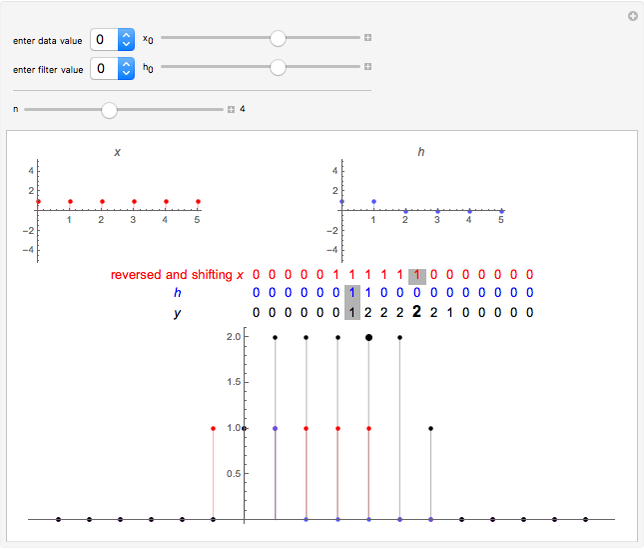
  as an inner product of and a shifted reversed . For purposes of illustration and can have at most six nonzero terms corresponding to
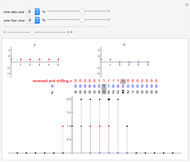
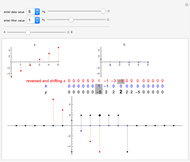
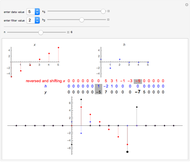
  . These terms are entered with the controls above the delimiter. In the table the gray-shaded cells mark the position
  . The bold number in the table and larger point on the plot indicate .
Contributed by: Bruce Atwood (Beloit College) (June 2009)
Suggested by: Patrick Van Fleet (University of St. Thomas)
Open content licensed under CC BY-NC-SA
Snapshots


Details
Convolution is a topic that appears in many areas of mathematics: algebra (finding the coefficients of the product of two polynomials), probability, Fourier analysis, differential equations, number theory, and so on. One important application is processing a signal by a filter. For more information see P. J. Van Fleet, Discrete Wavelet Transformations, Hoboken, New Jersey: John Wiley & Sons, Inc., 2008.
In signal processing the list is the data or input signal and the kernel is a filter or the response to a unit impulse for a linear time-invariant system. There are several examples in the bookmarks to look at and explore by modifying the terms of and . Students might want to think about and then experiment with this Demonstration to answer the following questions: (1) what scales by a constant? (2) what would cause  to be a delayed version of ? and (3) what interpretation would you give to convolving a signal with itself?
Except for padded zeros at the beginning and end of , this Demonstration replicates the output of the Mathematica command ListConvolve[h, x, {1, -1}, 0]. Additional interesting applications can be found in the Mathematica help for ListConvolve, at this link.
Permanent Citation
 Convolution with a Rectangular Pulse
Carsten Roppel Wavelet Shrinkage Denoising
Bruce Atwood (Beloit College) NMR Signal Processing Lab: Two Spins-1/2
Russ Bowers Reconstructing a Sampled Signal Using Interpolation
David Bremner and Bruce Atwood Trigonometric Fitting and Interpolation
Bruce Atwood and Rikley Buckingham Riemann Surfaces of Inverses of Sums of Two Trigonometric Functions
Michael Trott with permission of Springer Solving Hard Traveling Salesman Problems
Heikki Ruskeepää Discrete-Time Convolution
Carsten Roppel Equivalence of Linear and Circular Convolutions
Jelena Kovacevic Comparing Two Discrete Lowpass Filters with Low Distortion
Ted Ersek
-
Trigonometric Fitting and Interpolation
Bruce Atwood -
 Balancing a Can on Its Edge
Bruce Atwood -
 Spinning Out Sine and Cosine
Bruce Atwood -
 Forecasting with Exponential Moving Averages
Bruce Atwood -
 Convolution Sum
Bruce Atwood -
 Lunar Calendar Maker
Bruce Atwood -
 Center of Mass of a Polygon
Bruce Atwood -
 Projection into Spaces Generated by Haar and Daubechies Scaling Functions
Bruce Atwood -
 Adaptive Monte Carlo Integration
Bruce Atwood -
 The Polar Planimeter
Bruce Atwood -
Reconstructing a Sampled Signal Using Interpolation
Bruce Atwood -
 Bootstrap Percentile Confidence Intervals
Bruce Atwood -
 Power Curve of a Mean Test
Bruce Atwood -
 Approximating Continuous Functions with Haar Approximations
Bruce Atwood -
 Sliding to the Fermat Point
Bruce Atwood -
Wavelet Shrinkage Denoising
Bruce Atwood -
 Filling a Container Defined by a Curve
Bruce Atwood -
 Squeeze Theorem
Bruce Atwood -
 Signed Area of a Polygon
Bruce Atwood -
 Bézier Curve by de Casteljau's Algorithm
Bruce Atwood