
Modeling Light Curves



Requires a Wolfram Notebook System
Interact on desktop, mobile and cloud with the free Wolfram Player or other Wolfram Language products.
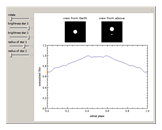
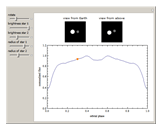
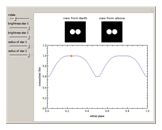
Many objects in astronomy are too far away to resolve with optical telescopes. Astronomers have to rely on other methods to learn about these objects. For objects that orbit each other in a plane nearly edge-on from Earth's viewpoint, the repeating eclipses that occur allow the construction of a light curve. The changes in slope and other features provide important details that are not otherwise observable.
Contributed by: Jeff Bryant (March 2011)
Open content licensed under CC BY-NC-SA
Snapshots
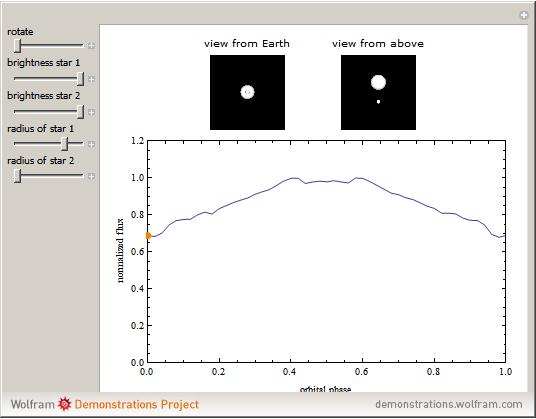
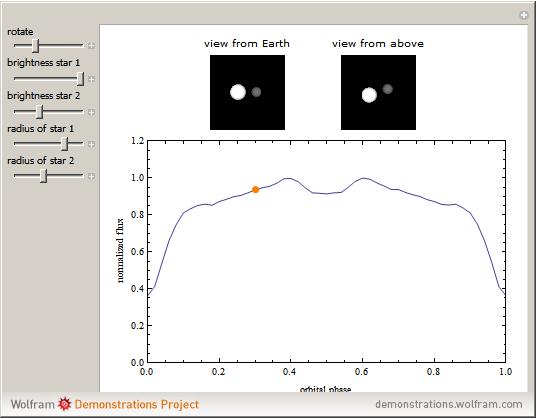
Details
When the more massive object is eclipsed, it is called the primary eclipse. Light curves are traditionally shown with the primary eclipse at orbital phase 0 and 1. The primary eclipse is usually the deeper eclipse, but not always. The relative depths of the eclipses can provide clues to the relative brightness of the objects. The rate of brightness change and the flatness of the eclipse minima can provide clues to the relative sizes of the objects.
Permanent Citation
"Modeling Light Curves"
http://demonstrations.wolfram.com/ModelingLightCurves/
Wolfram Demonstrations Project
Published: March 7 2011
 Microlensing Light Curve for Stellar Objects
Bryan Brzycki Dixon Model for Magnetic Field of a Neutron Star
Enrique Zeleny Mass Transfer in Binary Star Systems
Jeff Bryant Contact Binary Star Envelopes
Jeff Bryant Orbital Wobble
Jeff Bryant Stellar Luminosity
Jeff Bryant Blackbody Spectrum
Jeff Bryant Pulsars
Jeff Bryant Kepler's Second Law
Jeff Bryant Bending of Light by a Star
Chetiya Sahabandu
-
 Combining Two 3D Rotations
Jeff Bryant -
 Keplerian Orbital Elements
Jeff Bryant -
 Colored Lights
Jeff Bryant -
 Solar System Mandalas
Jeff Bryant -
 Three-Body Problem in 3D
Jeff Bryant -
 Stellar Nucleosynthesis
Jeff Bryant -
 Three World Systems for Earth-Sun-Mars Kinematics
Jeff Bryant -
 Continental Plate Configurations through Time
Jeff Bryant -
 Galactohedra
Jeff Bryant -
 Oloid
Oloid
Jeff Bryant -
 Fundamental Law of Fractions
Jeff Bryant -
Blackbody Spectrum
Jeff Bryant -
 Great Circles on Mercator's Chart
Jeff Bryant -
 Broadcasting Satellite in a Geocentric Kepler Orbit
Jeff Bryant -
 Annual Sunspot Numbers
Jeff Bryant -
 Galactic Coordinate System
Jeff Bryant -
 Radius and Temperature of Main Sequence Stars
Jeff Bryant -
 Deltoidal Hexecontahedron
Jeff Bryant -
 Axial Tilts of Planets
Jeff Bryant -
 Pythagorean Theorem
Jeff Bryant