
Diffusion to a Spherical Reactor



Requires a Wolfram Notebook System
Interact on desktop, mobile and cloud with the free Wolfram Player or other Wolfram Language products.
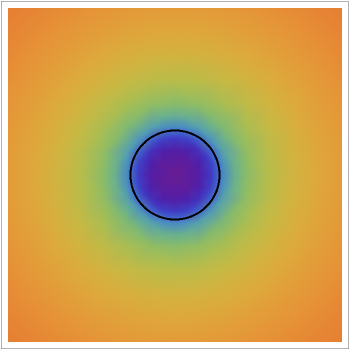
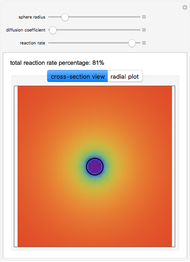
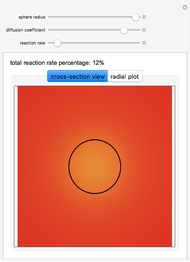
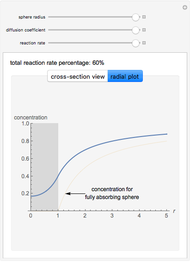
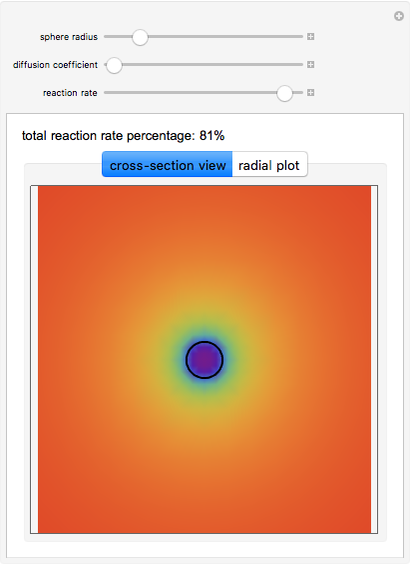
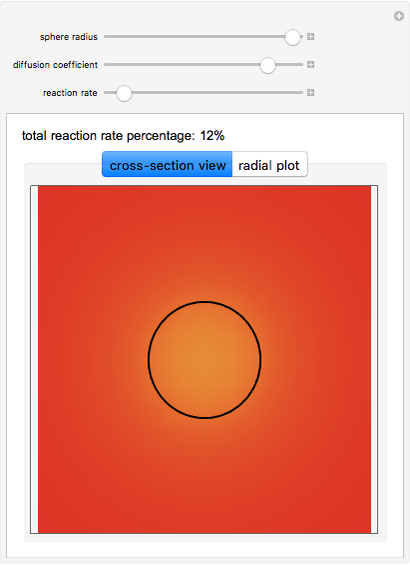
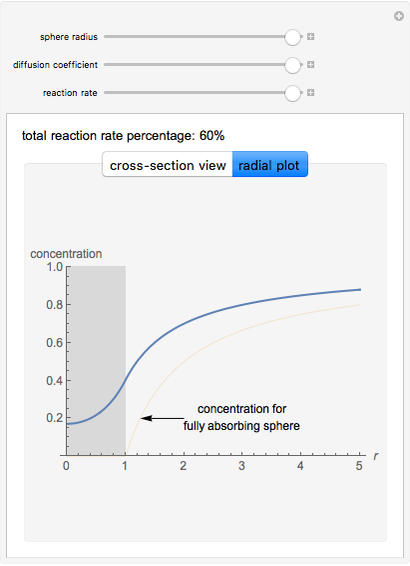
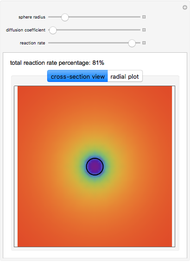
This Demonstration shows the steady-state chemical concentration around and within a spherical chemical reactor that consumes the chemical reaching the sphere via diffusion. The "cross-section view" shows the concentration on a plane through the center of the sphere, with the sphere's surface indicated by the black circle. The "radial view" compares the concentration with that of a fully absorbing sphere of the same size, with the gray region indicating the sphere's interior. The total reaction rate percentage is the rate at which the reactor consumes the chemical relative to the rate for a fully absorbing sphere.
Contributed by: Tad Hogg (March 2011)
Open content licensed under CC BY-NC-SA
Snapshots
Details
The concentration  at distance
  from the center of the spherical reactor satisfies the diffusion equation
  if
if  and 0 if
  , in spherical coordinates, where
  is the diffusion coefficient,
  is the radius of the spherical reactor, and
  is the reaction rate coefficient. The sphere is in an unbounded fluid. In the units used here, the concentration approaches
  far from the sphere.
The reaction inside the sphere is first-order kinetics, meaning the reaction rate is proportional to the concentration: the number of molecules removed from the fluid per unit time and per unit volume is  at a position with distance from the center of the sphere. The removal of the chemical in the reactor creates a concentration gradient and hence a diffusion of the chemical from the surrounding fluid into the sphere.
For comparison, the fully absorbing sphere satisfies  for with boundary condition
  .
.
The fully absorbing sphere gives the maximum possible rate a sphere can absorb the diffusing chemical. The reactor gets close to this maximum by consuming arriving molecules before they have a chance to diffuse back out of the reactor. Achieving this requires the typical distance a molecule in the reactor diffuses before being consumed,  , to be small compared to the radius of the sphere, . In this case, most of the consumption occurs close to the surface of the sphere.
H. C. Berg, Random Walks in Biology,  ed., Princeton: Princeton University Press, 1993.
Permanent Citation
 Reactor Steady States
Brian G. Higgins Diffusion Coefficients for Multicomponent Gases
Brian G. Higgins and Housam Binous Selectivity in a Semibatch Reactor
Rachael L. Baumann Reactor with Recycle Stream
Michael Wrobel Polymerization in a Batch Reactor
Rachael L. Baumann and Nathan S. Nelson Material and Energy Balances in a Reactor with Heat Exchange
Michael Wrobel and Rachael L. Baumann Estimating Kinetic Parameters from a Batch Reactor Experiment
Housam Binous, Ahmed Bellagi, and Brian G. Higgins Continuously Stirred Tank Reactor Using Arc-Length Parameter
Housam Binous and Brian G. Higgins Chemical Reaction and Diffusion in a Spherical Catalyst Pellet (the Nonisothermal Effectiveness Factor)
Housam Binous Chromatographic Reactor
Clay Gruesbeck
-
 Compressing Ideal Fermi and Bose Gases at Low Temperatures
Tad Hogg -
 Irreversible and Reversible Temperature Equilibration
Tad Hogg -
 Maximum Likelihood Estimation for Coin Tosses
Tad Hogg -
 Stroop Effect: Reading Colored Words
Tad Hogg -
 Bijective Mapping of an Interval to a Square
Tad Hogg -
 The Multi-Arm Bandit
Tad Hogg -
 Juggling the Cascade Pattern
Tad Hogg -
 Quantum Random Walk
Tad Hogg -
 Diffusion to a Spherical Reactor
Tad Hogg -
 Particles Thrown from a Rotating Bar
Tad Hogg -
 Grover's Quantum Search Algorithm
Tad Hogg -
 Simulated Quantum Computer Algorithm for Database Searching
Tad Hogg -
 Quantum Computer Search Algorithms
Tad Hogg