
Disparity, Convergence, and Depth (Visual Depth Perception 10)



Requires a Wolfram Notebook System
Interact on desktop, mobile and cloud with the free Wolfram Player or other Wolfram Language products.
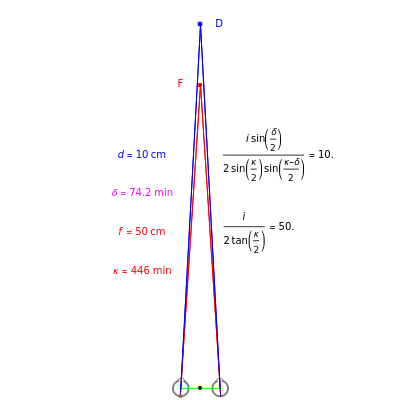
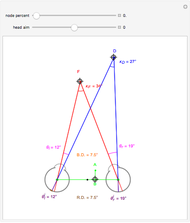
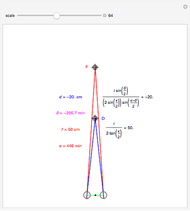
This Demonstration shows binocular disparity together with the convergence angle required for the eyes to fix on F. The angles  and
and  together determine the depth of objects on the
  axis.
axis.
Contributed by: Keith Stroyan (March 2011)
Open content licensed under CC BY-NC-SA
Snapshots
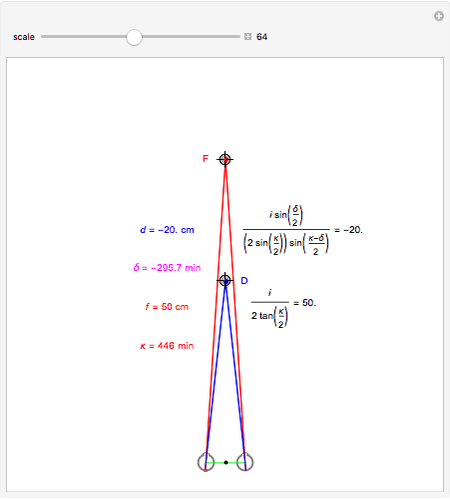
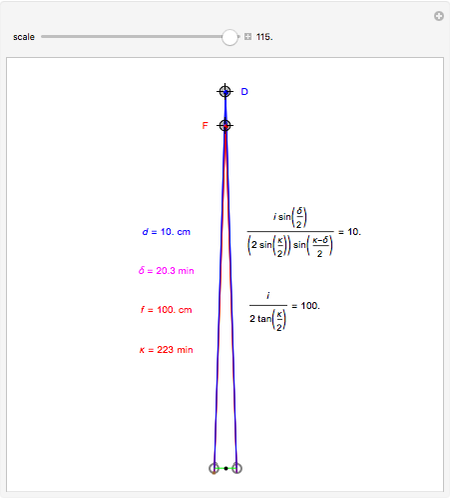
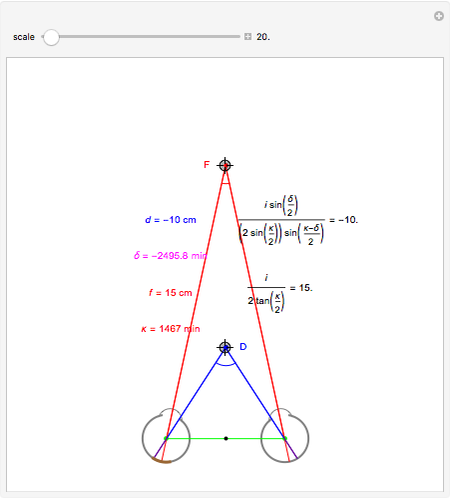
Details
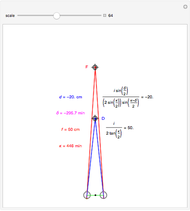
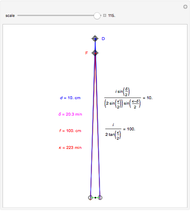
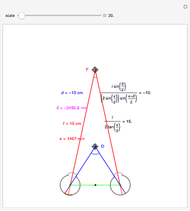
Binocular disparity has been studied since Euclid, but was popularized by Wheatstone about 150 years ago with the invention of the stereoscope. A stereoscope shows two slightly different images to the separate eyes and gives the scene the appearance of depth. However, disparity alone does not determine depth, as shown in the Demonstration "Binocular Disparity versus Depth (Visual Depth Perception 9)" (see Related Links). To simplify derivations for this Demonstration we take no aim offset and set the nodePercent equal to zero, that is, nodes are (unrealistically) at the center of the eye.
The exact formula for depth when the fixate and distraction are on the axis (including sign) from  (in radians) for a given fixate distance
  is given by the following formula with interocular distance
  :
:
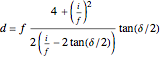 .
.
Binocular disparity does not determine depth since it requires the absolute fixate distance . The value of could come from a convergence cue since the convergence angle of the eyes is related to fixate distance by
 ,
,
so (after simplification) depth from static cues is
 .
.
For more information about stereoscopic vision, see the Wikipedia page.
Permanent Citation
 Binocular Disparity (Visual Depth Perception 7)
Keith Stroyan Binocular Disparity versus Depth (Visual Depth Perception 9)
Keith Stroyan Speed, Motion, Pursuit, and Depth (Visual Depth Perception 15)
Keith Stroyan Motion Parallax versus Depth, 3D (Visual Depth Perception 13)
Keith Stroyan Motion Parallax versus Depth, 2D (Visual Depth Perception 12)
Keith Stroyan Fixation and Distraction (Visual Depth Perception 5)
Keith Stroyan Tracking and Separation (Visual Depth Perception 11)
Keith Stroyan Vieth-Müller Circles (Visual Depth Perception 8)
Keith Stroyan Eye Parameters (Visual Depth Perception 6)
Keith Stroyan Motion/Pursuit Ratio and Depth in 1D (Visual Depth Perception 17)
Keith Stroyan
-
 Vaccinations and Herd Immunity Using the SIR Disease Epidemic Model
Keith Stroyan -
 Motion/Pursuit Law in 1D (Visual Depth Perception 1)
Keith Stroyan -
 Motion/Pursuit Law on Invariant Circles (Visual Depth Perception 4)
Keith Stroyan -
 Motion/Pursuit Law in 2D (Visual Depth Perception 3)
Keith Stroyan -
 SIR Epidemic Dynamics
Keith Stroyan -
 Dynamic Approximation of Static Quantities (Visual Depth Perception 14)
Keith Stroyan -
 Motion/Pursuit Ratio and Depth in 2D (Visual Depth Perception 18)
Keith Stroyan -
Motion Parallax versus Depth, 3D (Visual Depth Perception 13)
Keith Stroyan -
Motion Parallax versus Depth, 2D (Visual Depth Perception 12)
Keith Stroyan -
Tracking and Separation (Visual Depth Perception 11)
Keith Stroyan -
 Disparity, Convergence, and Depth (Visual Depth Perception 10)
Keith Stroyan -
Binocular Disparity versus Depth (Visual Depth Perception 9)
Keith Stroyan -
Binocular Disparity (Visual Depth Perception 7)
Keith Stroyan -
Fixation and Distraction (Visual Depth Perception 5)
Keith Stroyan -
 Speed, Pursuit, M/P Ratio, and Depth (Visual Depth Perception 16)
Keith Stroyan -
Motion/Pursuit Ratio and Depth in 1D (Visual Depth Perception 17)
Keith Stroyan -
Speed, Motion, Pursuit, and Depth (Visual Depth Perception 15)
Keith Stroyan -
Vieth-Müller Circles (Visual Depth Perception 8)
Keith Stroyan -
Eye Parameters (Visual Depth Perception 6)
Keith Stroyan -
 Motion, Pursuit, Fixate, and Distractor (Visual Depth Perception 2)
Keith Stroyan