
Motion/Pursuit Law in 2D (Visual Depth Perception 3)



Requires a Wolfram Notebook System
Interact on desktop, mobile and cloud with the free Wolfram Player or other Wolfram Language products.
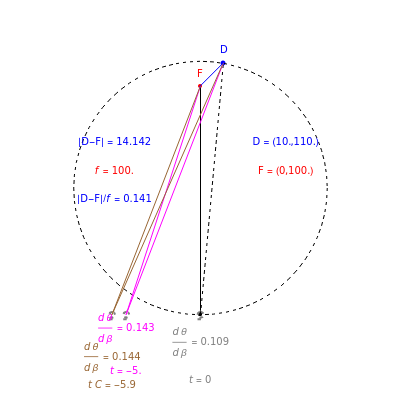
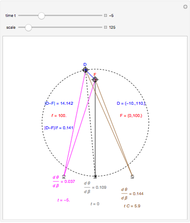
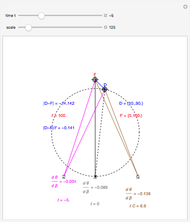
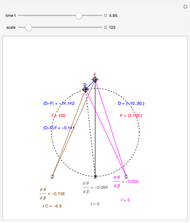
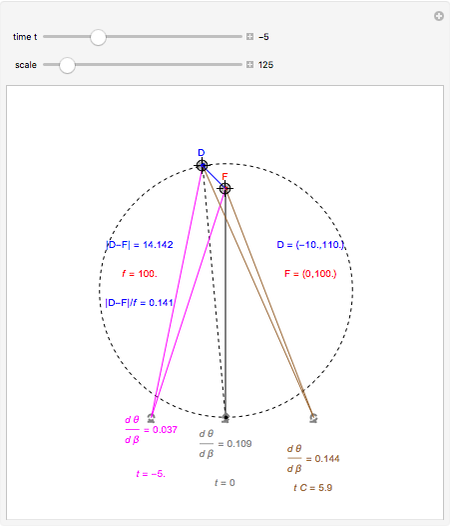
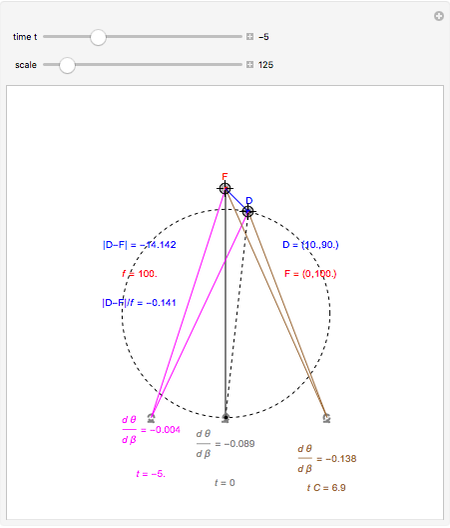
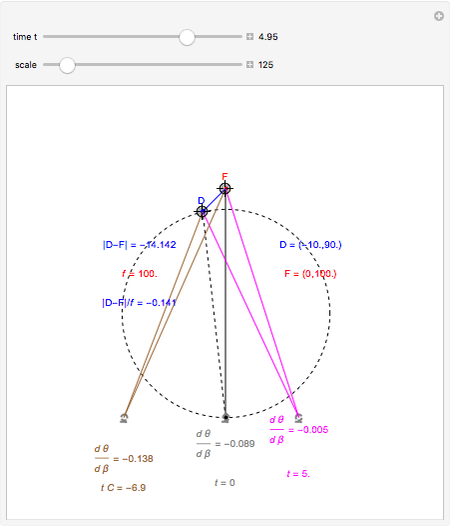
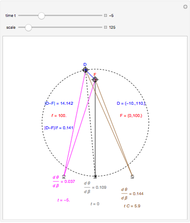
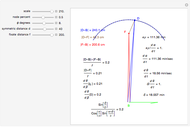
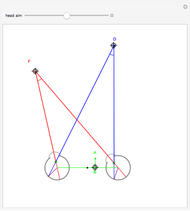
This Demonstration computes the motion/pursuit law in the two-dimensional horizontal fixation plane of the eyes. The observer is looking mainly at F on the vertical axis, but also sees D as he translates to the right at speed equal to the interocular distance per second.
[more]


Contributed by: Keith Stroyan (March 2011)
Open content licensed under CC BY-NC-SA
Snapshots
Details
Permanent Citation
"Motion/Pursuit Law in 2D (Visual Depth Perception 3)"
http://demonstrations.wolfram.com/MotionPursuitLawIn2DVisualDepthPerception3/
Wolfram Demonstrations Project
Published: March 7 2011
 Motion/Pursuit Law in 1D (Visual Depth Perception 1)
Keith Stroyan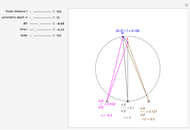 Motion/Pursuit Law on Invariant Circles (Visual Depth Perception 4)
Keith Stroyan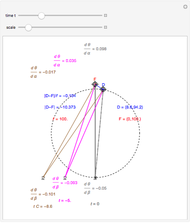 Motion/Pursuit Ratio and Depth in 2D (Visual Depth Perception 18)
Keith Stroyan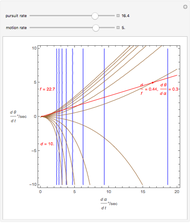 Speed, Motion, Pursuit, and Depth (Visual Depth Perception 15)
Keith Stroyan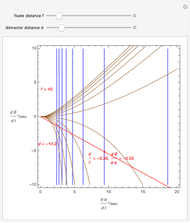 Motion, Pursuit, Fixate, and Distractor (Visual Depth Perception 2)
Keith Stroyan Motion/Pursuit Ratio and Depth in 1D (Visual Depth Perception 17)
Keith Stroyan Motion Parallax versus Depth, 2D (Visual Depth Perception 12)
Keith Stroyan Tracking and Separation (Visual Depth Perception 11)
Keith Stroyan Vieth-Müller Circles (Visual Depth Perception 8)
Keith Stroyan Binocular Disparity (Visual Depth Perception 7)
Keith Stroyan
-
 Vaccinations and Herd Immunity Using the SIR Disease Epidemic Model
Keith Stroyan -
Motion/Pursuit Law in 1D (Visual Depth Perception 1)
Keith Stroyan -
Motion/Pursuit Law on Invariant Circles (Visual Depth Perception 4)
Keith Stroyan -
 Motion/Pursuit Law in 2D (Visual Depth Perception 3)
Keith Stroyan -
 SIR Epidemic Dynamics
Keith Stroyan -
 Dynamic Approximation of Static Quantities (Visual Depth Perception 14)
Keith Stroyan -
Motion/Pursuit Ratio and Depth in 2D (Visual Depth Perception 18)
Keith Stroyan -
 Motion Parallax versus Depth, 3D (Visual Depth Perception 13)
Keith Stroyan -
Motion Parallax versus Depth, 2D (Visual Depth Perception 12)
Keith Stroyan -
Tracking and Separation (Visual Depth Perception 11)
Keith Stroyan -
 Disparity, Convergence, and Depth (Visual Depth Perception 10)
Keith Stroyan -
 Binocular Disparity versus Depth (Visual Depth Perception 9)
Keith Stroyan -
Binocular Disparity (Visual Depth Perception 7)
Keith Stroyan -
 Fixation and Distraction (Visual Depth Perception 5)
Keith Stroyan -
 Speed, Pursuit, M/P Ratio, and Depth (Visual Depth Perception 16)
Keith Stroyan -
Motion/Pursuit Ratio and Depth in 1D (Visual Depth Perception 17)
Keith Stroyan -
Speed, Motion, Pursuit, and Depth (Visual Depth Perception 15)
Keith Stroyan -
Vieth-Müller Circles (Visual Depth Perception 8)
Keith Stroyan -
 Eye Parameters (Visual Depth Perception 6)
Keith Stroyan -
Motion, Pursuit, Fixate, and Distractor (Visual Depth Perception 2)
Keith Stroyan