
Maxwell's Demon

Requires a Wolfram Notebook System
Interact on desktop, mobile and cloud with the free Wolfram Player or other Wolfram Language products.
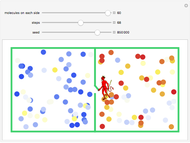
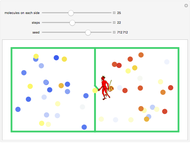
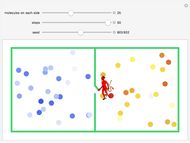
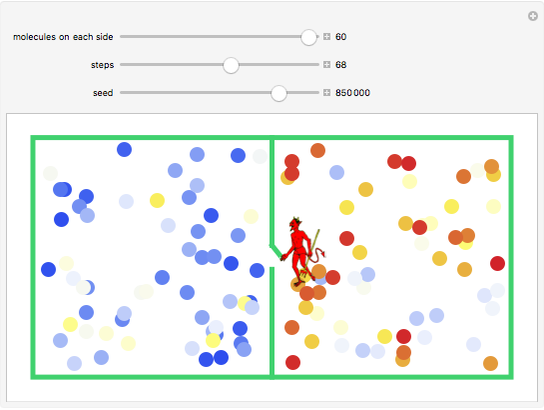
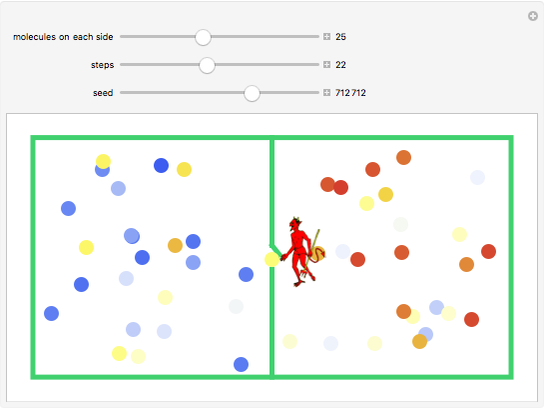
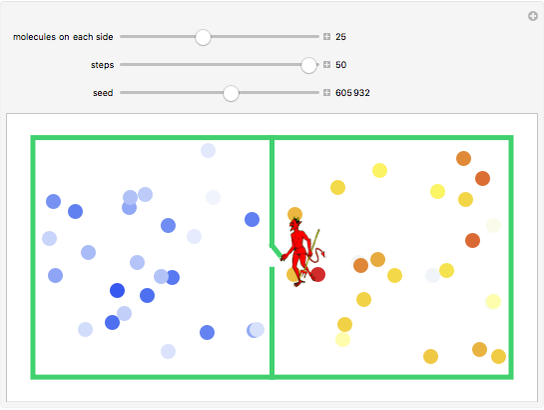
In 1867 the Scottish physicist James Clerk Maxwell formulated this thought experiment that seems to violate the second law of thermodynamics. The apparent violation was later explained by Leó Szilárd and Léon Brillouin. The experiment shows a gas-filled container that is divided into two compartments with a trapdoor in the wall that separates them. A "demon" supposedly has the power to select the molecules passing through the trapdoor according to their velocities; those with more kinetic energy than the mean energy of the molecules of the first compartment pass to the second, and vice versa. At the end, molecules with higher velocities finish in the second container and slower molecules are in the first, so that the temperature is greater in the second than the first, contrary to what the second law of thermodynamics states. Actually, the second law is not violated because no matter what method is used by the hypothetical demon, entropy is increased by the work done by the demon in monitoring the particles.
Contributed by: Enrique Zeleny (April 2011)
Open content licensed under CC BY-NC-SA
Snapshots
Details
For more details, see "Maxwell's Demon" on Wikipedia.
Permanent Citation
"Maxwell's Demon"
http://demonstrations.wolfram.com/MaxwellsDemon/
Wolfram Demonstrations Project
Published: April 21 2011
 The Coffee Cooling Problem
S. M. Blinder Experiment Verifying Charles's Law
Enrique Zeleny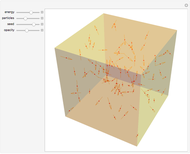 Thermal Energy
Enrique Zeleny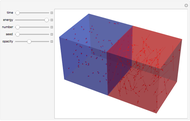 Thermal Equilibrium
Enrique Zeleny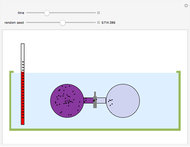 Joule Experiment on Free Expansion
Enrique Zeleny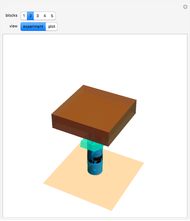 An Experiment with Boyle's Law
Enrique Zeleny Rock Bed Heat Storage System
Enrique Zeleny Newton's Law of Cooling
Jeff Bryant Bose-Einstein, Fermi-Dirac, and Maxwell-Boltzmann Statistics
Christian Freier (University of Technology Berlin) Simulation of a Simple Gas Pressure Model
Jon McLoone
-
 Sign of a Function
Enrique Zeleny -
 Length of the Perpendicular from a Point to a Straight Line
Enrique Zeleny -
 Van de Graaff Generator
Enrique Zeleny -
 Equilibrium of a Suspended Mobile
Enrique Zeleny -
 Rømer's Measurement of the Speed of Light
Enrique Zeleny -
 Charles's Law
Enrique Zeleny -
 Forces Acting on a Ladder
Enrique Zeleny -
 Density
Enrique Zeleny -
 Tumor Growth Model
Enrique Zeleny -
 Newton's Second Law
Enrique Zeleny -
 Weight of a Person Riding in an Elevator
Enrique Zeleny -
 Active Shock Absorbers
Enrique Zeleny -
 Bragg's Law
Enrique Zeleny -
 Projectile with Air Drag
Enrique Zeleny -
 Coulomb Wavefunctions
Enrique Zeleny -
 Jorge-Meeks K-Noids
Enrique Zeleny -
 Motion of a Parachuter
Enrique Zeleny -
 Asimov's Ladder of Physical Constants
Enrique Zeleny -
 Solutions of the Elliptic Membrane Problem
Enrique Zeleny -
 Lagrange Points
Enrique Zeleny