
Projections of the 16-Cell


Requires a Wolfram Notebook System
Interact on desktop, mobile and cloud with the free Wolfram Player or other Wolfram Language products.
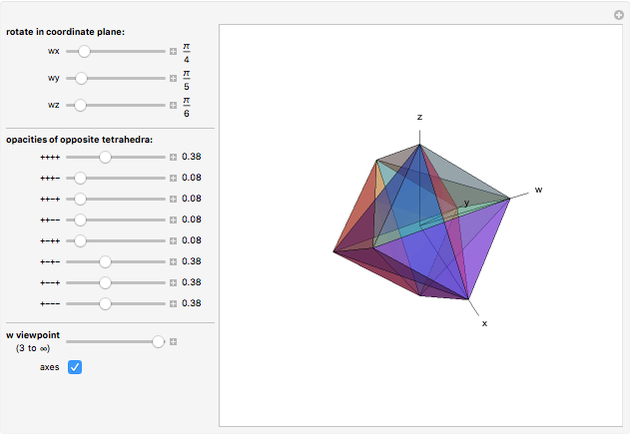
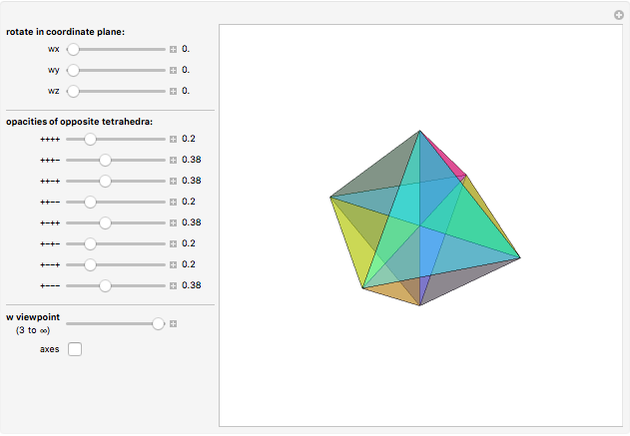
Rotate a four-dimensional regular cross polytope (or 16-cell, Schlaefli symbol {3,3,4}) and project it into three-dimensional graphics. The rotation is the composite of rotations in the  ,
,  , and
, and  planes, in that order. Opposite tetrahedra (3-cells) of the cross polytope are colored with similar colors. Play with the opacity to see how the cross polytope is bounded by 16 tetrahedra.
Contributed by: Michael Rogers (Oxford College/Emory University) (March 2011)
Open content licensed under CC BY-NC-SA
Snapshots

Details
A cross polytope is a higher-dimensional analog of the octahedron. The rotation of the 4D cross polytope, whose vertices have coordinates all zero except one either ±1, is the composite of rotations in the , , and planes, in that order. Combined with Mathematica's built-in rotation of 3D graphics, this gives all six degrees of freedom of four-dimensional rotations. The bounding tetrahedra are drawn in the order from least  coordinate to greatest. If all the opacities are set to one, the display shows the tetrahedra "visible" from out on the positive axis. The projection is from a point on the positive axis onto the
  hyperplane; the resulting 3D figure is then projected onto the screen by the normal Mathematica 3D graphics. The positive
  ,
,  ,
,  , and axes of the cross polytope may be shown; these rotate with the cross polytope, which helps illustrate how the rotations work. The opacity sliders are labeled according to the nonzero coordinates of the vertices of one of the corresponding pairs of bounding tetrahedra (in the order
  ). Each tetrahedron has one vertex on each of the four axes.
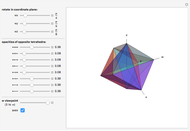
Snapshot 1: projection as a cube (just as the octahedron may be projected as a square)
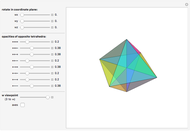
Snapshot 2: projection as an octahedron
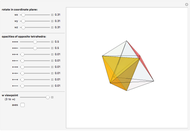
Snapshot 3: projection as a triangular antiprism
Permanent Citation
 Projection of Polytopes into Three Dimensions
Yuncong Ma Stereogram of 4D Pentachoron Rotations
Richard Hennigan Stereographic Projection of a Cube
Gerard Balmens The 57-Cell
Ed Pegg Jr 600-Cell 120-Cell Duality
Michael Schreiber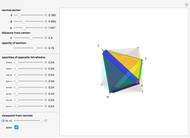 Sections of the 16-Cell
Michael Rogers (Oxford College/Emory University) Stereographic Projection of Platonic Solids
Emile Okada Orthographic Projection of Parallelepipeds
Anastasiya Rybik Rotating a Hypercube in Four Dimensions with Eight Spaced Cubes
Gerard Balmens Tetrahedron Centers
Ed Pegg Jr
-
 Swirl and the Curl
Michael Rogers -
 Constructing Vector Geometry Solutions
Michael Rogers -
 The Mating Dance of the Alexander Horned Spheres
Michael Rogers -
 Expansion and Divergence
Michael Rogers -
 Surface Integrals over Segments of Parametrized Surfaces
Michael Rogers -
 Surface Parametrizations and Their Jacobians
Michael Rogers -
 Composition and Transformations
Michael Rogers -
 Unwrapping Involutes
Michael Rogers -
 Aerial Tour of Differential Geometry
Michael Rogers -
 Exploring Surface Curvature and Differentials
Michael Rogers -
 Catacaustics for Some Graphs
Michael Rogers -
 Complex Slide Rule
Michael Rogers -
 Grow an Alexander Horned Sphere
Michael Rogers -
 Catacaustics Generated by a Point Source
Michael Rogers -
 The Geometry of Lagrange Multipliers
Michael Rogers -
 Goodness of Fit for Random Subsets
Michael Rogers -
 Newton's Integrability Proof
Michael Rogers -
 Calculus Slalom
Michael Rogers -
 Gauss Map and Curvature
Michael Rogers -
 Generating Lissajous Figures
Michael Rogers