
Exploring Surface Curvature and Differentials

Requires a Wolfram Notebook System
Interact on desktop, mobile and cloud with the free Wolfram Player or other Wolfram Language products.
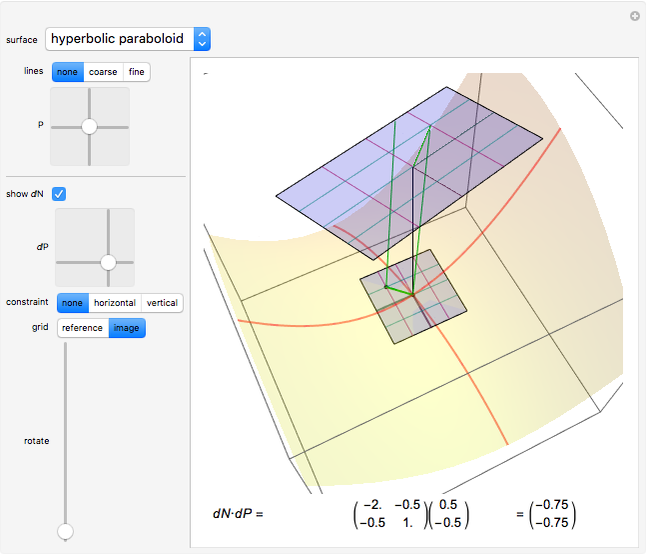
This Demonstration shows the relationship between the principal curvatures of a surface and the differential  of the unit normal of the surface. The differential
  at a point may be viewed as a linear transformation of the tangent plane at the point, since the derivative of the unit normal is orthogonal to the normal. The eigenvalues of
  are the negatives of the principal curvatures of the surface at the point, and correspondingly the eigenvectors are the principal directions. At a point
  one may rotate an orthogonal basis for the tangent plane to diagonalize the matrix for
  by aligning the basis with the principal directions. One may see how a small tangent vector
  is mapped by
  and compare it to the actual difference in the normals at the points
  and
and  .
. The lines that are drawn on the surface are lines of curvature, which are curves whose tangents at every point match one of the principal directions.
Contributed by: Michael Rogers (Oxford College of Emory University) (March 2011)
Open content licensed under CC BY-NC-SA
Snapshots
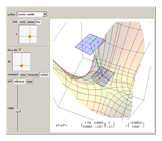
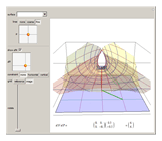
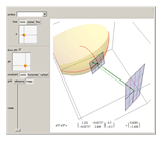


Details
In addition to the principal curvatures of a surface, this Demonstration illustrates geometrically several interesting concepts: differentials and local linear approximation, linear transformations, eigenvectors and eigenvalues, the orthogonal diagonalization of symmetric matrices, and the relation of the rotation of the normal vector of a surface to the curvature. Note the negative of  is called the shape operator.
To explore  as a linear transformation: move
  to a desired location. Move
  to change the tangent vector at
  ; the motion of
  may be constrained to move horizontally or vertically. The image vector
  is drawn in the plane at the end of the normal at
  . The image plane may be drawn with the same basis as the tangent plane (the "reference" grid) or with the image of the basis under
  (the "image" grid). The basis of the tangent plane may be rotated with the slider. By rotating the basis to align with the principal directions, the matrix of
  may be diagonalized. In the display, numerical values of
  ,
,  , and
, and  are given with respect to the basis of the tangent plane.
The display: the lines on the surface show the principal configuration (lines of curvature). At the point  , the unit normal vector is drawn in black, and the lines of curvature through
  are drawn on the surface. For the point
  , the normal is drawn twice in green, both at
  and at
  . There are two things to observe: the angle between the normals and the displacement between the tips of the normals. On the one hand, if the change
  is parallel to a principal direction, then the angle rotated will be approximately the negative of the curvature times the distance moved; on the other hand, the displacement will be approximately equal to
  . Basis vectors are highlighted in the tangent plane and the image grid.
Umbilic points are points where the normal curvature is the same in all directions and  is scalar. Some of them are bookmarked in the + menu in the upper left. Darboux first classified curvature umbilics into three types, now sometimes called lemons, stars, and monstars (or lemonstars). For more information, see G. Darboux, "Note VII: Sur la forme des lignes de courbure dans la voisinage d'un ombilic," Leçons sur la Théorie Générale des Surfaces, Vol. 4, Paris: Gauthier–Villars, 1896 pp. 448–465.
Questions for exploration:
When the matrix of  is diagonalized, the image grid is a rectangle. Why?
When the vector  is rotated, which way does its image rotate? When is it in the same direction and when is it different? Is it ever the case that the image of
  does not rotate but changes length?
Sometimes the tip of the image vector  stays close to the tip of the green normal based at
  , and sometimes it does not. Why? To clarify: since the normal vectors are unit length, the green vector rotates away from the plane. One expects the tips to lie on a line approximately parallel to the normal. In other words, if the viewpoint is adjusted so the reference grids align, one tip should be on top of the other. Sometimes they are closer, and sometimes not.
Is it obvious—in the visual sense—that the principal curvatures and the eigenvalues of  have opposite signs?
Show that if  traces the unit circle
  in the tangent plane, the coordinates being with respect to the orthonormal basis of principal directions, then its image
  traces the ellipse
  , where
  and
and  are the principal curvatures. Deduce Euler's formula for the normal curvature
  in the direction
  , namely,
  .
.
Permanent Citation
 Surfaces of Revolution with Constant Gaussian Curvature
Antonin Slavik Gauss Map and Curvature
Michael Rogers (Oxford College/Emory University) An Enneper-Weierstrass Minimal Surface
Michael Schreiber Unwrapping Involutes
Michael Rogers (Oxford College of Emory University) Cone Geodesics
Antonin Slavik Hyperboloid Geodesics
Antonin Slavik Normal Curvature at a Regular Point of a Surface
Desana ?tambuk (University of Zagreb) Catalan's Surface
Enrique Zeleny Hyperboloid as a Ruled Surface
Bruce Atwood Views of the Costa Minimal Surface
Enrique Zeleny
-
 Swirl and the Curl
Michael Rogers -
 Constructing Vector Geometry Solutions
Michael Rogers -
 The Mating Dance of the Alexander Horned Spheres
Michael Rogers -
 Expansion and Divergence
Michael Rogers -
 Surface Integrals over Segments of Parametrized Surfaces
Michael Rogers -
 Surface Parametrizations and Their Jacobians
Michael Rogers -
 Composition and Transformations
Michael Rogers -
Unwrapping Involutes
Michael Rogers -
 Aerial Tour of Differential Geometry
Michael Rogers -
 Exploring Surface Curvature and Differentials
Michael Rogers -
 Catacaustics for Some Graphs
Michael Rogers -
 Complex Slide Rule
Michael Rogers -
 Grow an Alexander Horned Sphere
Michael Rogers -
 Catacaustics Generated by a Point Source
Michael Rogers -
 The Geometry of Lagrange Multipliers
Michael Rogers -
 Goodness of Fit for Random Subsets
Michael Rogers -
 Newton's Integrability Proof
Michael Rogers -
 Calculus Slalom
Michael Rogers -
Gauss Map and Curvature
Michael Rogers -
 Generating Lissajous Figures
Michael Rogers