
Simplified Statistical Model for Equilibrium Constant



Requires a Wolfram Notebook System
Interact on desktop, mobile and cloud with the free Wolfram Player or other Wolfram Language products.
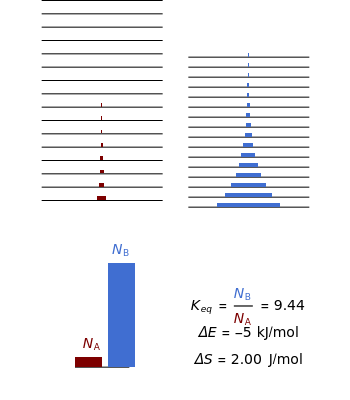
Consider a simple chemical equilibrium  with equilibrium constant
  . (This can alternatively be written
  in terms of the concentrations of
  and
and  .) The difference in electronic energy for the reaction
  equals
  , conveniently expressed in kJ/mol. Let the internal structure of each molecule be idealized as a series of equally spaced energy levels (similar to those of a harmonic oscillator), with the energy increments
  and
and  . The spacings and relative to are exaggerated in the graphic for easier visualization. The sublevels of each molecular species are assumed to occupy a Boltzmann distribution at temperature
  . Accordingly,
  , where
  , the molecular partition function for , and analogously for . For a mixture of and , a single Boltzmann distribution can be considered to apply for the composite levels of both molecules. This leads to the formula for equilibrium constant in statistical thermodynamics:
  .
.


Contributed by: S. M. Blinder (March 2011)
Open content licensed under CC BY-NC-SA
Snapshots
Details
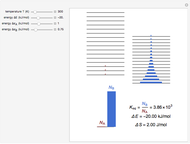
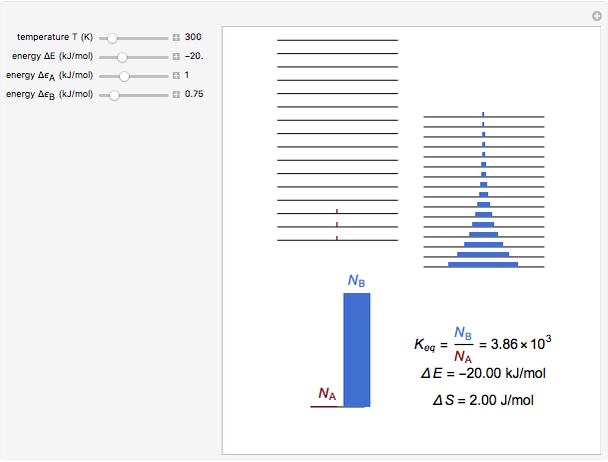
Snapshot 1: a strongly exothermic forward reaction
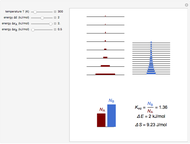
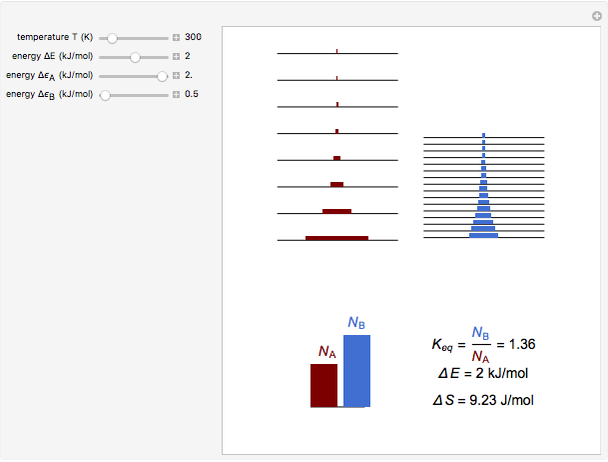
Snapshot 2: an endothermic forward reaction enabled by entropy effect
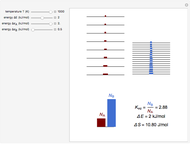
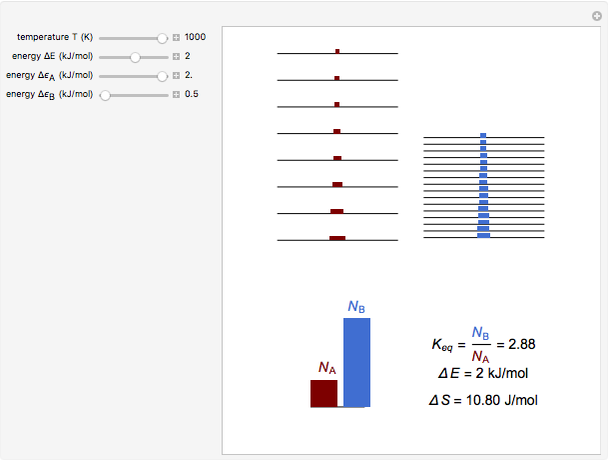
Snapshot 3: effect of higher temperature
Reference
[1] D. A. McQuarrie, Statistical Mechanics, New York: Harper & Row, 1976 pp. 142 ff.
Permanent Citation
 Statistical Thermodynamics of Ideal Gases
S. M. Blinder Second Virial Coefficients Using the Lennard-Jones Potential
S. M. Blinder Low-Temperature Heat Capacity of Hydrogen Molecules
S. M. Blinder Statistical Mechanics of Money
Ian Wright Approach of a System of Particles towards Thermal Equilibrium
Ulrich Mutze and Stephan Leibbrandt Three Intermolecular Potential Models
Megan E. Maguire and Rachael L. Baumann Electron Conductance Models Using Maximal Entropy Random Walks
Jarek Duda Temperature Variation of Heat Capacity for an Ideal Diatomic Gas
Hayley Petit and Siddharth Madapoosi Steady-States of a Nonlinear Chemical System Using the Arc Length Continuation Method
Housam Binous and Brian G. Higgins Comparing Properties of Chemical Elements
Stephen Wolfram
-
 Ice Cube Melting in Water
S. M. Blinder -
 Absorption Spectroscopy
S. M. Blinder -
 Height of Object from Angle of Elevation Using Tangent
S. M. Blinder -
 Internal Rotation in Ethane and Substituted Analogs
S. M. Blinder -
 Topological Spaces on Three Points
S. M. Blinder -
 Hydrogen Atom in Curved Space
S. M. Blinder -
 Multipurpose Tool
S. M. Blinder -
Statistical Thermodynamics of Ideal Gases
S. M. Blinder -
 Bell's Theorem
S. M. Blinder -
 Kepler's Mysterium Cosmographicum
S. M. Blinder -
 Bonding and Antibonding Molecular Orbitals
S. M. Blinder -
 Visible and Invisible Intersections in the Cartesian Plane
S. M. Blinder -
 Heron's Formula
S. M. Blinder -
 How Zippers Work
S. M. Blinder -
 Mittag-Leffler Expansions of Meromorphic Functions
S. M. Blinder -
 Orbital Resonance in the Asteroid Belt
S. M. Blinder -
 Jordan's Lemma Applied to the Evaluation of Some Infinite Integrals
S. M. Blinder -
 Configuration Interaction for the Helium Isoelectronic Series
S. M. Blinder -
 Structure and Bonding of Second-Row Hydrides
S. M. Blinder -
 DNA Base Pairing
S. M. Blinder