
The Seven Crystal Classes


Requires a Wolfram Notebook System
Interact on desktop, mobile and cloud with the free Wolfram Player or other Wolfram Language products.
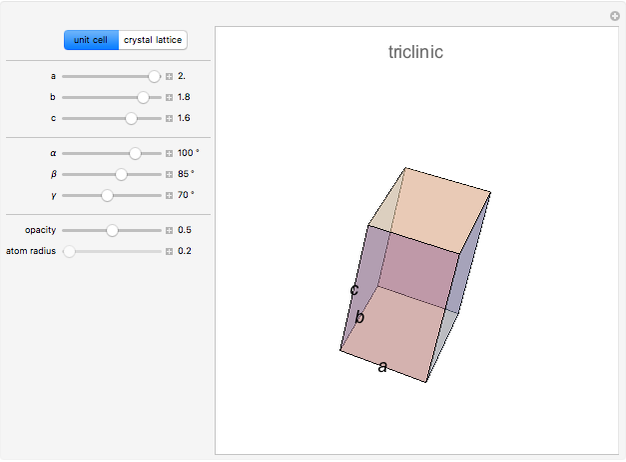
The three-dimensional arrangement of the atoms, molecules, or ions in a crystalline solid can be described by the geometry of its unit cell. The entire crystal can then be constructed by translational repetitions of the unit cell. A unit cell is described by six lattice parameters: edge dimensions  ,
, ,
,  and inter-edge angles
  ,
,  ,
,  . There are seven possible crystal systems that can produce an infinite lattice in three-dimensional space so that each lattice point has an identical environment. Depending on relationships between lattice parameters, the seven crystal systems are classified as cubic (or isometric), tetragonal, orthorhombic, rhombohedral (or trigonal), hexagonal, monoclinic, and triclinic. (This Demonstration does not consider further classifications within these crystal systems, such as body-centered, face-centered, etc., which make up a total of 14 Bravais lattices.)
Contributed by: S. M. Blinder (March 2011)
Open content licensed under CC BY-NC-SA
Snapshots
Details
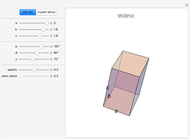
Snapshot 1: unit cell of triclinic class, the lowest symmetry type
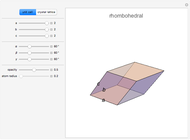
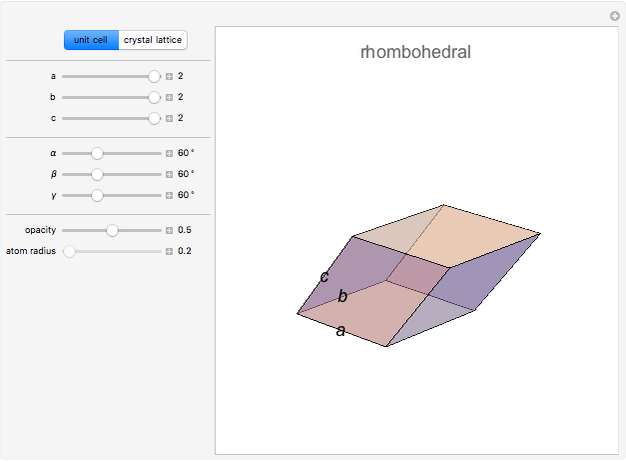
Snapshot 2: rhombohedral unit cell
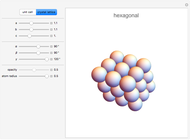
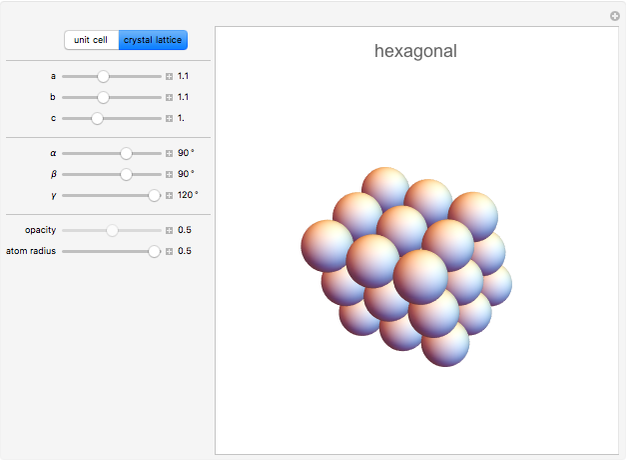
Snapshot 3: Hexagonal closest packing (HCP) of spheres, filling about 74% of three-dimensional space. Cubic closest packing (CCP) using a face-centered lattice (not available in this Demonstration) fills an equal fraction of space. Kepler conjectured that these are the densest possible arrangements of spheres. (A proof by Thomas Hales in 1998 is considered "99% certain".)
Permanent Citation
 Modeling the Atomic Structure of an Ice Crystal
Sándor Kabai Crystal Viewer
Nikolai Mikuszeit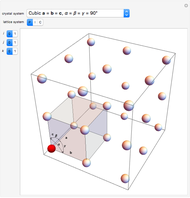 The 14 3D Bravais Lattices
D. Meliga and S. Z. Lavagnino The Structure of Diamond
S. M. Blinder d-Orbitals in an Octahedral Field
S. M. Blinder Doped Silicon Semiconductors
S. M. Blinder Double Refraction by a Uniaxial Crystal
S. M. Blinder Visualizing Atomic Orbitals
Guenther Gsaller Zeolite A
Sándor Kabai Zeolite Unit Cell Based on Cuboctahedron
Sándor Kabai
-
 Ice Cube Melting in Water
S. M. Blinder -
 Absorption Spectroscopy
S. M. Blinder -
 Height of Object from Angle of Elevation Using Tangent
S. M. Blinder -
 Internal Rotation in Ethane and Substituted Analogs
S. M. Blinder -
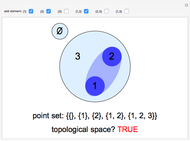 Topological Spaces on Three Points
S. M. Blinder -
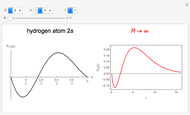 Hydrogen Atom in Curved Space
S. M. Blinder -
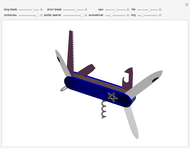 Multipurpose Tool
S. M. Blinder -
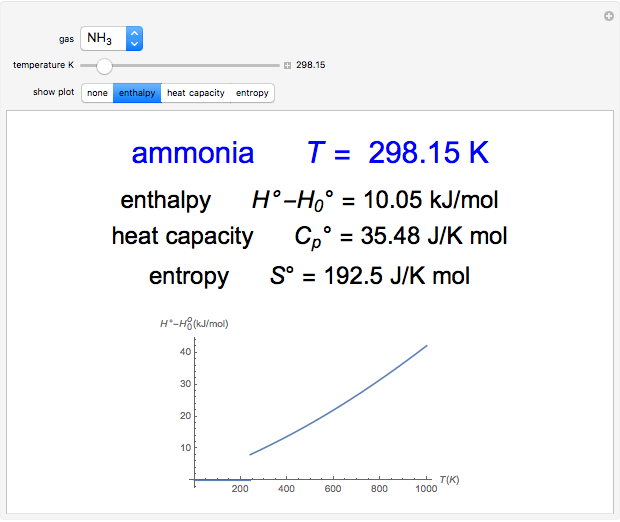 Statistical Thermodynamics of Ideal Gases
S. M. Blinder -
 Bell's Theorem
S. M. Blinder -
 Kepler's Mysterium Cosmographicum
S. M. Blinder -
 Bonding and Antibonding Molecular Orbitals
S. M. Blinder -
 Visible and Invisible Intersections in the Cartesian Plane
S. M. Blinder -
 Heron's Formula
S. M. Blinder -
 How Zippers Work
S. M. Blinder -
 Mittag-Leffler Expansions of Meromorphic Functions
S. M. Blinder -
 Orbital Resonance in the Asteroid Belt
S. M. Blinder -
 Jordan's Lemma Applied to the Evaluation of Some Infinite Integrals
S. M. Blinder -
 Configuration Interaction for the Helium Isoelectronic Series
S. M. Blinder -
 Structure and Bonding of Second-Row Hydrides
S. M. Blinder -
 DNA Base Pairing
S. M. Blinder