
An Amoeba Problem


Requires a Wolfram Notebook System
Interact on desktop, mobile and cloud with the free Wolfram Player or other Wolfram Language products.
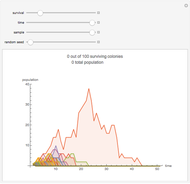
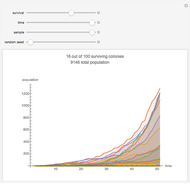
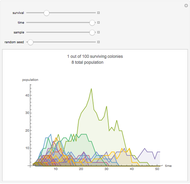
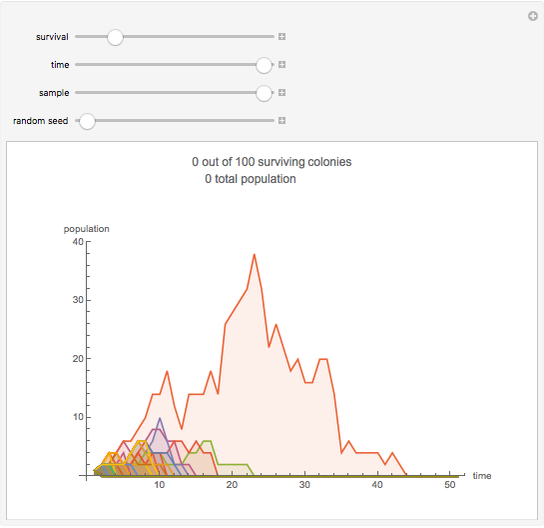
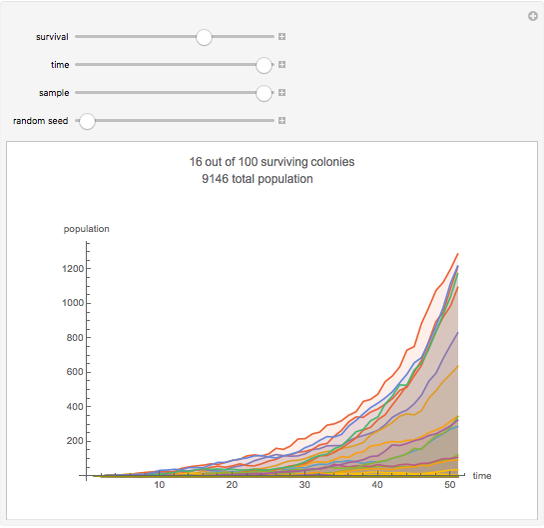
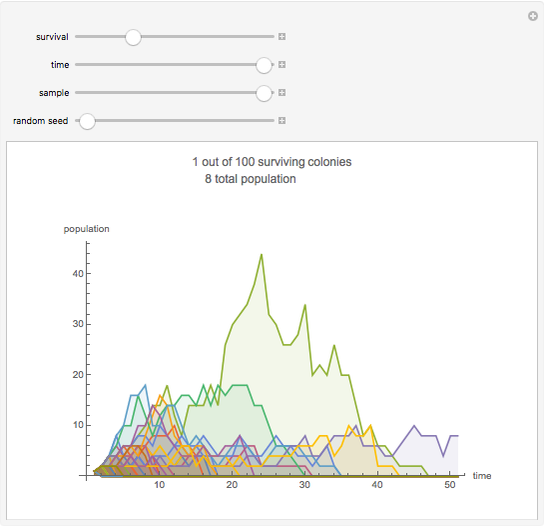
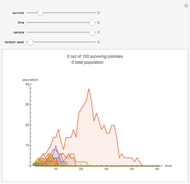
This stylized amoeba problem is a classic illustration of a random process. Each sample colony starts from a single parent amoeba. At each time step, each living amoeba either survives to split into two or dies out, with a constant survival chance. A colony dies out if all its members—daughters of one original parent—die out. For different probabilities of survival, times, and starting sample sizes, the population history of each colony is shown, along with the number of surviving colonies and the total number of surviving individuals.
Contributed by: Jason Cawley (March 2011)
Open content licensed under CC BY-NC-SA
Snapshots
Details
For individual survival chances well below half, all colonies will frequently die out in finite time.
For high survival chances, many colonies will still die out, but the most successful will grow exponentially, and total population rises as a result.
Larger samples will show more outlier survivors. At short time scales, chance dominates the fate of each colony.
Generalizations of the problem can involve the possibility of more than one daughter cell at each generation, or a link between survival probability and existing population level (to model resource depletion, for example).
The problem can also be thought of as modeling the consequences of a series of double or nothing bets—note how much of the eventual "population" belongs to the most successful colonies.
Permanent Citation
"An Amoeba Problem"
http://demonstrations.wolfram.com/AnAmoebaProblem/
Wolfram Demonstrations Project
Published: March 7 2011
 Predator-Prey Ecosystem: A Real-Time Agent-Based Simulation
Hiroki Sayama Coupon Collector Problem
Ed Pegg Jr A Probabilistic Model for Population Extinction
Mark D. Normand and Micha Peleg Movement between Three Populations in a Closed System
Alex Bongiovanni (Science and Math Academy) Human Population Densities by Continent
Trevor Cole Population Cube
Michael Schreiber Life Expectancy in the U.S. Population
Jean Buck and Mike Pilat Country Statistics over Time
Alan Joyce Population Selector
Ed Pegg Jr Comparing Data on Countries
Stephen Wolfram
-
 Expected Returns of the Dow Industrials, Beta Model
Jason Cawley -
Comparing Data on Countries
Jason Cawley -
 Rank Plots for Countries
Jason Cawley -
 Country Groups
Jason Cawley -
 Country Data and Benford's Law
Jason Cawley -
 Cellular Automata with Global Control
Jason Cawley -
 Simulating the 2008 U.S. Presidential Election
Jason Cawley -
 Exploring Social Choice Theory
Jason Cawley -
 Fully Random, Five-Rule Interactive Cellular Automata (ICA)
Jason Cawley -
 Algorithmic Architecture with Cellular Automata
Jason Cawley -
 Modeling Return Distributions
Jason Cawley -
 Expected Returns of the Dow Industrials, Fama-French Model
Jason Cawley -
 Credit Risk
Jason Cawley -
 Highlighting Patterns in Cellular Automata
Jason Cawley -
 Markov Volatility Random Walks
Jason Cawley -
 Asset Allocation
Jason Cawley -
 Mean-Reverting Random Walks
Jason Cawley -
 An Amoeba Problem
Jason Cawley -
 Totalistic K3 R 1/2 Cellular Automata
Jason Cawley -
 Cellular Automaton Model of Pine Savanna Dynamics in Response to Fire and Hurricanes
Jason Cawley