
Operation of Heat Exchangers

Requires a Wolfram Notebook System
Interact on desktop, mobile and cloud with the free Wolfram Player or other Wolfram Language products.
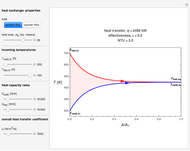
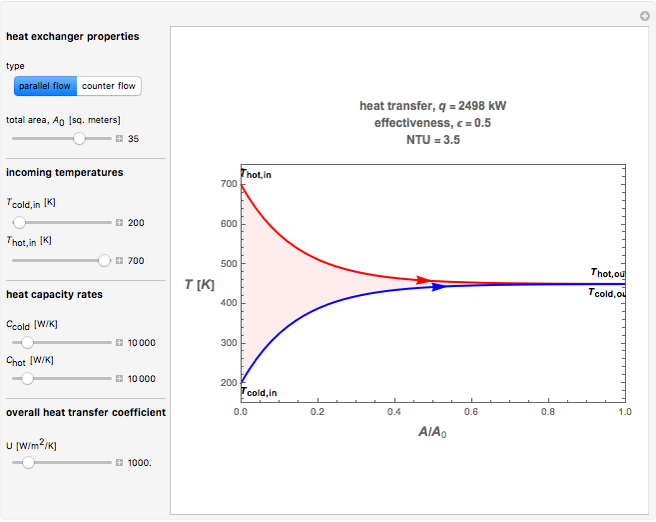
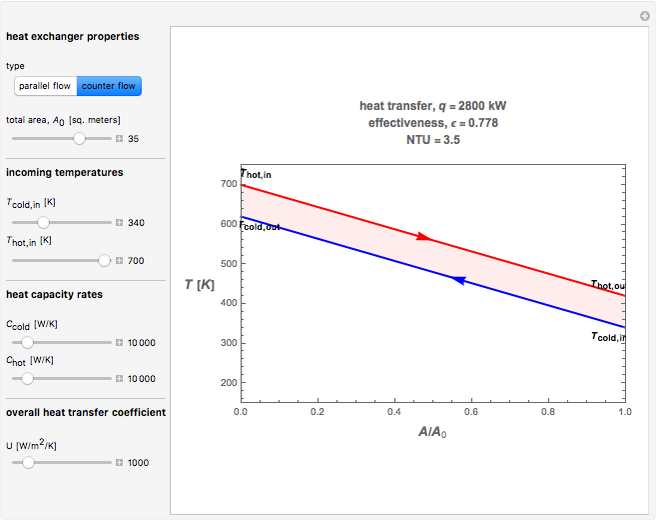
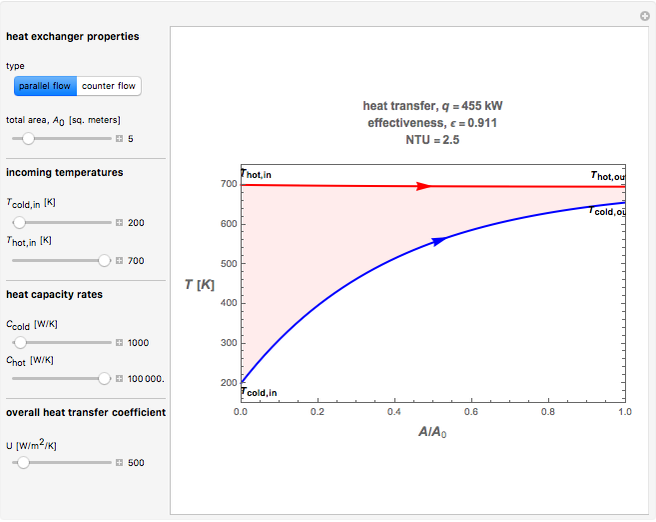
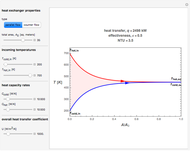
This Demonstration illustrates the effects of various input parameters on parallel-flow and counter-flow heat exchangers. It shows the temperature distribution and calculates the total heat transfer  , the effectiveness
  , where
  , and the number of transfer units
  , for both cases. By varying the input parameters, this tool lets you compare and understand the effects in these types of heat exchangers.
Contributed by: Maximilian Jüngst and Brian Vick (November 2011)
Open content licensed under CC BY-NC-SA
Snapshots
Details
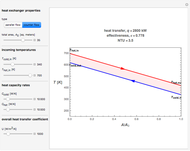
Snapshot 2: This has the same input as in snapshot 1, but for a counter-flow heat exchanger. The effectiveness and heat transfer are larger than the corresponding parallel-flow case, while the  is the same. It is also important to recognize that same heat capacity rates for the counter-flow effect a constant
  through the whole heat exchanger.
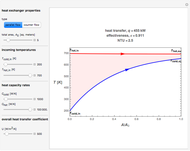
Snapshot 3: This snapshot shows the temperature distribution in a parallel-flow heat exchanger in which  . In this case the temperature of the hot flow is nearly constant through the heat exchanger.
Snapshot 4: This has the same input as in snapshot 3, this time for the counter-flow heat exchanger. For  , the flow direction does not matter. The effectiveness, heat transfer, and are the same in both parallel and counter flow arrangements.
Snapshot 5: Limiting case: The overall heat transfer coefficient  . The fluids pass each other without any heat transfer.
As the chosen snapshots point out, this tool is useful for comparing different cases for parallel- and counter-flow heat exchangers, including limiting cases. It helps to understand the effects of various input parameters on temperature distributions, effectiveness, heat transfer, and .
The temperature distribution is plotted versus the area ratio. The assumption for this model of heat exchangers is a one-dimensional flow for the hot and cold streams. This model can then be used if the fluids exchange heat through a plate or if they exchange heat by flowing through concentric tubes.
Permanent Citation
 Heat Transfer in Fluid Flow
Adam Cho and Brian Vick Parallel and Counterflow Heat Exchangers
Rachael L. Baumann Heat Transfer in a Bank of Tubes
Benjamin L. Kee Carnot Cycles with Irreversible Heat Transfer
Rachael L. Baumann Maximum Heat Transfer by Liquids at Different Temperatures
Desi Dikova, Kaylie Sierra and Franco Szeto Heat Flow from a 2D Source
Mohammad Saad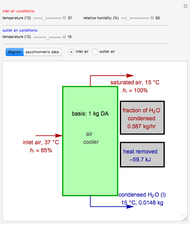 Operation of an Air Conditioner
Housam Binous and Ahmed Bellagi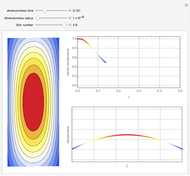 Unsteady-State Heat Conduction in a Cylinder
Clay Gruesbeck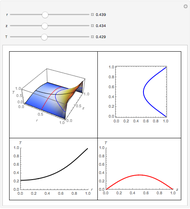 Steady-State Heat Conduction in a Cylinder
Jorge Gamaliel Frade Chávez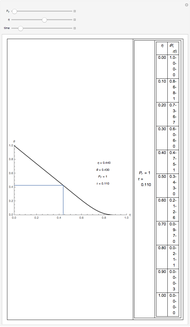 Unsteady Heat Transfer over a Porous Flat Plate
Jorge Gamaliel Frade Chávez
-
Heat Transfer in Fluid Flow
Brian Vick -
 2D Wave Propagation
Brian Vick -
 Operation of Heat Exchangers
Brian Vick -
 Solution to Differential Equations Using Discrete Green's Function and Duhamel's Methods
Brian Vick -
 Numerical Integration Examples
Brian Vick -
 A Tour of Second-Order Ordinary Differential Equations
Brian Vick -
 Bifurcations in First-Order ODEs
Brian Vick -
 Green's Functions for Diffusion
Brian Vick -
 Heat Diffusion in a Semi-Infinite Region
Brian Vick