
Small Set Partitions
Initializing live version


Requires a Wolfram Notebook System
Interact on desktop, mobile and cloud with the free Wolfram Player or other Wolfram Language products.
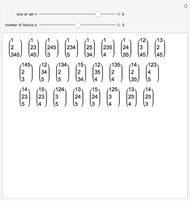
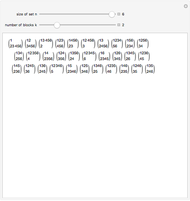
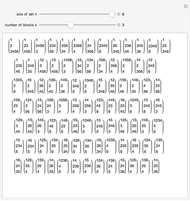
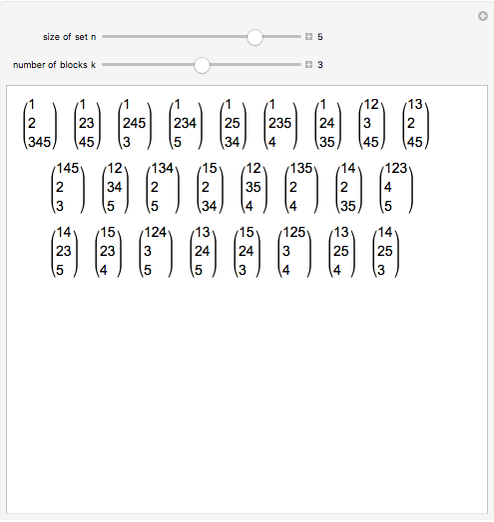
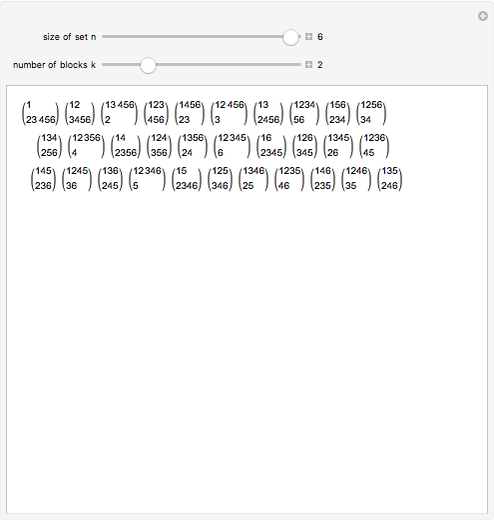
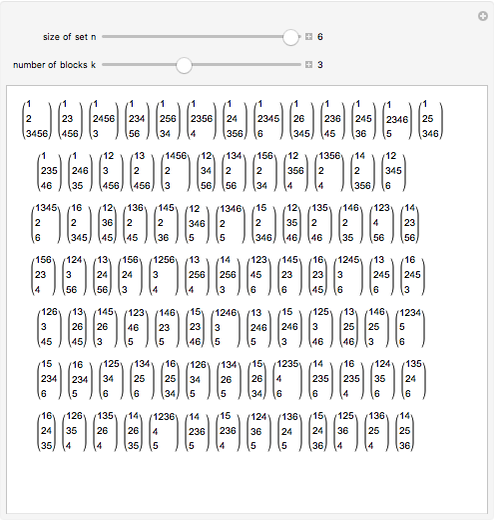
This Demonstration shows the partitions of the set  into
into  blocks, where
  and are small. For example, you could split
  into the blocks
  ,
,  , and
, and  . This is written compactly as
  .
.


Contributed by: George Beck (March 2011)
Open content licensed under CC BY-NC-SA
Snapshots
Details
Permanent Citation
Related Demonstrations
More by Author
 Set Partitions Match Restricted Growth Functions
George Beck Patterns in Partitions of Integers
Enrique Zeleny The Fractal Nature of Partitions
George Beck The Number of Partitions into Odd Parts Equals the Number of Partitions into Distinct Parts
George Beck Euler's Generating Function for the Partition Numbers
George Beck Counting Paths through a Grid
George Beck and Rob Morris The Number of Partitions with a Given Largest Part
Jon Perry Arranging Balls into Boxes
Marc Brodie Values of Combinatorial Functions
Jeff Bryant Bell Number Diagrams
Robert Dickau
-
 Vertex and Edge Truncations of the Platonic Solids
George Beck -
 Multiplying a Matrix by a Number
George Beck -
 Matrix Addition and Subtraction
George Beck -
 Plot a Quadratic Inequality
George Beck -
 Insphere and Four Exspheres of a Tetrahedron
George Beck -
 Permutations, k-Permutations and Combinations
George Beck -
 Cone, Tent, and Cylinder
George Beck -
 Chains of Regular Polygons and Polyhedra
George Beck -
 Rotational Symmetries of Platonic Solids
George Beck -
 Rotational Symmetries of Colored Platonic Solids
George Beck -
 Duals by Rotating the Edges of Polyhedra
George Beck -
 Combining Two 3D Rotations
George Beck -
 Passing a Cube through a Cube of the Same Size
George Beck -
 0/1-Polytopes in 3D
George Beck -
 The Path of a Ray on a Cube
George Beck -
 Applications of Lanchester's Square Law
George Beck -
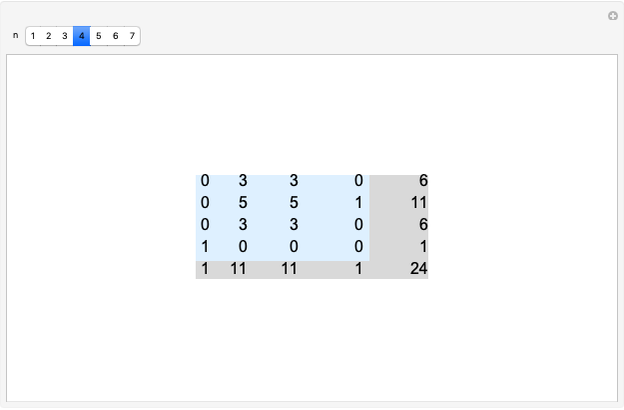 Eulerian Numbers versus Stirling Numbers of the First Kind
George Beck -
 Multiple Reflections of a Regular Polygon in Its Sides
George Beck -
 The Four-Runner Problem
George Beck -
 Iteratively Reflecting a Point in the Sides of a Triangle
George Beck