
Solving Stefan-Maxwell Equations Using Orthogonal Collocation and Shooting Method


Requires a Wolfram Notebook System
Interact on desktop, mobile and cloud with the free Wolfram Player or other Wolfram Language products.
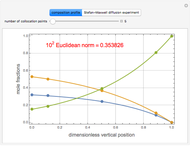
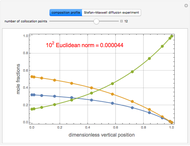
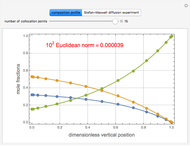
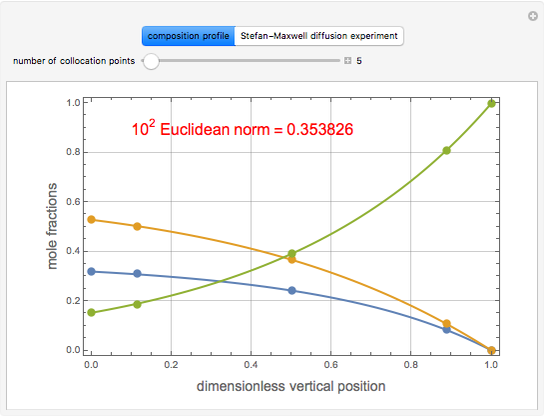
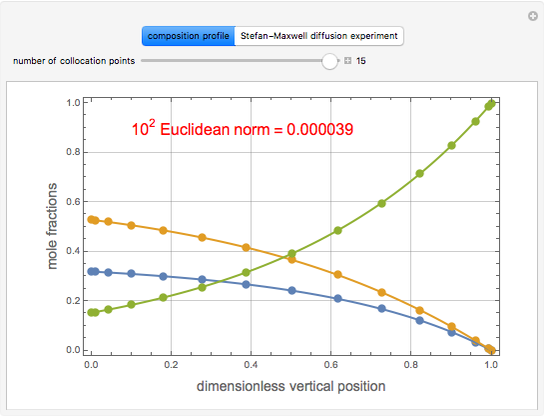
Consider acetone and methanol diffusing concurrently through a stagnant air column. The mole fractions of all three components are obtained by solving the species balance equation augmented with the Stefan–Maxwell equations for the diffusion fluxes. The resulting nonlinear boundary value problem can be solved using either a shooting method or by implementing an orthogonal collocation technique. In this Demonstration we use both methods. The plot shows the steady state concentration profiles of the three species in the diffusion column. The solid curves were obtained with a shooting technique using the terminal concentrations  ,
,  ,
,  , and
, and  , using Mathematica's built-in function NDSolve. The blue, magenta, and brown colors correspond to acetone, methanol, and air, respectively. The colored dots shows the solution obtained using the orthogonal collocation technique for user-set values for the number of interior collocation points. As expected, excellent agreement is seen between both numerical methods.

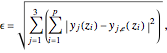


Contributed by: Housam Binous, Brian G. Higgins, and Ahmed Bellagi (April 2011)
Open content licensed under CC BY-NC-SA
Snapshots

Details
The Stefan–Maxwell relationships for unidirectional diffusion are given by:
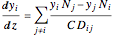 for
for  , where
  is the flux of species
  (expressed in
  ). From the calculation we find that
  and
and  , while
  is assumed equal to zero. Binary diffusivities are equal to
  ,
,  , and
, and  (all expressed in
  ).
).
References
[1] J. Benitez, Principles and Modern Applications of Mass Transfer Operations, New York: Wiley–Interscience, 2002.
[2] R. Carty and T. Schrodt, "Concentration Profiles in Ternary Gaseous Diffusion," Industrial Engineering and Chemistry Fundamentals, 14(3), 1975 pp. 276–278.
Permanent Citation
 Compressibility Factors Using the Soave-Redlich-Kwong Equation of State
Housam Binous Continuously Stirred Tank Reactor Using Arc-Length Parameter
Housam Binous and Brian G. Higgins Arrhenius Equations for Reaction Rate and Viscosity
Mark D. Normand, Maria G. Corradini, and Micha Peleg Reaction-Diffusion in a Drop Using Orthogonal Collocation
Housam Binous and Brian G. Higgins Thermodynamic Properties of Acetylene Using Cubic Equations of State
Housam Binous and Brian G. Higgins Finding the Minimum Reflux Ratio Using the Underwood Equations
Housam Binous Gas Absorption Computed Using the Successive Over-Relaxation (SOR) Method
Housam Binous Residue Curve Maps in a Triangular Ternary Diagram
Housam Binous, Brian G. Higgins, and Ahmed Bellagi Composition of Vapor and Liquid Phases for a Ternary Ideal Mixture
Housam Binous, Brian G. Higgins, and Ahmed Bellagi Vapor-Liquid Equilibrium Calculator for Chloroform/Acetone/Methanol Mixture
Housam Binous and Brian G. Higgins
-
 Liquid-Liquid Equilibrium for the 1-Butanol-Water System
Ahmed Bellagi -
 Temperature Dependence of Dehydrogenation of Ethyl Benzene to Styrene
Ahmed Bellagi -
 Deconvolution of a Chromatogram
Ahmed Bellagi -
 Design of a Shell and Tube Heat Exchanger
Ahmed Bellagi -
 Correction Factor for Shell and Tube Heat Exchanger
Ahmed Bellagi -
 Contour Plots for Reaction Rates
Ahmed Bellagi -
 Optimal Conditions for CO2/n-Hexane Flash Separation
Ahmed Bellagi -
 Residual Functions for the SRK and PR Equations of State
Ahmed Bellagi -
 Gas-Phase Fugacity Coefficients for Propylene
Ahmed Bellagi -
 Operation of a Throttling Valve
Ahmed Bellagi -
 Joule-Thomson Inversion Curves for Soave-Redlich-Kwong (SRK) and Peng-Robinson (PR) Equations of State
Ahmed Bellagi -
 Lee-Kesler Generalized Correlations for Gases
Ahmed Bellagi -
 Operation of an Air Conditioner
Ahmed Bellagi -
 Adiabatic Mixing of Two Moist Air Streams
Ahmed Bellagi -
 Adiabatic Humidification
Ahmed Bellagi -
 Psychrometric Data Calculator in English Engineering Units
Ahmed Bellagi -
 Psychrometric Data Calculator in SI Units
Ahmed Bellagi -
 Concentration of Sugar Solution in a Bubble Column
Ahmed Bellagi -
 Operation of a Partial Condenser
Ahmed Bellagi -
 Steam Reforming of Propane
Ahmed Bellagi