
The Action of the Modular Group on the Fundamental Domain


Requires a Wolfram Notebook System
Interact on desktop, mobile and cloud with the free Wolfram Player or other Wolfram Language products.
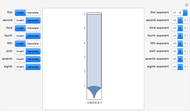
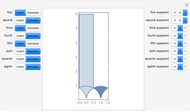
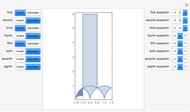
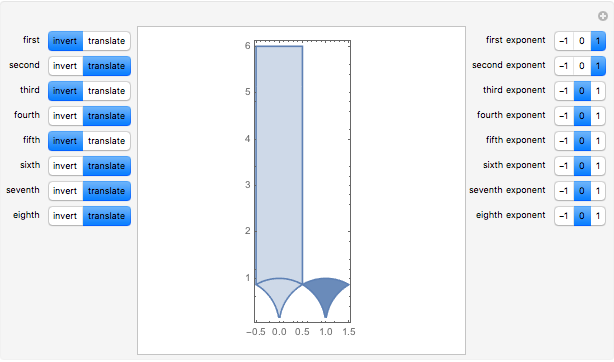
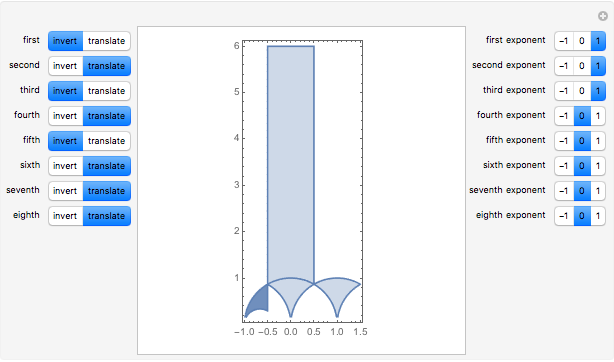
Choose eight transformations from the set of controls on the left. Each transformation can be either an inversion or a translation. Choose the exponent of each of these transformations (-1, 0, or 1) from the set of controls on the right. This Demonstration shows the fundamental domain and its images under the consecutive compositions of the chosen transformations.
Contributed by: Andrzej Kozlowski (March 2011)
Open content licensed under CC BY-NC-SA
Snapshots

Details
The modular group is the quotient of the group of integer matrices  with
with  by the subgroup
  , where
  denotes the
  identity matrix. This group acts on the upper half-plane
  by
by  . It turns out that the modular group is generated by just two elements: inversion, given by the matrix
  , and translation, given by
  . The fundamental domain is the subset of the upper half-plane
  formed by all points
  such that
  and
and  . The action of the modular group tiles the upper half-plane exactly with images of the fundamental domain. This tiling requires the use of the entire infinite fundamental domain, so it cannot be demonstrated by Mathematica. However, this tiling can be approximated by considering the images of a finite part of the fundamental domain under a finite number of compositions
  , where each
  and
and  is either a translation by an integer or a reflection.
Permanent Citation
"The Action of the Modular Group on the Fundamental Domain"
http://demonstrations.wolfram.com/TheActionOfTheModularGroupOnTheFundamentalDomain/
Wolfram Demonstrations Project
Published: March 7 2011
 Heisenberg Group Action on Quintics
Vignon S. Oussa Rotating by Powers of i
Michael Schreiber The Fundamental Theorem of Finite Abelian Groups
Marc Brodie (Wheeling Jesuit University) The Monodromy Group of an Algebraic Function
Maxim Rytin Icosahedral Group Polyhedra
Ed Pegg Jr Stereographic Projection of Some Double Groups
Brad Klee A Function Invariant under a Group of Transformations
Juan Luis Varona Stabilizers and Fixes of the Action of D4 on the Two-Colorings of a 2 by 2 Chessboard
Marc Brodie (Wheeling Jesuit University) Cayley Graphs for Weyl Groups
Justin Paston-Cooper Cellular Automata Based on Permutation Groups
Stephen Wolfram
-
 The Black-Scholes European Call Option Formula Corrected Using the Gram-Charlier Expansion
Andrzej Kozlowski -
 Option Prices in the Kou Jump Diffusion Model
Andrzej Kozlowski -
 The Polar and Bipolar of a Convex Polytope
Andrzej Kozlowski -
 Two Jump Diffusion Processes
Andrzej Kozlowski -
 The Vieta Mapping for the Coxeter Group A_2
Andrzej Kozlowski -
 The Bifurcation Set of the Space of Smooth Real Functions
Andrzej Kozlowski -
 The Swallowtail Singularity
Andrzej Kozlowski -
 Singularities of an Ellipsoidal Wave Front
Andrzej Kozlowski -
 Nonuniqueness of Option Pricing Under the Meixner Model
Andrzej Kozlowski -
 Coin Machine
Andrzej Kozlowski -
 A Mean-Reverting Jump Diffusion Process
Andrzej Kozlowski -
 Standard American and European Options
Andrzej Kozlowski -
 Density of the Kou Jump Diffusion Process
Andrzej Kozlowski -
 The Meixner Process
Andrzej Kozlowski -
 Fitting the Meixner Distribution to S&P 500 Returns
Andrzej Kozlowski -
 Simple Graphs and Their Binomial Edge Ideals
Andrzej Kozlowski -
 The Eneström-Kakeya Bounds for Roots of a Polynomial with Positive Coefficients
Andrzej Kozlowski -
 Newton Polygon and Branching of Algebraic Curves
Andrzej Kozlowski -
 Counting the Number of Roots of Transcendental Functions in Bounded Regions Using Winding Numbers
Andrzej Kozlowski -
 The Space of Inner Products
Andrzej Kozlowski